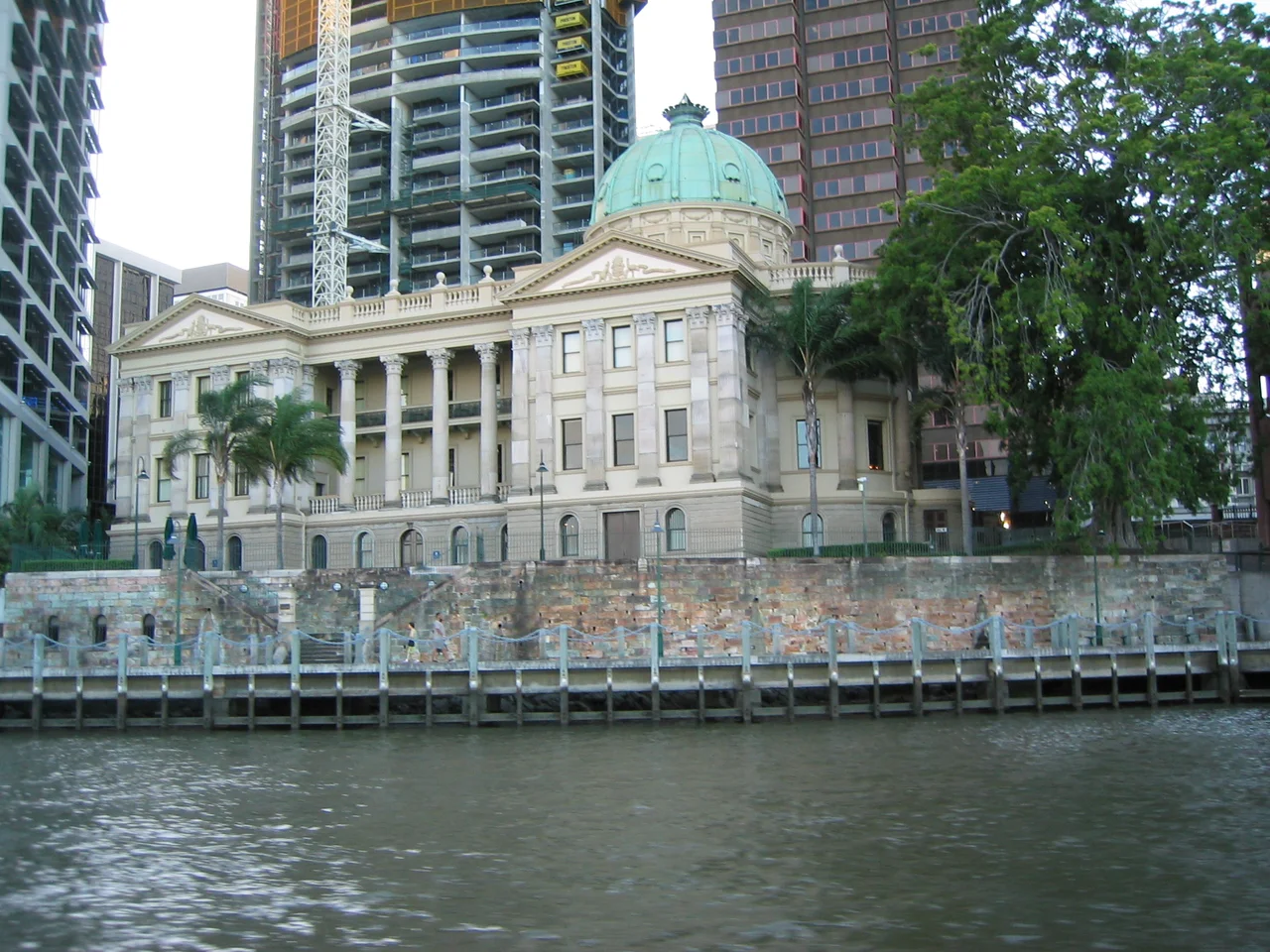

Customs House, Brisbane
Ships rounding the last bend of the Brisbane River used to look for the dome. Green-skinned copper crowning a pale classical facade, it told a captain he had reached the head of navigation, the place where every barrel and bale had to be counted, taxed, and logged before it could become part of the colony. The Customs House was Brisbane's threshold. Built between 1886 and 1889 where Queen Street meets the water, it sat at the exact seam between the river and the town, and its two grand entrances, one facing the wharves and one facing the city, made that double life literal. More than a century later the dome still catches the light, though the cargo it now welcomes is wedding guests and graduating students.
A Tax in Stone
Queensland had a problem that this building was designed to solve. With almost no manufacturing of its own, the young colony lived and died by what it could import, and the duties levied on those imports paid the government's bills. Brisbane had been declared a port in 1846, and as trade swelled, the colony needed a customs house worthy of the revenue passing through it. Charles McLay of the Colonial Architect's Office drew the plans; the contractor John Petrie and Son raised the walls of brick on a stone foundation, with columns and balusters cut from Murphy's Creek sandstone. The whole thing cost 38,346 pounds and took three years. The site, at the downstream end of the city, was chosen deliberately to pull wharf development toward Petrie Bight. Architecture, here, was economic policy made visible.
An Empire's Flourishes
Look closely at the facade and you find the confidence of the late Victorian age. A shield sits between an emu and a kangaroo, an antipodean coat of arms improvised at a time when no government in the country actually held one. An iron balustrade, shipped all the way from England, carries the royal cypher VR, for Victoria Regina, a small bow to the distant queen whose empire this port served. Inside, the dome covers the Long Room, the great public hall where merchants once queued to pay their dues. Fluted Corinthian pilasters rise to a coffered ceiling with a glazed eye at its centre, letting daylight pour down onto black and white marble and cedar joinery. It was a temple, and the god was commerce.
The Port Moves On
Buildings outlive their purposes. As ships grew larger they could no longer reach this stretch of river, and the working port crept downstream toward the mouth, leaving the Customs House stranded as a monument to a Brisbane that had moved on. The Australian Customs Service occupied it for nearly a hundred years before finally leaving. The building stood empty from 1988 until the University of Queensland took it on, restoring it between 1991 and 1994 and reopening it as a heritage and function venue. The old bonded warehouse became an art gallery; the Long Room became a place for receptions beneath the dome. Today it survives as one of the few visible reminders of the port that gave the city its first reason to exist.
A Battle for the View
Heritage is never entirely safe. In the 2010s a proposal to build a high-rise tower beside the Customs House set off a public fight, with residents and the university warning that the structure would crowd the historic building, throw it into shadow, and threaten a mature fig tree on the grounds. The university argued the tower would stand only 2.6 metres from the boundary, against a council policy calling for a far greater setback, and it took the dispute to court. It lost the case in July 2016. Yet a few months later a compromise was reached: the tower's profile was reshaped to protect sightlines to the dome, and protections were agreed for the fig. The copper dome, focal point of two centuries of approaches by river and by road, kept its place against the sky.
From the Air
Customs House sits at roughly 27.466 degrees south, 153.031 degrees east, on the northern edge of Brisbane's central business district at the bend of the river known as Town Reach, in the Petrie Bight area. From the air the green copper dome and the surrounding loop of the Brisbane River make it easy to fix; the densely packed CBD towers rise immediately to the south and west. The nearest airfields are Brisbane Airport (ICAO YBBN), about 9 kilometres to the north-northeast over the river mouth, and Archerfield (ICAO YBAF) to the southwest. The riverfront location means low light at dawn and dusk rakes across the dome; clear, calm mornings give the cleanest view of the building against the water.
Nearby Stories
- Redcliffe Peninsula 2.7 km away
- Tamborine National Park 12 km away
- Cressbrook Homestead 27 km away
- Main Range National Park 31 km away
- 2010-2011 Queensland Floods 38 km away
- Cape Byron 96 km away
- Cape Byron Light 126 km away
- HMS Porpoise (1799) 588 km away