
Diocese of Raleigh
In 1860, North Carolina had three hundred and fifty Catholics. They lived in seven parishes scattered across a state that, until 1789, had legally required public officeholders to affirm that Protestantism was the true Christian faith. By 2025, the Diocese of Raleigh that grew out of those seven parishes counted five hundred and ten thousand Catholics across fifty-four eastern North Carolina counties. The growth was not steady, the road was not smooth, and the diocese spent a century arguing with itself about almost everything that mattered.
Belmont Abbey and the Vicariate
Before Raleigh became a diocese, North Carolina answered to a long chain of distant authorities: London before independence, Baltimore after, then Charleston starting in 1820. The first Catholic church in Raleigh was built in 1834, mostly to serve Irish immigrants working on the railroads. In 1876, Benedictine monks from Pennsylvania arrived in Belmont and built a priory. Twelve years later Pope Leo XIII made Leo Michael Haid, that priory's abbot, the apostolic vicar of all North Carolina. Haid wore two hats. The arrangement got stranger in 1910 when Pope Pius X gave Belmont Abbey territorial control over eight counties of its own, creating two parallel Catholic jurisdictions in one state, both led by the same man. Haid died in 1924.
From Vicariate to Diocese
On December 12, 1924, Pope Pius XI elevated the apostolic vicariate into the Diocese of Raleigh, the first Catholic diocese in North Carolina. William Hafey of Baltimore became its first bishop. The state's Catholic population was still small but no longer invisible. Hafey moved to Scranton in 1937 and was replaced by Eugene McGuinness, who in turn was sent to Oklahoma City in 1944. Vincent Waters, transferred from Richmond, then took over and would lead the diocese for thirty years.
Vincent Waters and the End of Segregation
Waters was not a quiet bishop. In the early 1950s, when segregation was still hard law across the South, he decreed that every Catholic parish and school in his diocese must integrate. He called racial segregation a product of darkness and said the time had come for it to end. He also said something braver still, in print: I am not unmindful, as a Southerner, of the force of this virus of prejudice among some persons in the South, as well as in the North. I know, however, that there is a cure for this virus, and that is our faith. His own priests were not uniformly with him; some clashed with him over property and governance, and twenty percent once petitioned the Vatican for his removal. He stayed until 1974. In 1962, Pope John XXIII transferred the diocese from the Archdiocese of Baltimore to the new Archdiocese of Atlanta, where it remains.
A Cathedral, a Reckoning, and What Comes Next
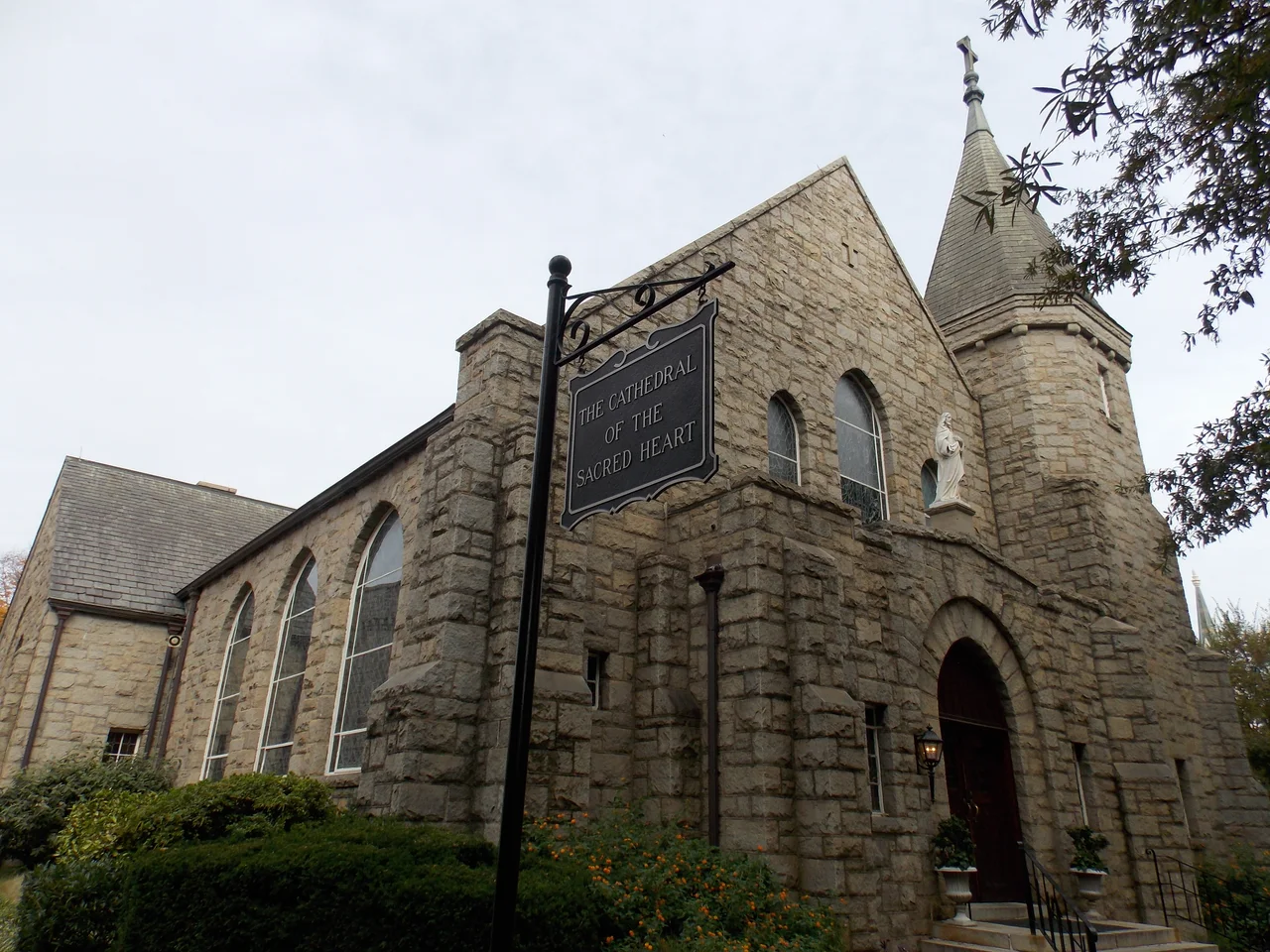
By 2011 Sacred Heart Cathedral on Hillsborough Street, built when Raleigh's Catholic population was modest, could no longer hold the people who came to it. Bishop Michael Burbidge announced a new cathedral. Groundbreaking happened in January 2015 on the site of the old Nazareth Orphanage. Holy Name of Jesus Cathedral, designed by O'Brien & Keane and seating two thousand, was dedicated July 26, 2017. Five weeks later, on August 29, Bishop Luis Rafael Zarama, the first Hispanic bishop of Raleigh, was installed there. The diocese has also reckoned painfully with itself: by 2020, settlements paid in clergy sexual misconduct cases since 1950 totaled more than $2.7 million, and twenty-nine clergy were on the diocese's published list of those credibly accused. The diocese that began with 350 Catholics has become one of the larger Catholic communities in the South, still working out what it owes to its history.
From the Air
The diocesan offices and Holy Name of Jesus Cathedral sit at 35.777°N, 78.673°W in west Raleigh, near the NC State University campus. Raleigh-Durham International (KRDU) is six miles northwest. The diocese covers 54 counties of eastern North Carolina, roughly the area east of a line from Reidsville south to the South Carolina border. From cruise altitude over central NC, the cathedral's copper-clad dome at 173 feet is the brightest landmark in the western Raleigh skyline at midday.
Nearby Stories
- Sanford, North Carolina 7.6 km away
- Wilson, North Carolina 12 km away
- Cherry Hospital 13 km away
- Campbell University 19 km away
- North Carolina Tornado Outbreak of April 2014 21 km away
- Neuse River 23 km away
- Coal Glen Mine Disaster 26 km away
- Alamance County, North Carolina 27 km away