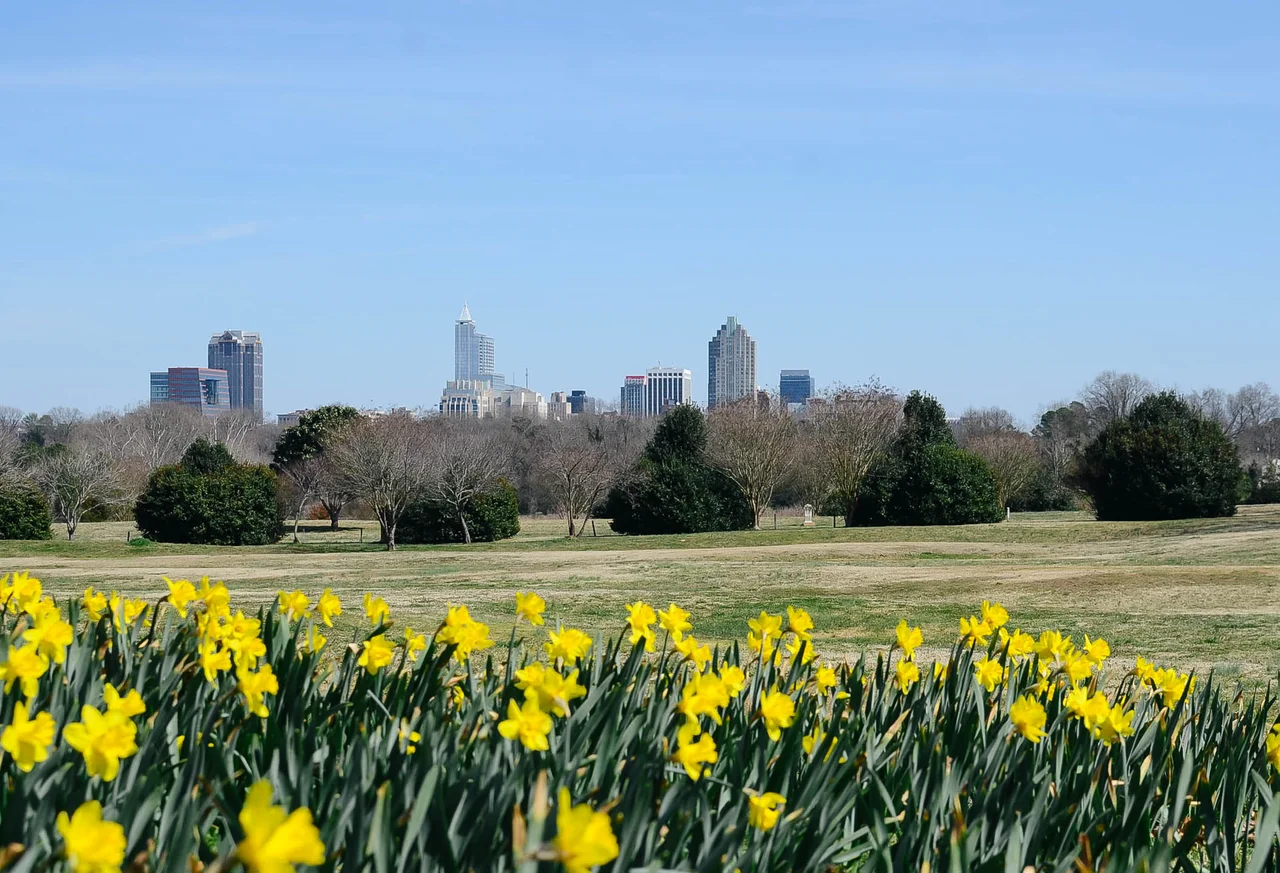

Dix Park
Walk the eastern edge of Dix Park on a July evening and you can hear honeybees. The five-acre sunflower field, planted as a Raleigh Water Department biofuel experiment in 2018 and then loved enough by the public to become permanent, blooms all at once in mid-July: about two hundred thousand stalks, taller than you, facing east at dawn and west at sunset. Goldfinches, painted buntings, and Mississippi kites have all been spotted feeding on the seeds when the petals fall. But the sunflowers are also covering ground that, until recently, was a state psychiatric hospital where hundreds of people lived, worked, and died largely outside public memory.
From Dorothea Dix Hospital to a 308-Acre Park
Dorothea Dix was a nineteenth-century reformer who spent her life arguing that people with mental illness deserved care, not jails. North Carolina's hospital named for her opened in 1856 on a Raleigh hill the locals already called Dix Hill. It operated until 2012. The 308-acre campus, listed on the National Register of Historic Places in 1990, sat empty while the state and the city argued for over a decade about what to do with it. A 2004 public forum first floated the idea of a park. A 2012 lease was almost killed by the state senate. In 2015, after extensive negotiations, Raleigh agreed to buy the land outright for $52 million. The city took possession in July of that year, released its master plan in 2018, and opened the grounds to the public. By 2025, twenty-five buildings had been demolished; larger ones are planned for 2026.
The Cemetery on the Hill
Three acres of the park hold approximately nine hundred graves. Between 1859 and 1970, patients who died at Dorothea Dix Hospital were buried here, often without family present and frequently without permanent markers. Many were Black North Carolinians; many were poor; many had been institutionalized for conditions that today would be treated outpatient or not at all. For most of a century, almost nothing was known about who lay in the ground. Then, in 1991, volunteers began the slow work of identifying them. By the mid-2020s nearly eight hundred names had been recovered. New markers were installed where the old ones had vanished. The work continues. These were not patients in the abstract. They were people, and the city of Raleigh now walks above them, and the recognition that they had names matters.
Sunflowers, Power Poles, and a Play Plaza
The park's headline attractions are bright. The Sunflower Field, planted every spring and timed to bloom simultaneously in mid-July, draws thousands of visitors during its two-week peak. Artist Thomas Sayre wrapped the utility poles at the park's entrance in stylized sunflower sculptures, turning Duke Energy infrastructure into public art. Gipson Play Plaza, the centerpiece of a seventy-million-dollar project funded with ten million from namesake donors Tom and Pat Gipson and a 2022 city bond, opened in May 2025. It includes interactive water features modeled on the nearby historic Yates Mill, allowing children to learn about pulleys and water levels while getting wet. The mid-century Greg Poole Jr. All Faiths Chapel, built in 1955 and renovated in 2020, hosts weddings and quiet events. In 2025, Dix Park took home three Sir Walter Raleigh design awards. USA Today readers ranked it the tenth best city park in America the same year.
Inter-Tribal Pow Wow and the Land Underneath
In August 2020, the city held its first native land blessing and acknowledgment ceremony at the park. The annual Inter-Tribal Pow Wow followed in 2021. It recognizes the eight North Carolina tribes with ancestral ties to this ground: the Coharie, Cherokee, Haliwa-Saponi, Lumbee, Meherrin, Occaneechi, Sappony, and Waccamaw-Siouan. The pow wow brings dance, music, and cultural programming to the Big Field every year. Spring Hill House and its historic marker stand on the park grounds, a reminder that this land was a plantation before it was a hospital. The park is still growing into itself. Demolition continues. New buildings are planned. The sunflowers come back every July. The names in the cemetery keep being found.
From the Air
Dix Park covers 308 acres centered at 35.771°N, 78.660°W, just south of downtown Raleigh and east of NC State's Centennial Campus. Raleigh-Durham International (KRDU) lies seven miles northwest, Raleigh Executive Jetport (KTTA) twenty miles south. From 2,500 feet AGL the park is unmistakable in summer: a yellow-gold sunflower field against the green of the Big Field, framed by Rocky Branch Creek to the north and Walnut Creek to the south. The downtown skyline rises directly behind it.
Nearby Stories
- Sanford, North Carolina 7.6 km away
- Wilson, North Carolina 12 km away
- Cherry Hospital 13 km away
- Campbell University 19 km away
- North Carolina Tornado Outbreak of April 2014 21 km away
- Neuse River 23 km away
- Coal Glen Mine Disaster 26 km away
- Alamance County, North Carolina 27 km away