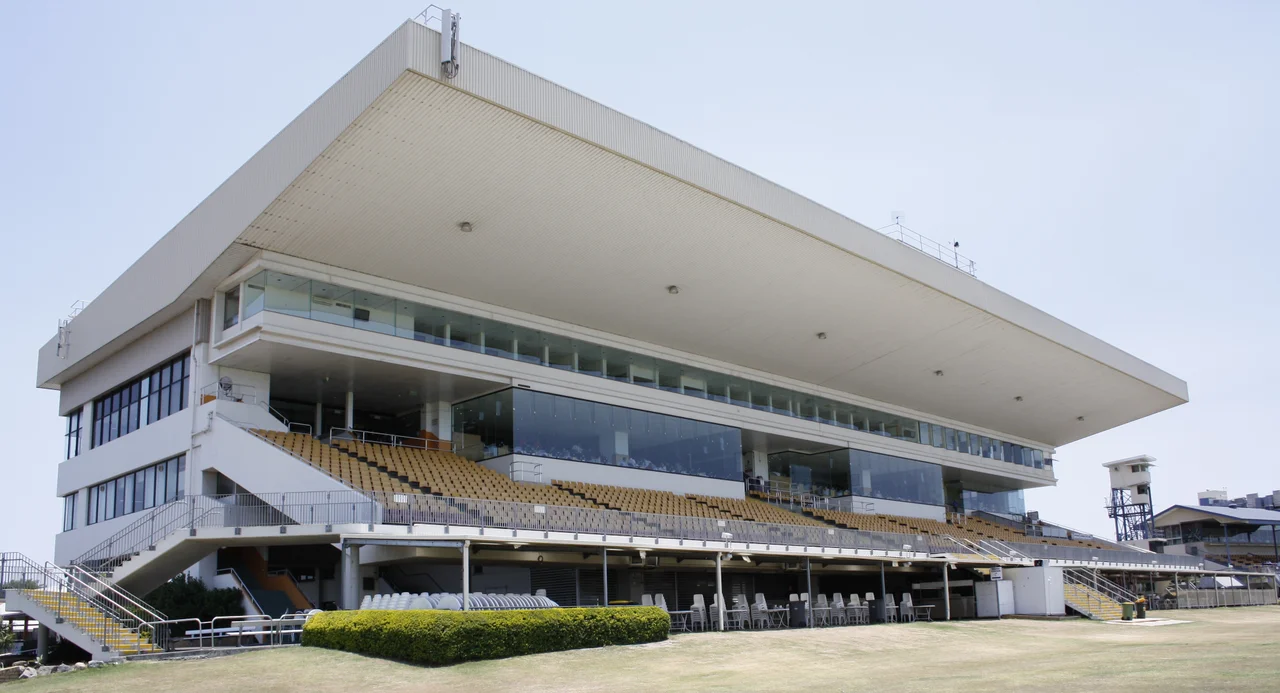

Doomben Racecourse
For a few years in the 1940s, the fastest thing moving across Doomben was not a horse. The grandstands had become offices, the infield had vanished under a sea of canvas tents, and American servicemen, fresh off ships from a Pacific suddenly at war, slept where punters had once cheered. Doomben is a racecourse in the Brisbane suburb of Ascot, seven kilometres north of the city, and for most of its life since 1933 it has done exactly what a racecourse does: run horses in tight clockwise circuits while crowds roar. But the turf here has a second history, written in khaki, that sits just beneath the green.
The Gaza Strip
Doomben does not stand alone. Barely half a kilometre west, across a single road, lies Eagle Farm Racecourse, the older and grander of the pair. For decades the two tracks were bitter commercial rivals, run by competing clubs and fighting over the same Brisbane racing crowd, and the road dividing them, Nudgee Road, earned a wry local nickname: the Gaza Strip, after one of the world's most contested borders. The rivalry eventually proved ruinous. Splitting the audience between two venues bled both clubs of profit, and in 2008 the Brisbane Turf Club, which ran Doomben, lost more than a million dollars in a single year. In 2009 the warring clubs finally merged into the Brisbane Racing Club, and the two courses that had spent a century glaring across the Gaza Strip became neighbours under one owner.
The Richest Sprint in the Land
Doomben opened on 20 May 1933 with seven races, the first straight six-furlong sprint ever run in Queensland, won by a horse named Wollun over the favourite, Closing Time. That sprint would become the course's signature. After the war ended and the soldiers left, the race was relaunched on 1 June 1946 as the Ahern Memorial Handicap, with prize money lifted to ten thousand pounds, an enormous purse that made it the richest sprint in Australia. The following year it was renamed for that prize money and given the name it still carries: the Doomben 10,000. A week after that very first 1933 meeting, the inaugural Doomben Cup was run too, won by Pentheus. Both races endure. Today the Doomben 10,000 and the Doomben Cup remain Group 1 fixtures on the Australian calendar, their prize money now counted in the hundreds of thousands of dollars.
Camp Doomben
The attack on Pearl Harbor in December 1941 changed everything for this quiet corner of Ascot. American forces poured into Brisbane, and the two racecourses, flat, open, and close to the river and the airfield, were perfect for an army that arrived faster than barracks could be built. Eagle Farm became Camp Ascot; Doomben became Camp Doomben; and when even two camps could not hold the troops massing in the suburb, a third, Camp Raceview, spread north over Raceview Avenue. The infield disappeared beneath tents. The members' stand was converted into an Australian Army Signals office. A corner of the track was even paved into an aircraft apron feeding the hangars next door at Eagle Farm aerodrome. With the courses occupied, Saturday racing simply moved across town to Albion Park until peace returned the turf to the horses.
Built to Run
Strip away the history and Doomben is, at heart, a finely tuned machine for racing. Its last major rebuild, completed in December 1996 for 3.3 million dollars, replaced the turf, the rails, and the irrigation, leaving a track 1,715 metres around and 27 metres wide, surfaced in hardy kikuyu grass and run clockwise in the Australian fashion. The straights carry a gentle two per cent camber; the turns bank more steeply at five. Three training tracks nest inside the main circuit. Even the water tells a story of cooperation: a 2019 system draws from storage in Doomben's infield, fed in turn from a larger dam over at Eagle Farm, the two old rivals now quite literally sharing the same supply. The grandstand, first raised in 1932 before the course even opened, still presides over it all.
From the Air
Doomben Racecourse lies at about 27.426 degrees south, 153.076 degrees east, in the suburb of Ascot, roughly 7 kilometres north of central Brisbane and immediately east of Eagle Farm Racecourse, the two ovals separated by Nudgee Road. From the air the pair of adjoining racetrack ovals beside the Brisbane River is a distinctive landmark. Brisbane Airport (ICAO YBBN) is only a few kilometres to the northeast, so this airspace is busy and controlled; Archerfield (ICAO YBAF) lies to the southwest. Expect the manicured green ovals to stand out sharply against the surrounding suburbs and the industrial flats running down to the river.
Nearby Stories
- Redcliffe Peninsula 2.7 km away
- Tamborine National Park 12 km away
- Cressbrook Homestead 27 km away
- Main Range National Park 31 km away
- 2010-2011 Queensland Floods 38 km away
- Cape Byron 96 km away
- Cape Byron Light 126 km away
- HMS Porpoise (1799) 588 km away