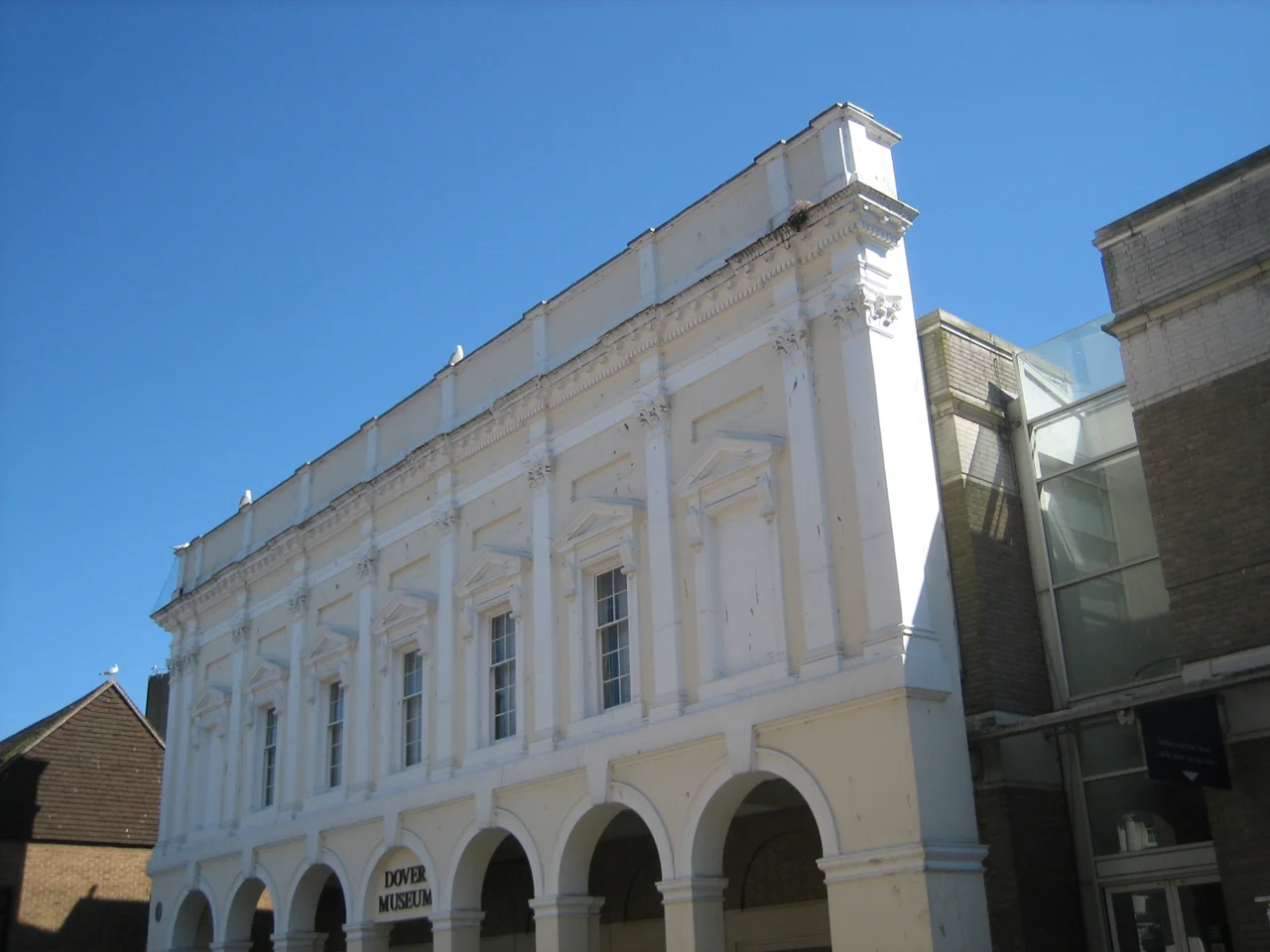

Dover Museum
The boat is the wrong color for something that old. Honey-brown, smooth-grained, the curve of its hull still showing the marks of bronze tools that worked it in roughly 1550 BC. It sits behind glass on the second floor of Dover Museum, and once you stop and look properly, the whole building organizes itself around the fact of it - this seaworthy vessel, pulled from six metres of mud in 1992, older than the founding of Rome by eight hundred years. The Queen came in 1999 to open the gallery built around it. A British Archaeological Award followed in 2000. Everything else in the museum - the Roman dioramas, the Saxon cemetery finds, the Victorian paintings - feels like commentary on a single, astonishing question: how long have people been crossing this water?
Founded by a Mayor
In February 1836, Dover's mayor Edward Pett Thompson founded a museum and tucked it inside the old Guildhall, where the Dover Philosophical Institute ran it for the town's curious. The Town Council took it over twelve years later and built a new building in Market Square, where it shared space with the town's market. For a century it stayed there - a small, civic-minded place collecting the artefacts that washed up through the lives of a ferry port. Then in 1942, with the war narrowed to its sharpest point, German guns at Cap Gris Nez began shelling Dover from the French coast. The museum was hit. Most of the natural history collection was destroyed. Surviving material sat neglected in caves and store-rooms until 1946, by which time only about thirty percent of the pre-war holdings remained.
The Temporary Museum That Lasted Forty-three Years
In 1948, a 'temporary' museum opened in the undercroft beneath the Town Hall. It was supposed to be a stopgap. It lasted until 1991. When the current three-storey building finally opened - tucked behind the original Victorian facade in Market Square - it had a Bronze Age boat already in the wings, waiting. The boat had been discovered in 1992 during construction of the A20 road link, six metres down, its timbers still showing the joinery of Bronze Age shipwrights. Radiocarbon dating placed its construction around 1550 BC. It was one of the oldest seaworthy boats ever found. The gallery built to display it opened in 1999, and the Queen herself cut the ribbon. The Langdon Bay hoard - bronze axes of French design, dredged up from the seabed off Dover in 1974 - sits alongside it, the cargo of a sunken ship from the same era. Together they prove what the museum's whole collection whispers: cross-channel trade between Britain and France was thriving when the pyramids were still middle-aged.
The White Elephant Next Door
Next to the museum, from 1991 until 1999, stood the White Cliffs Experience - a visitor attraction the Labour opposition on Dover District Council bluntly renamed the White Elephant. It promised three hundred thousand visitors a year, ran dioramas and animatronics off laser discs and 35mm projectors, included a Blitz Experience where audio-visual gunfire echoed through a mocked-up wartime street. Visitors never came in the predicted numbers. Costs ran high. Labour won the council in 1997 and decided that tourism subsidy was not what Dover needed. By 1998, the laser discs and slide carousels were obsolete, and the quotes to refit the whole attraction landed higher than the council would pay. The Experience closed in 1999. Its building became the Dover Library and Discovery Centre. The dioramas and reconstructed figures - including a famous one of the Roman emperor Claudius arriving in Britain on an elephant in 43 AD - migrated next door into the museum, where they remain on the ground floor, doing the work they always should have done: telling a quieter, truer version of Dover's deep history.
Three Floors, Two Thousand Years
The collection now spreads across three storeys. The ground floor handles archaeology from prehistory to 1066 - Celts and Romans and Saxons, the Buckland Saxon cemetery, that diorama of Claudius on his improbable elephant at Richborough Castle. The first floor changes with temporary exhibitions. The second floor opens at 1066 and runs forward through the medieval town, the Cinque Ports league, Dover Castle, the Victorian harbour, and on into the present. It includes the Victoriana collection bequeathed in 1990 by William Williamson of Deal - paintings by Dame Laura Knight, by E.W. Cooke, by Benjamin Robert Haydon. And in the dedicated gallery, the Bronze Age boat keeps its silent vigil. For a town whose history runs back to the moment the English Channel became a channel - when meltwater from a vast pro-glacial lake breached the chalk ridge connecting Britain to France - the museum tells the only story a port town really has: people crossed here. They have always crossed here. And someone, three and a half thousand years ago, built a boat strong enough to make the journey.
From the Air
Dover Museum sits at 51.125°N, 1.313°E in Market Square in central Dover, Kent, beside the Discovery Centre that once housed the White Cliffs Experience. From the air, look for the dense urban grain of central Dover wedged into the valley of the River Dour, with the White Cliffs flanking the harbour to east and west. Nearest airport is London Ashford (Lydd) (EGMD) about 35 km west; London City (EGLC) is roughly 110 km northwest. Best visibility on clear days when the French coast at Cap Gris Nez is visible 34 km across the Strait.
Nearby Stories
- HMS Hermes (1898) 7.3 km away
- Herne Bay Museum and Gallery 8.5 km away
- Benenden School 9.2 km away
- Boulonnais 9.4 km away
- Priestfield Stadium 12 km away
- 1382 Dover Straits Earthquake 17 km away
- Royal Sovereign Lighthouse 21 km away
- Battle of Boulogne 28 km away