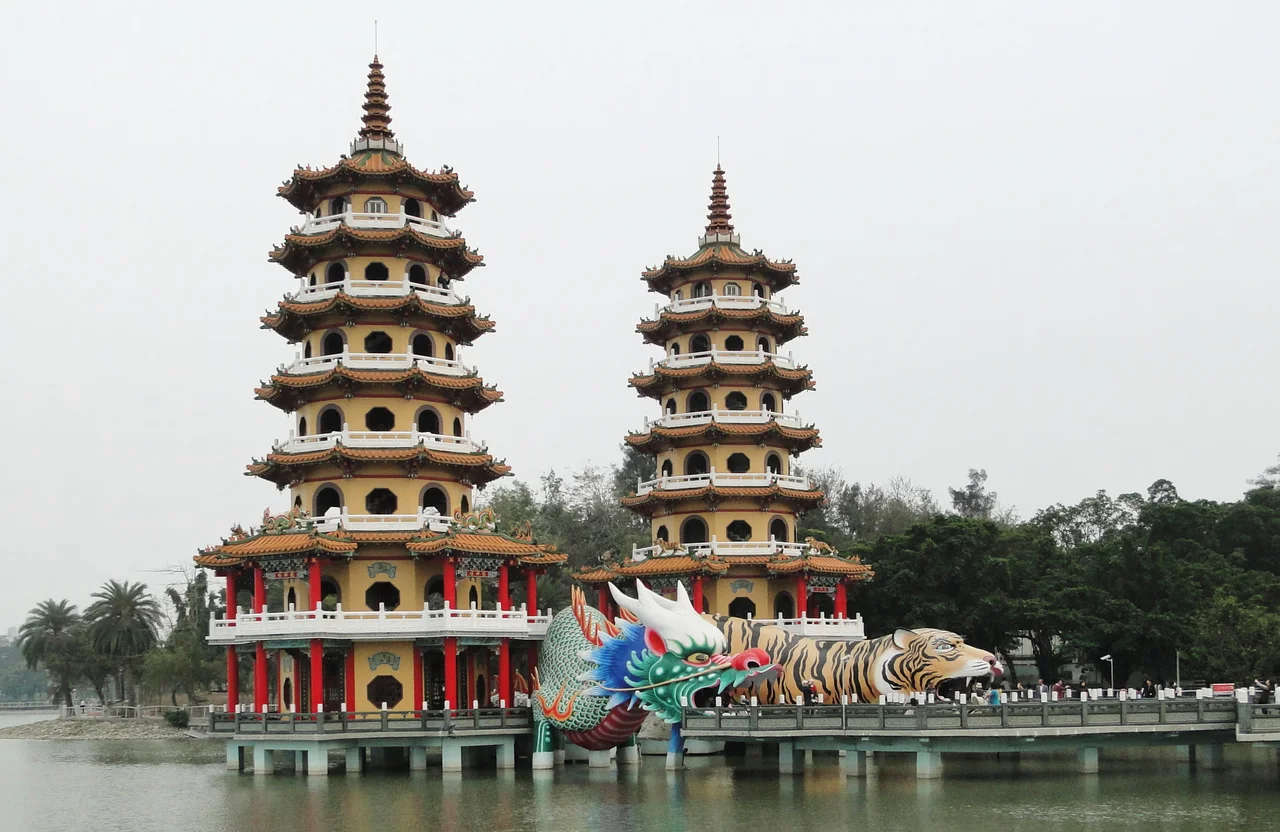

Dragon and Tiger Pagodas
Most temples ask you to stand before them. These two ask you to walk through them — literally, through the gaping mouth of a dragon on one side and out through the jaws of a tiger on the other. The instruction matters: you enter the dragon's mouth and exit the tiger's, and according to the tradition associated with this place, the passage transforms bad luck into good. It is the kind of concrete, physical ritual that folk religion does well, making abstract spiritual transactions into something you can feel in your feet as you climb seven stories and descend again, the lake shimmering outside the windows at every landing. At Lotus Pond in Kaohsiung's Zuoying District, the Dragon and Tiger Pagodas have been performing this service since 1976.
Two Towers at the Edge of the Lake
Lotus Pond is a shallow freshwater lake in northern Kaohsiung, and the pagodas stand at its edge on a zigzag bridge that connects them to the shore. The bridge's angular path — a deliberate design choice common in Chinese religious architecture, where evil spirits are believed to travel only in straight lines — brings visitors out across the water before depositing them at the pagodas' feet. The structures themselves are seven stories tall, their exteriors a vivid combination of yellow walls, red pillars, and orange roof tiles, visible from a considerable distance across the flat plain surrounding the lake. They are not subtle buildings. They were never meant to be. The scale and color declare their purpose: this is a place of significant religious intention, not a modest wayside shrine.
The Spiral Passage Within
Inside each pagoda, a double spiral staircase separates ascending and descending visitors — an elegant engineering solution that keeps traffic moving without the awkward passing on narrow stairs that plagues many tower shrines. The staircases wind upward through floors decorated with paintings and carvings. In the Tiger Tower, murals depict the twelve Magi of Chinese folk tradition and the thirty palaces of the Jade Emperor — a cosmological vision of the heavenly administration that governs the universe. Paintings of Confucius appear as well, a reminder that the religious landscape of these pagodas is not doctrinal in the way Western religions tend to be, but ecumenical, drawing on Taoist, Buddhist, and Confucian traditions as the moment requires. In the Dragon Tower, paintings of Ksitigarbha — the bodhisattva associated with beings in difficult circumstances — add a Buddhist dimension to the complex.
A Lake Full of Neighbors
The Dragon and Tiger Pagodas do not stand alone at Lotus Pond. The Spring and Autumn Pavilions occupy another section of the lakeshore, their own distinctive towers part of the same dense spiritual landscape. The Small Tortoise mountains, the 5-mile Pavilion, and the Pei Chi Pavilion are among the other structures visible from the pagoda towers' upper floors, each one contributing to what amounts to a concentrated religious precinct built up over decades around the lake. Lotus flowers bloom across the surface of the water in season, giving the pond its name and the whole scene a quality of deliberate beauty. The lake was not a wilderness that temples happened to surround — it was a managed landscape shaped to accommodate them.
Folk Religion in Vivid Color
Taiwan's religious culture is famously syncretic, layering folk beliefs, Taoism, Buddhism, and ancestor veneration in combinations that shift by neighborhood, by family, and by occasion. The Dragon and Tiger Pagodas express this tradition in its most visually exuberant form. The creature-entrance — walk through the dragon, exit the tiger — is a piece of ritual theater that communicates without requiring explanation. The colors are not decorative choices but symbolic ones: red for good fortune and protection, yellow for imperial and divine authority, orange for vitality and transition. Even the materials carry meaning. Visiting without knowing any of this, you still feel the intention: this is a place that takes luck seriously and provides a mechanism for affecting it.
Making the Visit
The pagodas are among the most photographed sites in Kaohsiung, and for good reason — the combination of their scale, their color, their reflection in the lake, and the sheer strangeness of walking through a dragon's mouth makes for images that resist indifference. Early morning, before tour groups arrive, the lake is quiet and the light is low and even. The zigzag bridge, empty, extends out over still water. At that hour the pagodas look genuinely ancient, though they are not — 1976 is recent history, as temples measure time. By midday the site fills, and the ritual passages through dragon and tiger become communal rather than solitary. Both versions are worth experiencing. The pagodas are the same either way; only the company changes.
From the Air
The Dragon and Tiger Pagodas are located at approximately 22.681°N, 120.293°E at the southern edge of Lotus Pond (Lotus Lake) in Zuoying District, northern Kaohsiung. From the air, Lotus Pond is a clearly visible rectangular freshwater lake on the flat plain north of central Kaohsiung. The two pagodas are identifiable by their distinctive seven-story orange-roofed towers at the lake's edge, connected to shore by a zigzag bridge. Multiple other pavilions and structures are visible around the lake perimeter. Nearest airport is Kaohsiung International (RCKH), approximately 10 km south-southeast. Recommended viewing altitude is 2,000–3,000 feet, from which the full lake complex, including the Spring and Autumn Pavilions to the north, can be appreciated in a single view.
Nearby Stories
- Huang Family Historical Residence 3.1 km away
- Taivoan Language 9 km away
- Zhiben Hot Spring 12 km away
- Bunun Cultural Museum 26 km away
- Dongji Island 33 km away
- South Penghu Marine National Park 58 km away
- Orchid Island 79 km away
- Hong Kong 12 550 km away