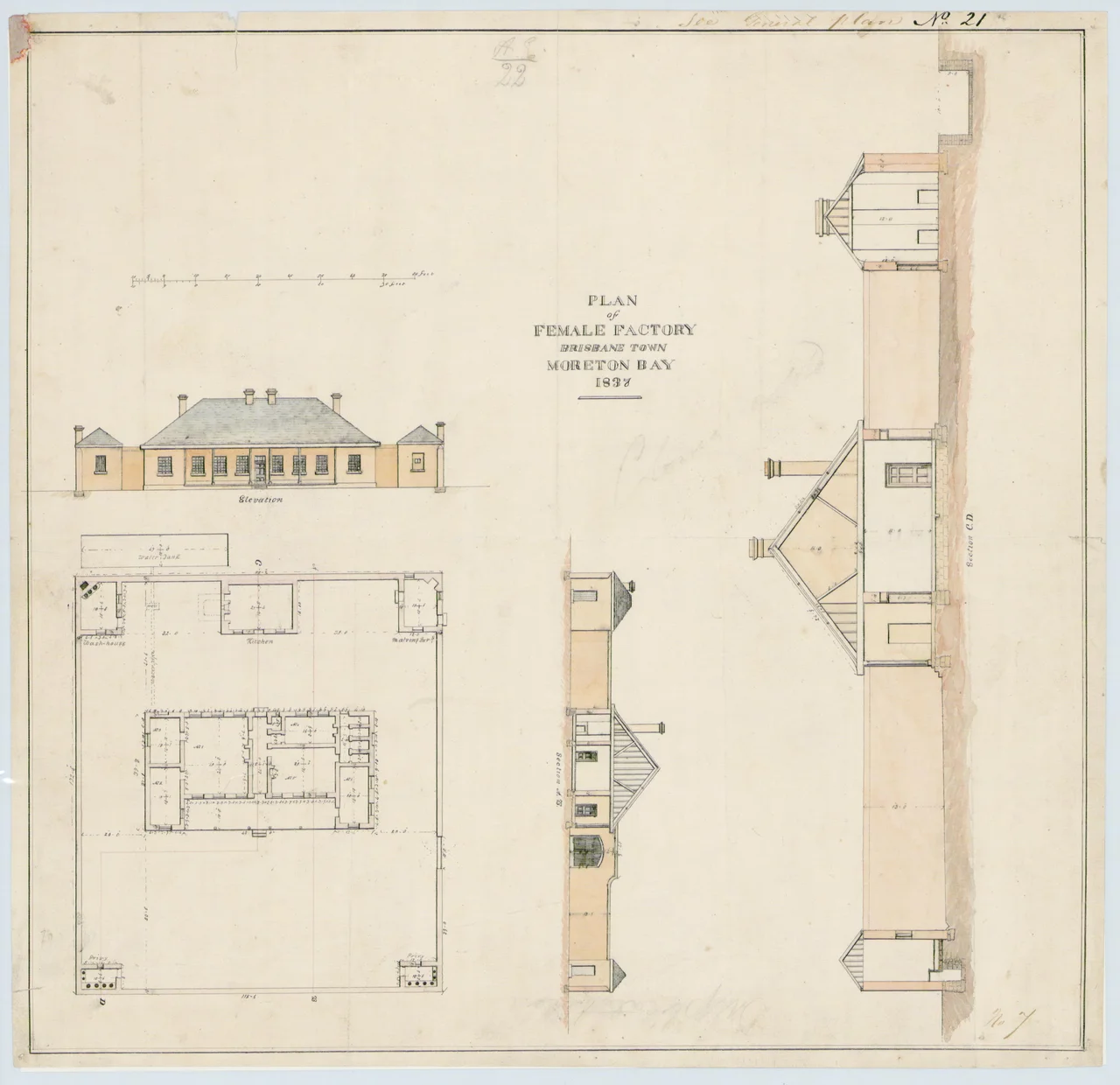

Eagle Farm Women's Prison and Factory Site
There is almost nothing to see here now. Beneath an industrial estate near Brisbane Airport lie the brick footings of a vanished building and a scatter of broken crockery, glass, and hand-forged nails. But this quiet ground holds the memory of women whose names history mostly failed to keep. Between 1829 and 1839, on land that belongs to the Turrbal and Yagara peoples, the Moreton Bay penal settlement confined transported convict women at Eagle Farm and set them to work. They were among the most punished people in the colony, sent here as a second exile, and the archaeological site that survives is one of only a handful in the country to preserve any trace of them at all.
Twice Condemned
To be sent to Moreton Bay was to have already been sent away once. This was a place of secondary punishment, reserved for convicts who had committed further offences after their transportation to Australia, and it held women as well as men. The women had first been housed in a Female Factory on Queen Street in Brisbane, on the ground where the General Post Office stands today. Many had been transported in the first place for petty crimes, the small thefts and survival offences of poor women in a harsh age, and now they found themselves doubly exiled at the far edge of the British world. The walls of their town factory rose high and were topped with broken glass. It was not enough to satisfy the men who ran the colony.
Moved to the Margins
The decision to move the women out to Eagle Farm was made by Captain Foster Fyans, and the reasoning reveals how the colony saw them. Officials were preoccupied with contact between the convict women and the soldiers and male convicts of Brisbane Town, and the remedy was distance. From 1830 women were recorded at the agricultural establishment Commandant Patrick Logan had founded at Eagle Farm, eight miles from town. By 1837 every female prisoner in Brisbane had been removed there. Whatever the records say about the anxieties of the men in charge, the human reality was plainer: women already serving brutal sentences were pushed further into isolation, away from the small town that was the only settlement for hundreds of miles.
The Work of Their Hands
When the Quaker missionary James Backhouse visited Eagle Farm in 1836, he counted forty women. Their days were filled with labour: washing, sewing, tending the farm, and picking oakum, the tedious unravelling of old tarred rope into fibre that left fingers raw. Some of the women, Backhouse noted, were wearing chains, a detail that mattered, because British regulations of the time forbade the chaining of female convicts. The rule was broken here all the same. They worked beside a swamp that bred malaria, and sickness ran through the establishment. These were not statistics. They were individuals with histories and families left behind in Britain and Ireland, enduring a punishment that the colony's own laws were supposed to have softened, and did not.
What the Ground Remembers
In May 1839 the last fifty-seven women were shipped to Sydney, and the establishment at Eagle Farm closed. The land went on to other lives, eventually becoming part of Brisbane's first airport and then an industrial precinct, the convict decade buried and almost forgotten. Yet it was never entirely lost. In the twenty-first century, archaeologists returning to the site uncovered the brick footings of the superintendent's quarters and the everyday debris of the people who had lived and laboured here. The Eagle Farm Women's Prison and Factory Site is now heritage-listed, valued precisely because so little like it remains. It is one of only seven secondary-punishment sites left in Australia, and among the very few anywhere tied specifically to convict women, a fragile archive of lives that deserved to be remembered.
From the Air
The Eagle Farm Women's Prison and Factory Site lies at roughly 27.430 degrees south, 153.083 degrees east, on Schneider Road in the suburb of Eagle Farm, about 7 kilometres northeast of central Brisbane and within the Australia TradeCoast industrial precinct on land that was once part of the old Eagle Farm Airport. There is nothing dramatic to pick out from the air; it is a small heritage parcel among warehouses and roads. Use the larger landmarks for orientation: Brisbane Airport (ICAO YBBN) lies just to the north, the Doomben and Eagle Farm racecourses sit a short distance west, and the Brisbane River winds past to the south and east. Archerfield (ICAO YBAF) is the alternate field to the southwest.
Nearby Stories
- Redcliffe Peninsula 2.7 km away
- Tamborine National Park 12 km away
- Cressbrook Homestead 27 km away
- Main Range National Park 31 km away
- 2010-2011 Queensland Floods 38 km away
- Cape Byron 96 km away
- Cape Byron Light 126 km away
- HMS Porpoise (1799) 588 km away