
Echinades
Herodotus watched the Achelous River at work and reported, matter-of-factly, that half of the Echinades islands had already merged with the mainland in his time. Thucydides went further: he predicted that all of them would join the coast before long, buried under silt. Both men were wrong about the speed but right about the process. Twenty-five centuries later, the Achelous is still pushing sediment into the Ionian Sea, and the Echinades are still out there — scattered, rocky, and stubbornly themselves.
Named for the Spine of the Sea Urchin
The name comes from the Greek word for sea urchin — echinus — chosen because the islands' sharp, jagged outlines resemble the animal's spines. The same quality earned them a second name: the Oxeiae, meaning the Sharp Islands, a name one of them still carries in slightly altered form as Oxeia. The Venetians called the group Kurtzolári, a name that technically belongs to a peninsula near the mouth of the Achelous, but which they applied to the whole cluster.
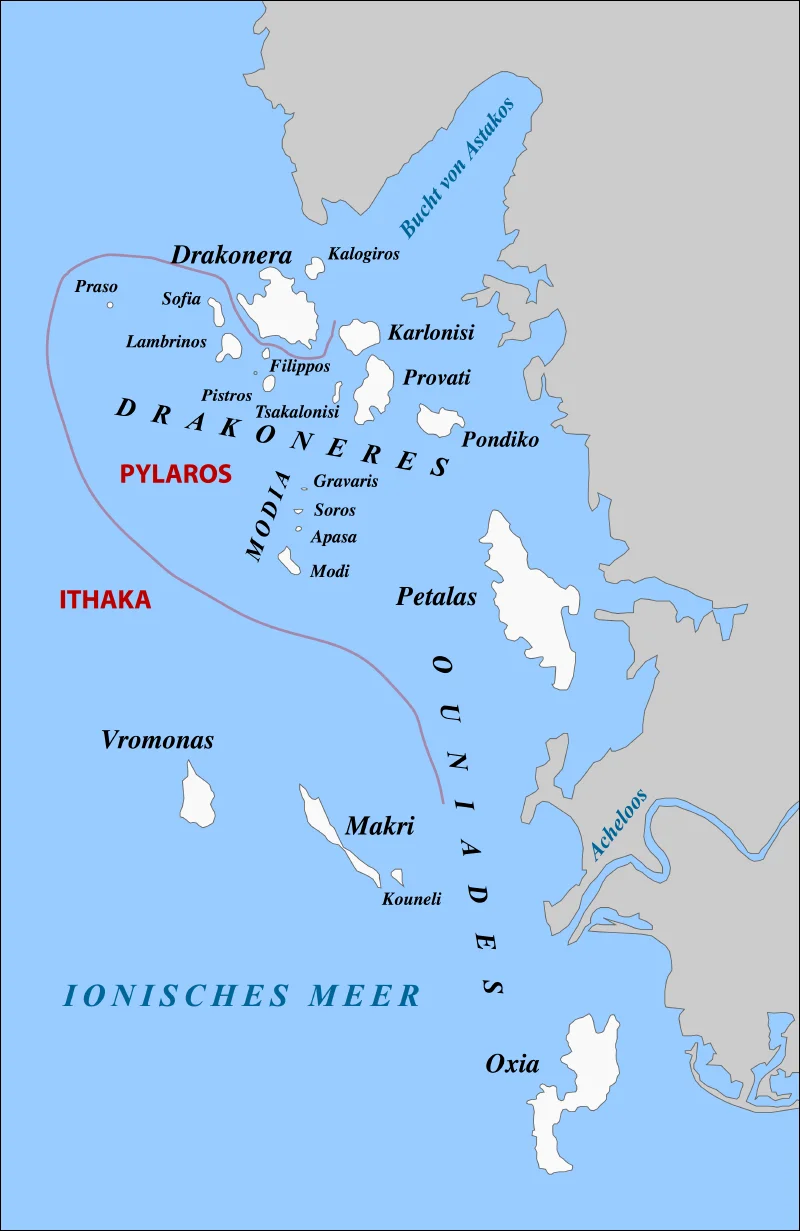
Today the archipelago divides into three groups: the Drakoneres in the north, named for the principal island Drakonera; the Modia in the middle, which includes four smaller islands, two of them barely rocks; and the Ouniades in the south. Seventeen islands have names. Nine are cultivated. Oxeia is the tallest, reaching 421 meters above the Ionian Sea. Makri and Vrómonas are the next most significant.
Homer's Sacred Islands
These islands appear in the earliest surviving Greek literature. In the Iliad, Homer mentions the sacred islands Echinae as the origin of Meges, son of Phyleus, who led forty ships to Troy from Dulichium and these waters. Dulichium, Kefalonia, Zacynthos, and Ithaca appear together in the Odyssey as the islands of Odysseus' domain — and scholars have long debated whether Dulichium was one of the Echinades, with most placing it at the island now called Makri.
Euripides identified the Echinades with the islands of Taphos in his Iphigeneia at Aulis, though most modern scholars, including those behind the Barrington Atlas of the Greek and Roman World, locate Taphos at Meganisi, considerably to the northwest near Lefkada. Homer described the islands as inhabited; both Thucydides and the geographer Scylax called them deserted. Strabo was blunter still, simply recording that they were barren and rugged. One island apparently once held a town called Apollonia, named in a source by Stephanus of Byzantium — but no trace of it survives.
A River's Slow Conquest
The geological story of the Echinades is a drama running on a timescale that defeats human attention. The Achelous, the longest river that flows entirely within Greece, has carried sediment from the mountains of Epirus and Aetolia down to the Ionian Sea since before recorded history. Where once there were more islands, there is now mainland. Artemita, one of the ancient Echinades, became a peninsula — Artemidorus described it as such, near the mouth of the Achelous, even in antiquity.
Why hasn't the process gone further? Pausanias, writing in the second century AD, suggested that the Achelous was bringing down less sediment because Aetolia had reverted to uncultivated land — stripped hillsides carry more soil than forested ones do. Modern analysis suggests a different answer: the deepening of the seabed offshore slows the deposit. The river pushes, the sea receives, and the islands persist. For now.
Battles, Ownership, and the Long View
The waters around the Echinades have seen fighting across twenty-five centuries. A naval battle in 322 BC, during the Lamian War, was fought near these islands between the Macedonian fleet and the Athenian navy. In 1427, a further Battle of the Echinades took place here. The Battle of Lepanto — one of the most consequential naval engagements in European history — was fought in 1571 just to the south, at the mouth of the Gulf of Patras.
In 2013, a different kind of transaction made international news: six of the islands, including Oxeia, were purchased by Sheikh Hamad bin Khalifa al-Thani, the former emir of Qatar, for a reported £7.3 million sterling. The islands now sit at the intersection of ancient myth, geological process, and twenty-first-century real estate — which may be as fitting an ending as any for a place Herodotus once thought was disappearing.
From the Air
The Echinades lie at approximately 38.30°N, 21.11°E, clustered just off the Acarnanian coast where the Achelous River meets the Ionian Sea. Araxos Airport (LGRX) is the nearest major airfield, roughly 55 km to the southeast along the southern shore of the Gulf of Patras. Approaching from the south at 3,000–5,000 feet, the islands become visible as a loose scatter of shapes against the open water, the largest being Oxeia to the southwest. The delta of the Achelous is visible as a greener, flatter fringe where the mainland meets the sea. Conditions are typically clear in summer, with the Meltemi affecting the area from July through August.
Nearby Stories
- Andravida 7 km away
- Astras 9 km away
- Melissani Cave 11 km away
- Salmeniko Castle 13 km away
- Aetolia 18 km away
- Ionian Islands 19 km away
- The Septinsular Republic 21 km away
- Duchy of Neopatras 48 km away