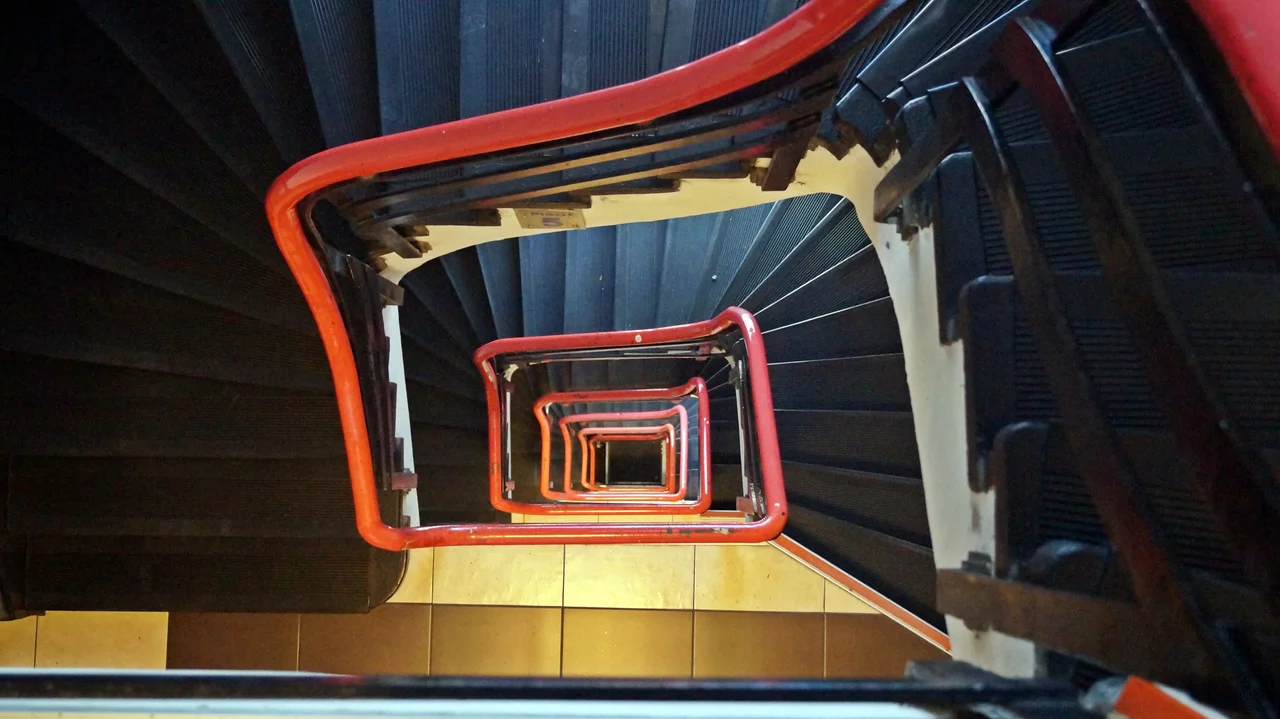

Edificio del Seguro Obrero
When it was finished in 1931, this was the tallest office building in Chile - a confident Art Deco tower on a downtown corner, twelve stories of clean lines and modern ambition. Stand on the sidewalk and you are within sight of La Moneda, the presidential palace; the same intersection holds the Plaza de la Constitucion and the seat of the metropolitan government. It is, by any measure, one of the most important corners in the country. Yet the Seguro Obrero Building is remembered less for its architecture than for a single afternoon in 1938, when it became the scene of one of the darkest episodes in modern Chilean history.
A Tower for the Workers' Fund
The building was raised for the Caja del Seguro Obrero Obligatorio, the compulsory workers' insurance fund created in 1924 - an institution born of Chile's early experiments in social welfare, in a decade when the country was beginning to write the rights of laborers into law. The architect Ricardo Gonzalez Cortes drew on two of the era's most forward-looking currents: the structural boldness of the Chicago school, which had taught the world how to build tall, and the geometric elegance of Art Deco, then sweeping fashionable cities everywhere. Construction ran from 1928 to 1931, and when the tower topped out at twelve stories it surpassed the nearby Edificio Ariztia as the tallest office building in the country. For a young agency dedicated to the wellbeing of working people, the building was a statement of permanence and purpose, planted at the very heart of the capital, where the government and the nation could not help but see it.
The Fifth of September
On 5 September 1938, Chile was weeks from a presidential election and simmering with political tension. A group of young men from the National Socialist Movement of Chile - the Nacistas, modeled on European fascism and hoping to clear a path back to power for the former president Carlos Ibanez del Campo - attempted to seize power. A contingent occupied the Seguro Obrero Building, just steps from La Moneda, while another group seized a nearby university building. A gun battle erupted between the occupiers and the Carabineros, Chile's national police. Outgunned and surrounded, the young men inside the tower surrendered. They had been promised they would not be harmed.
After the Surrender
The promise was broken. Inside the building, the police shot the men after they had given themselves up. Fifty-nine were killed. Of the roughly sixty-three who had taken part in the failed uprising, only a handful walked out alive. The dead were overwhelmingly young, and the killing was not combat but execution - prisoners shot after laying down their arms, allegedly on orders that reached to the office of President Arturo Alessandri himself. Whatever one makes of the politics that brought these men to the building, what happened to them after they surrendered was a massacre, and Chileans named it plainly: the Matanza del Seguro Obrero. A classic of Chilean literature, 'Los asesinados del Seguro Obrero,' would later be written to keep the memory of that afternoon alive.
How a Massacre Changed an Election
The bloodshed did not secure power for anyone - it transformed the country's mood instead. Public revulsion at the killings swung sympathy toward the left, and weeks later the Popular Front candidate Pedro Aguirre Cerda won the presidency, an outcome the massacre helped decide. The building, meanwhile, kept working. Since November 1989 it has housed the Ministry of Justice, an institution whose very name sits uneasily with what the walls once witnessed. Today the elegant Deco tower stands as it has for nearly a century, beautiful and unassuming, while the corner it anchors carries a memory that Chile has never quite let go.
From the Air
The building stands at the northeast corner of Morande and Moneda streets in Santiago's Civic District, at roughly 33.44 degrees south, 70.65 degrees west - directly adjacent to La Moneda Palace, the white neoclassical presidential building that is the most recognizable landmark in the downtown core. Santiago lies in a basin walled by the Andes to the east, the dominant feature on a clear day. The nearest major airport is Comodoro Arturo Merino Benitez International (SCEL), about 15 km northwest. From the air, the formal government quarter around La Moneda - its plazas and grid of ministry buildings - is the key orientation point. Winter smog frequently settles over the basin and reduces visibility; the cleanest views of the city center follow rain or wind.
Nearby Stories
- Paine Memorial 21 km away
- 1947 BSAA Avro Lancastrian Star Dust accident 23 km away
- Battle of Chacabuco 31 km away
- La Campana National Park 36 km away
- Puente del Inca 44 km away
- Casa de Isla Negra 62 km away
- Santa Cruz, Chile 103 km away
- Pierre Auger Observatory 172 km away