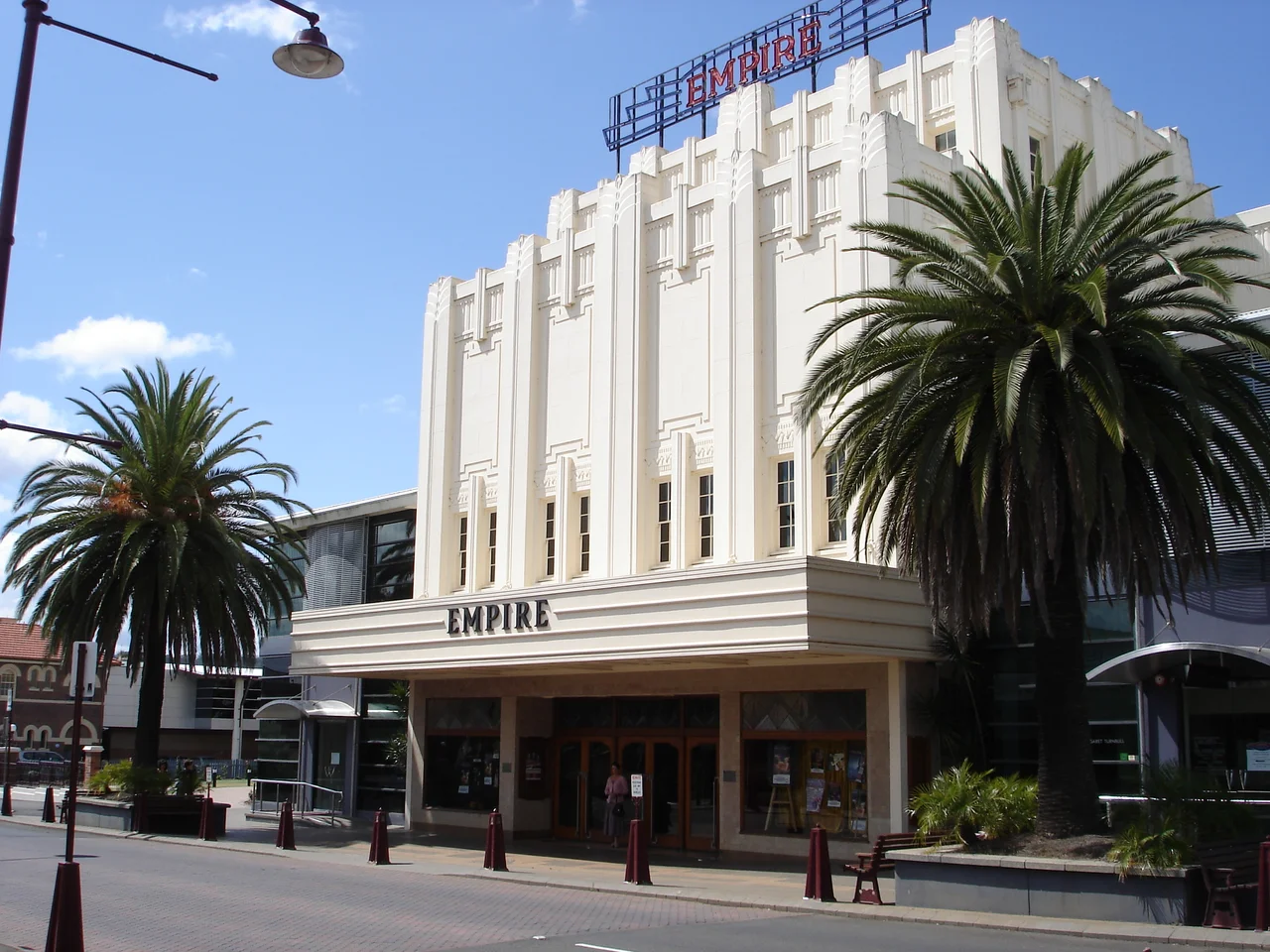

Empire Theatre, Toowoomba
The chief electrician's name was Edward Gold, and he gave the Empire Theatre its magic trick. Behind the grand proscenium arch he set hidden lights against a wall of open plaster fretwork, then wired them to a dimmer system that let the arch bloom and fade through a slow wheel of colour while the audience watched the screen. In 1933, the local press claimed no theatre in the entire British Commonwealth used diffused light so lavishly. Gold also founded Toowoomba's radio station. But it is the glowing arch, framing a stage on Neil Street, that people still describe when they talk about the night the Empire opened.
The Theatre That Burned
There was an Empire before this Empire. The first opened on 29 June 1911, a masonry picture house seating 2,200, built for a syndicate of six Toowoomba businessmen and the Brisbane showman E.J. Carroll, who would go on to help found the Birch, Carroll and Coyle cinema chain that became a fixture of Queensland life. Films shared the early bills with vaudeville acts. In 1929, sound arrived, and the first talkie Toowoomba ever heard, The Jazz Singer, played here. The town grew genuinely fond of the place. Then, on 22 February 1933, fire destroyed it. The owners did not hesitate. Within weeks a design for a new and grander theatre was commissioned, and much of the surviving 1911 brickwork was folded into its walls.
A Triumph in Steel
The new Empire was built to a scale Queensland had not seen outside its capital. Opened on 27 November 1933 and billed as the theatre supreme, it seated 2,500 and was the largest provincial theatre in the state, surpassed nationally only by a handful of grand houses in Melbourne, Sydney, and Brisbane. Its engineering was as ambitious as its scale. Seventy long tons of structural steel framed the gallery, fabricated in Brisbane, carried up the range by Queensland Rail, and riveted together on site. The Dress Circle rode on a riveted truss spanning 70 feet, so that not a single column interrupted the view of the stage. At the time it was considered an exceedingly intricate feat, unique in Queensland, and a triumph in steel.
Palms, Fish Tanks, and a Missing Light
Inside, the Empire leaned hard into the romance of Hollywood's golden age. Palm trees framed the exterior. Two fish tanks sat on plinths in a foyer finished in metallic gold and bronze. The pilasters running up the Neil Street facade were topped with patterns like palm fronds, and a neon Empire sign crowned the parapet in linear jazz ironwork. A huge central lamp of wrought iron and glass ran much of the ceiling, casting a soft, even light. That lamp did not survive the war. In 1942, with Japanese air raids feared a real possibility, the great fixture, affectionately known as the bomber light, was taken down lest a blast send a rain of glass onto the audience. It was never recovered, and the dark space where it hung is its own small monument to a nervous wartime city.
Dark Years and a Second Curtain
Television did to the Empire what it did to picture palaces everywhere. Audiences thinned through the 1960s, and on 1 April 1971 the last film flickered out. The seats were stripped, and the building drifted through other lives: a department store for a year, then decades as a technical college. It might have ended there. Instead, the Toowoomba City Council bought it and, in June 1997, reopened the Empire restored to its 1933 art deco glory with modern stagecraft behind the old plaster. In 1998 a national leisure magazine named it the best theatre in Australia. Today it seats 1,565 and stands as the largest proscenium arch theatre in regional Australia, a working stage where touring companies still play beneath the arch that Edward Gold taught to glow.
From the Air
The Empire Theatre stands on Neil Street in central Toowoomba at 27.563 degrees south, 151.956 degrees east, atop the Great Dividing Range at roughly 690 metres elevation, one of the higher cities in Queensland. Toowoomba Wellcamp Airport (YBWW) lies about 8 nautical miles to the west; the Oakey military aerodrome (YBOK) is nearby to the north, so check for restricted airspace. Brisbane Airport (YBBN) is roughly 70 nautical miles to the northeast, down on the coastal plain beyond the escarpment. From the air, Toowoomba's tidy grid sits on the tableland just before the land falls away eastward into the Lockyer Valley; look for the theatre's tall fly tower and parapet rising above the low-rise streetscape of the city centre. Toowoomba's elevation gives it cooler, clearer air than the coast, and crisp winter days offer excellent visibility over the Downs.
Nearby Stories
- North Ipswich Railway Workshops 20 km away
- Main Range National Park 22 km away
- Cressbrook Homestead 41 km away
- Woodford Folk Festival 41 km away
- Jimbour Homestead 43 km away
- Tamborine National Park 60 km away
- Warialda 217 km away
- Inverell 254 km away