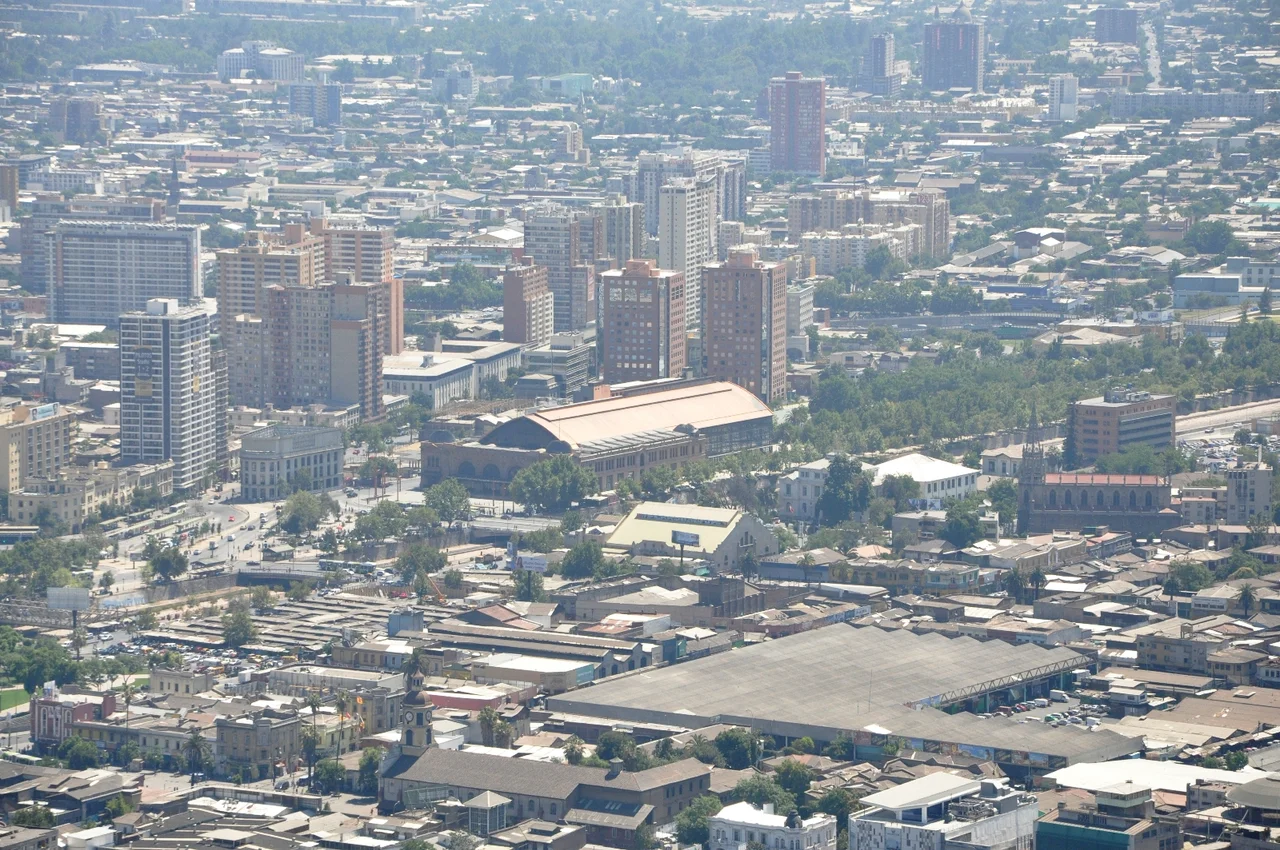

Estación Mapocho
The architect was born in Santiago but lived nearly his whole life in France, and you can read that double identity in the building he left behind. Emilio Jecquier, son of French parents, trained at the École des Beaux-Arts in Paris and brought its grammar home to a young republic eager to prove itself. The result rises on the south bank of the Mapocho River: a 280-metre hall whose iron vault, once glazed in glass and now sheathed in copper, arcs over a space large enough to swallow a steam locomotive whole. When it opened, this was the gateway through which Chile met the world.
Built for a Centennial
In 1905, with the hundredth anniversary of independence approaching, Chile set about building monuments worthy of a nation coming of age. Estación Mapocho was one of them, conceived alongside the landscaping of Santa Lucía Hill, the Palace of Justice, and the National Museum of Fine Arts, which Jecquier also designed. He had won the museum commission years earlier; the station was a companion piece in the same confident hand. A Belgian firm, Haine Saint Pierre, fabricated the great steel skeleton, and masonry anchored it to the riverbank. The official inauguration came on 12 May 1912, with trains carrying passengers from the following year.
The Door to Valparaíso and Beyond
For decades this was Santiago's principal rail hub, sending trains north toward the desert nitrate fields, across the cordillera to Argentina, and west to the port of Valparaíso. The pattern of travel was simple and grand: board here, ride to the coast, then cross an ocean to the rest of the world. Chile was riding the saltpeter boom, exporting the mineral wealth of its northern deserts, and the wealth flowed through halls like this one. To stand beneath the vault was to feel, for a moment, at the center of a country's ambitions and its commerce alike.
Decline and Rescue
Time was unkind. In 1986 the station closed for remodeling and traffic shifted to Alameda Station. That same year a rail disaster at Queronque killed 58 people and shuttered the Santiago–Valparaíso line. Work stopped, the building was decommissioned in 1987, and decay set in. Demolition might have followed, but Chilean law forbids the destruction of a national monument, a status the station had held since 1976. So the rail company sold it instead, and in 1991 a cultural corporation took on the task of bringing it back, one of the first times a private group managed a public building in newly democratic Chile.
A Hall Reborn
The restoration, led by architects Montserrat Palmer, Teodoro Fernández, Ramón López, and Rodrigo Pérez de Arce, followed a quiet principle: touch as little as possible. They reworked the ten thousand square metres with minimal disruption, preserving Jecquier's original design wherever they could. The new Estación Mapocho Cultural Centre opened on 3 March 1994. Today the old platforms host art exhibitions, concerts, and conventions, and every spring the Santiago International Book Fair fills the hall with readers. The work earned a City Heritage Award in 2005 and the Reina Sofía International Award for heritage restoration in 2008. The trains are gone, but the building still gathers the city beneath its copper sky.
From the Air
Estación Mapocho sits at 33.43°S, 70.65°W on the south bank of the Mapocho River in downtown Santiago, just steps from the Mercado Central and the Plaza de la Cultura. From the air its long arched copper roof reads clearly against the dense city grid, with the green slopes of San Cristóbal Hill rising to the north and the snow-capped Andes filling the eastern horizon. Best viewed from lower altitudes in clear conditions; Santiago's summer (December–February) offers the most reliable visibility, while winter inversions can trap haze in the basin. Nearest major field is Arturo Merino Benítez International Airport (SCEL), roughly 15 km northwest; the smaller Eulogio Sánchez Airport (SCTB) lies to the southeast.
Nearby Stories
- Paine Memorial 21 km away
- 1947 BSAA Avro Lancastrian Star Dust accident 23 km away
- Battle of Chacabuco 31 km away
- La Campana National Park 36 km away
- Puente del Inca 44 km away
- Casa de Isla Negra 62 km away
- Santa Cruz, Chile 103 km away
- Pierre Auger Observatory 172 km away