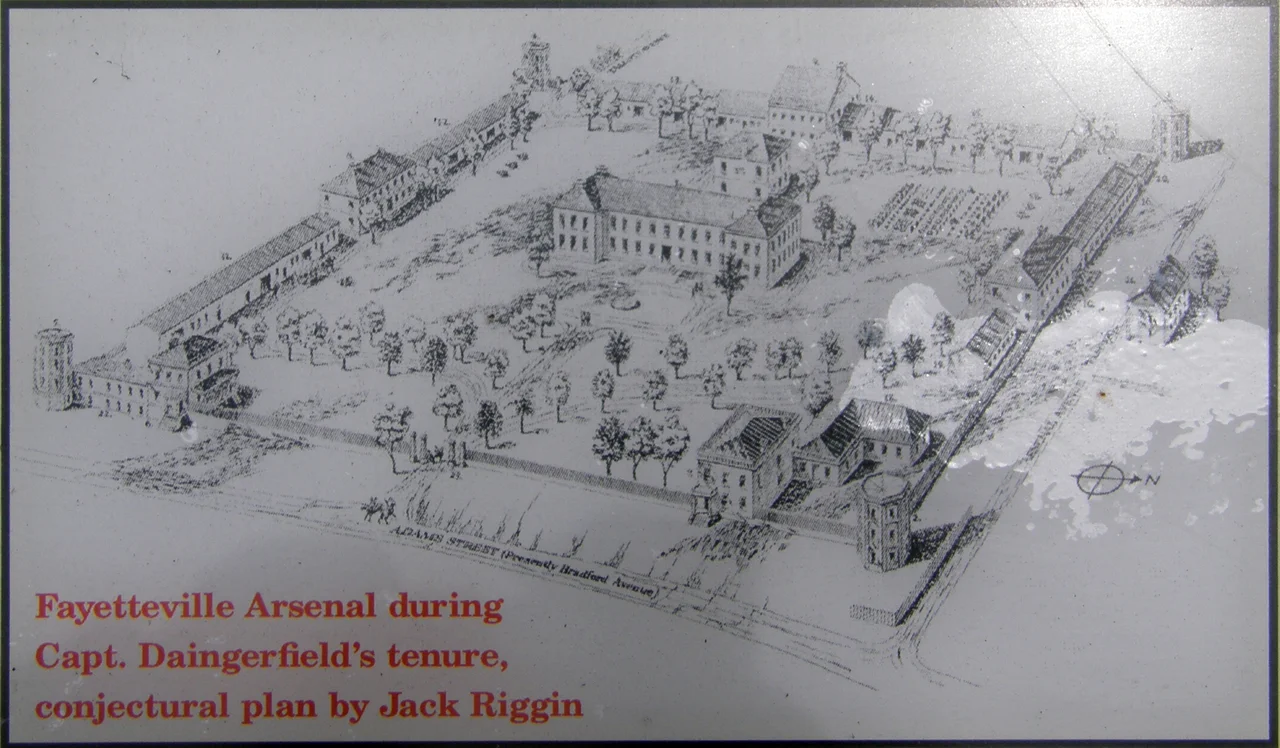

Fayetteville Arsenal
The cornerstone was laid on April 9, 1838, the date carefully chosen for what the building was meant to be: a federal arsenal that would stand for generations. By Civil War's end, it had stood for twenty-seven years. Sherman's soldiers used railroad rails as battering rams to bring down its octagonal corner towers. When the brick fell, leftover artillery shells in the rubble cooked off in the fire. The Fayetteville Arsenal was destroyed twice in the span of a few hours - first by the rams, then by its own ordnance exploding inside the wreckage. What you can visit today is what survives of a building that no longer exists.
Why It Was Built
The War of 1812 had taught the federal government a hard lesson about the geography of national defense. The country's arms factories were too clustered to defend against a determined raider. Congress began authorizing new arsenals spread across the young republic, none more than a long day's ride from the people who might need them. Bladen County's congressman, James McKay, introduced House Resolution No. 374 to put one at Fayetteville - a smart choice strategically, sitting on the Cape Fear River and at the head of navigation that could reach the coast. Construction began in 1838 and produced something striking: four octagonal towers anchoring the corners of massive walls of brick and stone, joined by iron gates and surrounded by workshops, barracks, and officers' quarters. From the river, it must have looked less like a workshop than a small fortress, which in many ways it was.
The Quiet Surrender
On April 22, 1861, before North Carolina had formally seceded, Governor John Ellis sent Warren Winslow to negotiate the arsenal's transfer. General Walker Draughon mobilized the North Carolina Militia - the Fayetteville Independent Light Infantry under Major Wright Huske (the FILI, the oldest independent militia company in the South and the second oldest in the nation in continuous existence, founded in 1793, still in existence today), the LaFayette Light Infantry under Captain Joseph B. Starr, and other companies. Roughly 500 troops formed up that morning at the gates. Inside, the federal garrison was Battery D, 2nd U.S. Artillery, under Lieutenant Julius de Lagnel. He looked at the numbers, decided resistance was futile, and surrendered without a shot. Federal troops vacated on April 27, 1861. In a footnote that says everything about Southern allegiances at the war's outset, both federal officers present - Captain Samuel Anderson and Lieutenant de Lagnel - resigned their U.S. commissions and joined the Confederate forces within weeks.
The Fayetteville Rifle
When the Confederate Army captured the U.S. arsenal at Harpers Ferry in April 1861, they seized the most valuable industrial asset in the South: the rifle-manufacturing machinery that had been making U.S. infantry weapons for decades. They couldn't keep it there - Harpers Ferry was vulnerable. By October 1861, the machinery had been carefully disassembled and shipped to Fayetteville, where new workshops were built to receive it. Over a hundred skilled workers from Harpers Ferry came south with their families, settling into Fayetteville's neighborhoods with the precision tools and Yankee accents that would now serve the Confederacy. At its peak, the arsenal produced 500 Fayetteville Rifles per month, along with cartridges, swords, bayonets, and larger ordnance. In the war's middle years, young women of the area worked in the cartridge rooms - skilled, careful, dangerous work for which they were paid wages that mattered. The Fayetteville Rifle became one of the better Confederate infantry arms, recognizable by its distinctive stock and lock plate. Surviving examples now sell at auction for tens of thousands of dollars.
March 11, 1865
By early 1865, William Tecumseh Sherman's army was moving north through the Carolinas. Confederate Colonel Childs, commanding at Fayetteville, ordered earthworks built along the approaches; you can still see remnants on the grounds of the Veterans Administration hospital on Ramsey Street. Resistance was given. The exhausted Confederate troops were overwhelmed. Sherman entered Fayetteville on March 11, 1865. The retreating Confederates had stripped the arsenal of its arms and useful machinery - the Harpers Ferry rifle-making equipment was said to have been hidden in the coal mines near Egypt, North Carolina. Sherman's soldiers, continuing the scorched-earth policy that had defined his Carolinas campaign, were ordered to raze the buildings to the ground. They used railroad rails as battering rams. As the brick walls came down and fires consumed the wreckage, remaining artillery shells exploded in the heat. What had been built carefully over years of peace was destroyed completely in a single afternoon. Twenty-three days later, Lee surrendered at Appomattox. Today, what remains is a partial frame outbuilding, a historical marker, and the foundations of two of the four corner towers - visible in the park behind the Museum of the Cape Fear, where you can walk the perimeter and try to imagine what once stood here. A central business district loop road was driven through the site in 1988, taking what time had spared.
From the Air
The arsenal ruins are at 35.05°N, 78.89°W in downtown Fayetteville. Fayetteville Regional Airport (KFAY) lies about 4nm south. Fort Bragg's airfields - Pope Field (KPOB) and Simmons (KFBG) - sit roughly 9nm north-northwest. The site is at approximately 100 feet MSL on a low rise above Cross Creek; from the air look for the Museum of the Cape Fear complex on Bragg Boulevard, with the historic Hay Street district just to the south.
Nearby Stories
- Laurinburg, North Carolina 4.7 km away
- Sampson County, North Carolina 9.1 km away
- Rockingham Speedway 18 km away
- Campbell University 19 km away
- The Robesonian Takeover 20 km away
- Johnston County, North Carolina 21 km away
- North Carolina Aviation Museum 53 km away
- Pender County, North Carolina 57 km away