
Fayetteville State University
The deed reads $136 for two lots on Gillespie Street. The seven men who signed it - Matthew Leary, Andrew Jackson Chesnutt, Robert Simmons, George Grainger, Thomas Lomax, Nelson Carter, and David Bryant - were Black residents of Fayetteville two years out from emancipation, putting their money together to build a school for the Black children of the city. Most of them had been born before the Civil War. Some had been enslaved. In 1867, they did what they could afford to do: bought land, formed a self-perpetuating board of trustees, and trusted the building to come later. From that purchase grew Fayetteville State University.
The Howard School
The school they built was named for General Oliver O. Howard, head of the Freedmen's Bureau, who supplied the building that went up on the Gillespie Street lots. The Howard School absorbed two earlier institutions, the Phillips and Sumner Schools, both founded in 1865 to teach primary and intermediate students in Fayetteville's African American community. By 1877, the Howard School had built a record solid enough that the North Carolina legislature noticed. That year, an act of the General Assembly established the first teacher-training institution for African Americans in the state - and the legislature designated the Howard School to fill that role. It became the State Colored Normal School, the first state-sponsored institution in the South for the education of African American teachers. That distinction is worth pausing on. North Carolina, in the depths of Reconstruction backlash, chose to put public money into Black teacher training. The school the formerly enslaved had built became a state school - still serving the same students, but now with a legislative mandate and a state budget.
Dr. Smith's Fifty Years
In 1883, the State Colored Normal School appointed a new principal: Dr. Ezekiel Ezra Smith, a graduate of Shaw Collegiate Institute in Raleigh. He stayed for fifty years. During that span, Smith left twice on assignments that reflected the wider arc of Black achievement in the post-Reconstruction era. He served as Resident Minister and Consul General of the United States to Liberia, a diplomatic posting at a moment when American policy toward Africa was being negotiated in fits and starts. He also served as Regimental Adjutant of the Third North Carolina Volunteer Infantry during the Spanish-American War, returning afterward to the school. Under Smith's tenure, the school moved to its permanent site on Murchison Road, which it still occupies. He personally deeded additional land to expand the campus to 92 acres. He oversaw a physical plant that grew from a single building to several major structures. In 1929, he discontinued the high school work that had once been part of the curriculum and refocused on higher education. The title of his position changed from principal to president. On June 30, 1933, he retired and became the school's first President Emeritus. His personal papers now reside in the university archives.
Charles W. Chesnutt's Library
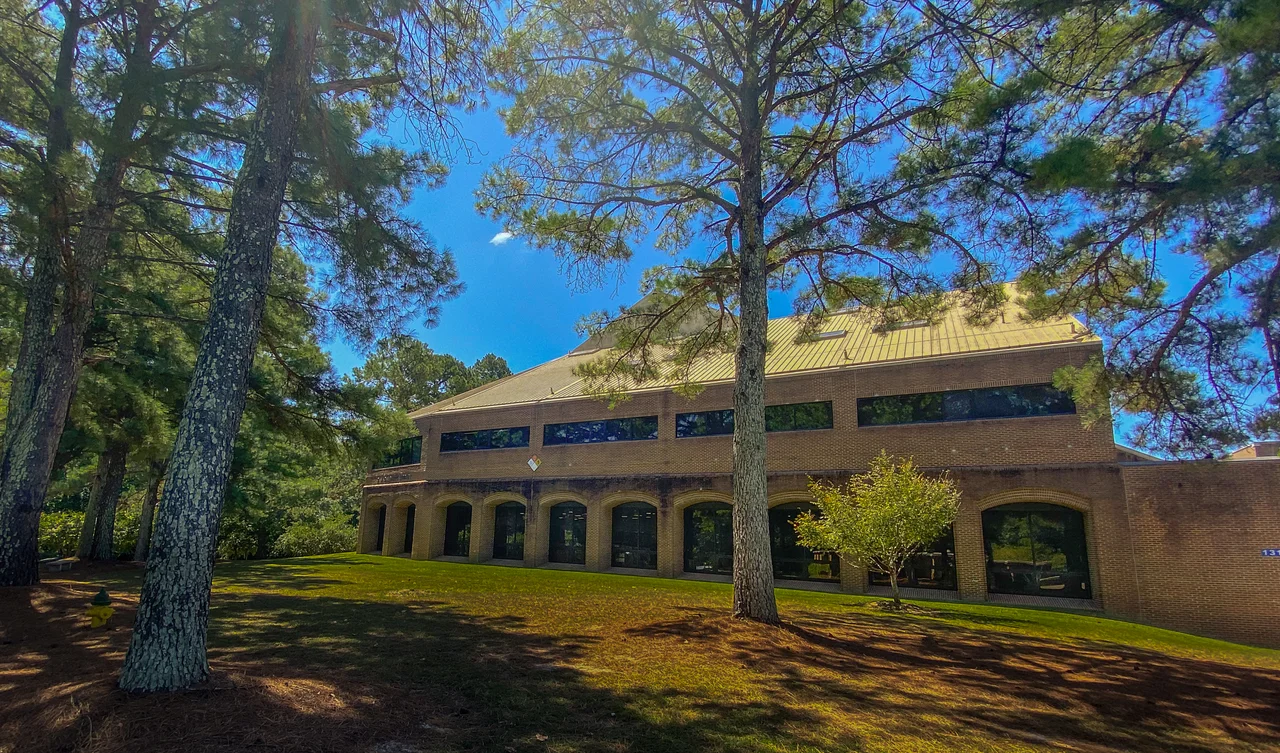
The campus library bears the name of Charles W. Chesnutt - son of Andrew Jackson Chesnutt, one of the seven founders who had bought those Gillespie Street lots. Charles W. Chesnutt grew up to become one of the first major African American novelists in American literature, author of The Conjure Woman, The House Behind the Cedars, and The Marrow of Tradition. He wrote about race, passing, color line, and Reconstruction with an unflinching eye that influenced everyone from W.E.B. Du Bois to Toni Morrison. The library named for him holds over 192,000 volumes, archives, special collections, and the original Charles Waddell Chesnutt Collection with his correspondence and family records. It is also a federal depository library, a member of the HBCU Library Alliance, and houses partnerships with the One Stop for Advising and Student Success and an Adult Learning Center. The American Library Association awarded the library a $20,000 grant in 2022 to purchase laptops for students - a small detail, but exactly the kind of practical equity work that has defined this institution since its founding.
Broncos
Today FSU is part of the University of North Carolina System and the Thurgood Marshall College Fund. It offers bachelor's degrees in more than 40 areas, master's in roughly a dozen fields, and one doctoral program in educational leadership. It participates in 10 NCAA sports as a member of the Central Intercollegiate Athletic Association (CIAA), with the men's basketball team winning the CIAA tournament in 2022. The alumni rolls run from Junkyard Dog (Sylvester Ritter, NFL player turned professional wrestler) to Michele S. Jones (first woman command sergeant major of the U.S. Army Reserve) to MLB pitcher Jim Bibby to comedian Affion Crockett. Among the more curious alumni connections: rapper Blueface played quarterback at FSU before leaving without graduating to pursue his music career. The campus sits on Murchison Road, north of downtown Fayetteville, a few miles from the gates of Fort Bragg and across town from the Cape Fear River. Each of those geographies has shaped what FSU is - the river city of Fayetteville's complicated Civil War past, the military installation that defines the regional economy, and the Black community whose founding gift made the whole thing possible.
From the Air
Fayetteville State University sits at 35.07°N, 78.89°W in northern Fayetteville, on Murchison Road. Closest commercial field is Fayetteville Regional Airport (KFAY) about 5nm south. Fort Bragg airfields - Pope Field (KPOB) and Simmons Army Airfield (KFBG) - lie roughly 7nm north-northwest. Campus elevation is approximately 120 feet MSL. From the air, look for the dense academic quadrangle northwest of downtown Fayetteville, with the Charles W. Chesnutt Library tower as the most prominent campus landmark.
Nearby Stories
- Laurinburg, North Carolina 4.7 km away
- Sampson County, North Carolina 9.1 km away
- Rockingham Speedway 18 km away
- Campbell University 19 km away
- The Robesonian Takeover 20 km away
- Johnston County, North Carolina 21 km away
- North Carolina Aviation Museum 53 km away
- Pender County, North Carolina 57 km away