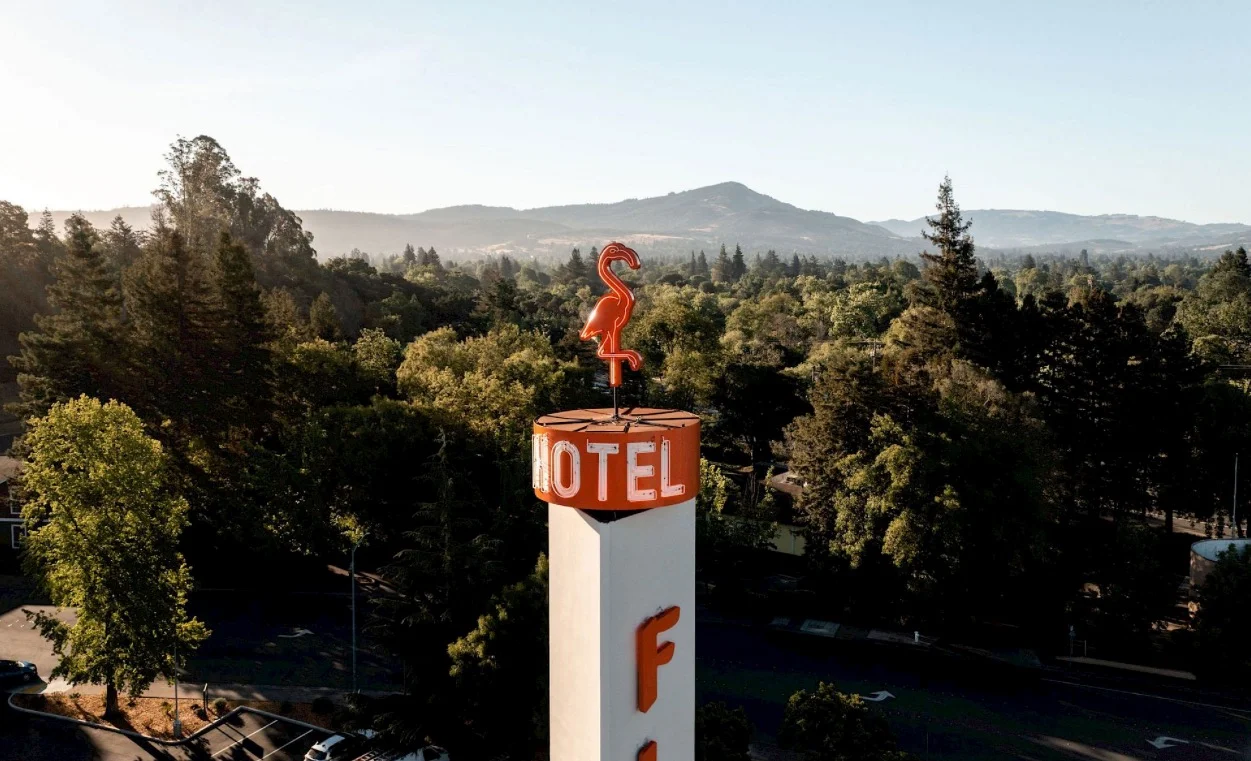

Neon and Nostalgia at the Flamingo
The neon sign appears before the building does. Driving east on Highway 12 through Santa Rosa, the Flamingo Resort's freestanding tower rises above the roadside trees like a relic from a more optimistic decade -- which is exactly what it is. When architect Homer A. Rissman designed this motor hotel in the mid-1950s, California was building the future one poolside cocktail at a time, and Sonoma County wanted in. The Flamingo opened in June 1957 with a layout that treated the automobile not as a nuisance to be hidden but as a guest to be welcomed: low-rise wings fanning out from a central courtyard in a wheel-and-spoke plan, every room angled toward an S-shaped swimming pool that promised leisure was the whole point of arrival.
The Garden Hotel on the Highway
Developer Hugh Codding's Garden Hotels Company conceived the Flamingo as auto tourism was remaking Northern California's economy. Families were loading station wagons and heading north from San Francisco, and the new highway corridor through Santa Rosa was ripe for something grander than a roadside motel. Rissman's design answered with landscaped courts, curvilinear pool geometry, and a deliberate blurring of indoor and outdoor space that borrowed as much from resort architecture as from the emerging vocabulary of mid-century modernism. The complex was never meant to be just a place to sleep. It was meant to be a destination -- a self-contained world of swim clubs, dining rooms, and event halls where the car that brought you could rest while you did the same.
Where Sonoma County Came to Celebrate
Within months of opening, the Flamingo became the county's de facto civic ballroom. The Santa Rosa Chamber of Commerce moved its offices to the property. The inaugural Golden Deed Ball, a civic fundraiser, drew nearly 900 guests in formal attire, with Academy Award-winning actor Charles Coburn among the attendees. Members-only clubs sprouted -- the Empire Club, the Cabana Club -- each with its own rituals of belonging. Beauty pageants crowned Flamingo Girls. Touring performers played the dinner theater. Local newspapers chronicled a steady rotation of charity balls, celebrity appearances, and community galas that transformed a hotel into a social institution. For a generation of Sonoma County residents, the Flamingo was where milestones happened: the prom, the fundraiser, the anniversary dinner where someone finally made a toast worth remembering.
Saving the Glow
By the 1990s, the neon sign that had guided travelers off Highway 12 for decades was showing its age, but Santa Rosa was not ready to let it fade. The city designated the sign a local historic landmark, recognizing it as both a wayfinding artifact and a piece of roadside Americana. Subsequent restoration work focused on preserving the original profile and lighting characteristics -- the specific colors, the tube bending, the way the glow spread against the evening sky. More recently, lighting upgrades have been framed as part of a broader movement to conserve roadside modernism across Sonoma County, treating neon not as kitsch but as cultural heritage. The sign still does what it was designed to do: it catches your eye and pulls you off the highway.
A Landmark Renewed
A major renovation announced in 2019 updated guest rooms, meeting spaces, and site circulation, with the work completed in 2021. The project walked the tightrope that historic renovations always do -- modernizing systems and surfaces while preserving the mid-century fabric that made the place worth preserving in the first place. That same year, on September 20, 2021, the Flamingo Hotel was listed on the National Register of Historic Places under two criteria: Criterion A for its role in community planning and development, and Criterion C for its architecture, specifically Rissman's design as a significant example of mid-century modern resort planning. The dual designation acknowledged what Sonoma County had known since 1957: the Flamingo was never just a hotel. It was a place where a community gathered, and the architecture made the gathering feel like an event.
From the Air
Located at 38.45N, 122.69W in Santa Rosa, California, along the Highway 12 corridor. The resort's wheel-and-spoke layout and S-shaped pool are identifiable from low altitude. Nearest airport: Charles M. Schulz-Sonoma County Airport (KSTS), approximately 7 nm northwest. Santa Rosa sits in the Santa Rosa Plain between the Sonoma Mountains to the east and the coastal hills to the west. Expect morning fog during summer months that typically burns off by midday.
Nearby Stories
- Sonoma Coast State Park 5 km away
- Engine Number 5 and the Tunnel That Kept Its Secret 5 km away
- The Canyon That Burned on Independence Day 6.5 km away
- Museum of the American Indian 8 km away
- California's Holland 16 km away
- Griffith Mansion 17 km away
- Where the Sheep Rancher Planted Stars 29 km away
- Cordell Bank: The Invisible Island 29 km away