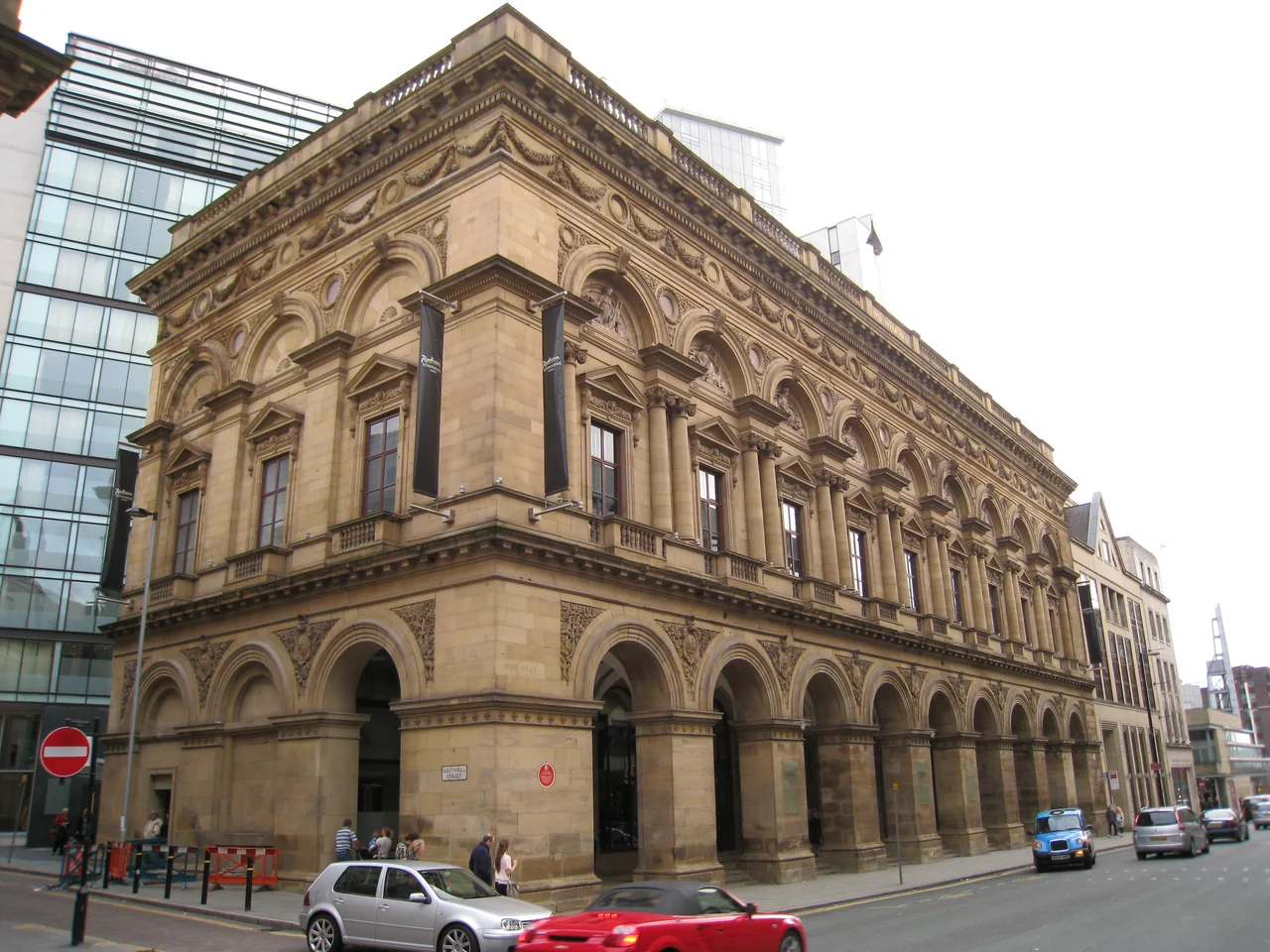

Free Trade Hall
On 16 August 1819, around sixty thousand people - working men, women, and children - gathered on St Peter's Fields in Manchester to demand parliamentary reform. Magistrates panicked. Cavalry of the Manchester and Salford Yeomanry charged into the crowd with sabres drawn. Around eighteen people died. Hundreds more were wounded. The newspaper coverage called it Peterloo, after Waterloo, four years earlier. Decades later, on the same blood-soaked ground, the Free Trade Hall was built - a meeting place dedicated to the cause for which Peterloo's victims had died. A red plaque marks it. The building today is a Radisson hotel.
Peterloo
The Peterloo Massacre is the founding tragedy of British radical politics. The crowd had come to hear the orator Henry Hunt argue for the expansion of the vote and for the repeal of the Corn Laws - the tariffs that kept bread prices high while the rural poor and the new industrial working class went hungry. The magistrates, watching from a window on Mount Street, lost their nerve. The yeomanry, untrained and reportedly drunk, hacked their way through the crowd. The 15th Hussars followed. Witnesses described women trampled by horses, children separated from parents and killed in the crush. The figure of around eighteen dead is from contemporary accounts; the number of wounded ran to perhaps seven hundred. The shock helped shape British political reform for the rest of the century. The Manchester Guardian newspaper - now the Guardian - was founded two years later in direct response. The Anti-Corn Law League, founded in Manchester in 1838 by Richard Cobden and others, finally won the repeal in 1846.
A Hall to Remember Repeal
Three Free Trade Halls were built on the site. The first, a large timber pavilion of 1840, hosted the Anti-Corn Law League's gatherings. A brick replacement followed in 1842. The third and final building, designed by Edward Walters and constructed between 1853 and 1856 on land given by Richard Cobden, was a Palladian façade in pale stone with a deeply rusticated ground floor. It opened as a public hall and concert venue funded by public subscription. From 1858 it was the home of the Hallé Orchestra, founded by Charles Hallé, the German pianist who had fled the revolutions of 1848 and settled in Manchester. In 1905, suffragettes Christabel Pankhurst and Annie Kenney were ejected from a Liberal political meeting at the hall after asking Sir Edward Grey whether the Liberal government would support votes for women. He refused to answer. They started the militant phase of the suffrage movement that morning.
Dylan and the Pistols
The hall was bombed and gutted in the Manchester Blitz of December 1940. Manchester City Council's architect L. C. Howitt rebuilt the interior behind Walters' surviving façade walls in 1950 to 1951, and Kathleen Ferrier sang at the reopening, ending with the only performance of Elgar's Land of Hope and Glory in her career - she died of cancer two years later, aged 41. On 17 May 1966, Bob Dylan played the Free Trade Hall on his first electric tour. Halfway through the second set, an audience member shouted "Judas!" Dylan replied: "I don't believe you. You're a liar." The bootleg circulated for thirty years as The Royal Albert Hall Concert before being officially released in 1998 as Bob Dylan Live 1966, with its true location finally credited. Ten years after Dylan, on 4 June and 20 July 1976, the Sex Pistols played the Lesser Free Trade Hall upstairs - a room with a 150-person capacity. Among the small audience were the people who would form Joy Division, New Order, the Smiths, Buzzcocks, the Fall, Magazine, and Simply Red. Tony Wilson was there. Factory Records started in that room.
From Concert Hall to Hotel
The Hallé moved to the new Bridgewater Hall in 1996, and the Free Trade Hall closed. In 1997 the building was sold to private developers. The Manchester Civic Society opposed it, citing the historical weight of the site. After the Secretary of State refused the initial planning application, a modified proposal was approved. Walters' façade was preserved. Howitt's post-war hall was demolished, though the main staircase and the 1950s statues were retained, and a 263-bedroom Radisson hotel opened behind the old front in 2004 at a cost of 45 million pounds. The transformation drew bitter criticism, but the façade still stands, the red Peterloo plaque is still mounted, and visitors arriving for a night's sleep walk through what is, in any honest reading, one of the most resonant pieces of ground in British political history.
From the Air
Located at 53.4778 degrees north, 2.2472 degrees west, on Peter Street in central Manchester, just east of Deansgate and west of St Peter's Square. The pale stone Palladian façade is recognisable amid the modern city. The Beetham Tower (47 storeys), Manchester Central Library's rotunda, and the Town Hall's clock tower are useful nearby landmarks. Manchester Airport (EGCC) is 8 miles south. Manchester City Airport (Barton, EGCB) is 5 miles west. Recommended viewing altitude is 2,000 to 3,500 feet AGL given Manchester's busy controlled airspace; check Manchester CTR boundaries.
Nearby Stories
- National Science and Media Museum 0.2 km away
- Jodrell Bank Observatory 3.2 km away
- Siege of Lathom House 5.6 km away
- Chester Zoo 6.2 km away
- Whalley Abbey 8.9 km away
- Haddon Hall 10 km away
- Wentworth Castle 16 km away
- Blackpool 16 km away