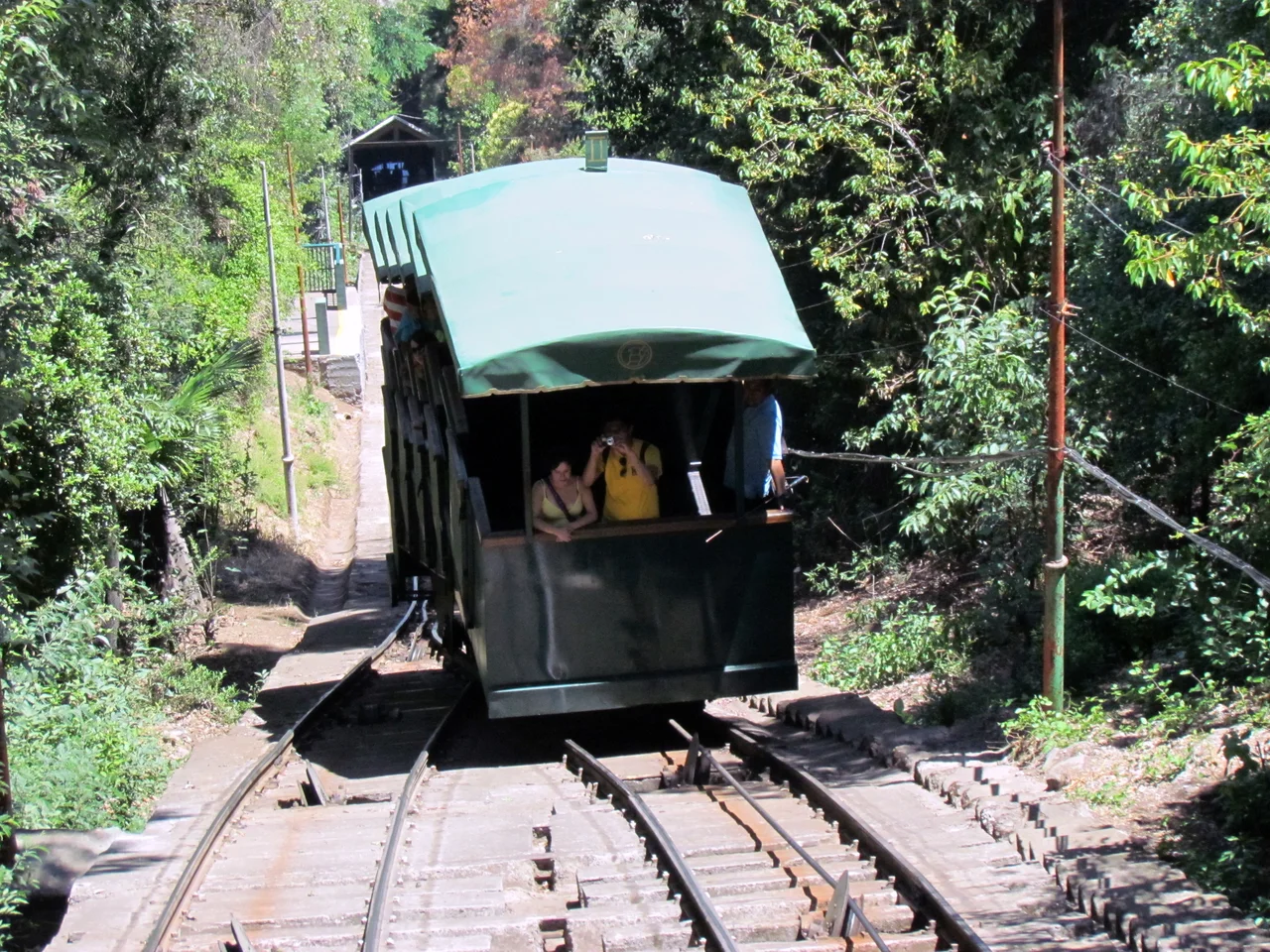

Funicular de Santiago
Two cars, joined by a single steel rope, balance each other on the slope of San Cristóbal Hill: as one climbs, the other descends, and gravity does much of the work. That elegant logic has carried passengers up Santiago's great green hill for a full century. The engineer who built it, Italian-born Ernesto Bosso, laid the foundation stone in 1923; President Arturo Alessandri rode the finished line at its opening on 25 April 1925. From the top, the whole sprawl of Santiago unfolds beneath the spread arms of a white statue of the Virgin.
A Hill for the City
By the 1910s, planners had begun turning Cerro San Cristóbal into a public refuge above the growing capital. A funicular was the natural way to reach the summit, and the project finally went to Bosso in 1922. The lower terminal, where riders still begin their climb today, was designed by architect Luciano Kulczewski, whose romantic, slightly fantastical style left a mark across Santiago. There is a nice piece of national trivia tucked into the construction: the strength of the steel cables was tested by engineer Jorge Alessandri, son of the president who opened the line and himself a future president of Chile from 1958 to 1964.
Three Stops to the Summit
The line runs 485 metres up the slope and pauses at three stations along the way. The first, Pío Nono, sits at the foot of the hill. The middle stop serves the national zoo, where generations of Santiago children have pressed against the railings. The top station, Cumbre, opens onto the sanctuary of the Virgin and links to the Santiago Cable Car that glides on across the park. The ride is short, but the climb peels the city away in layers, trading street noise for birdsong and the dry scent of the hillside.
A Century of Passengers
The funicular has worn its age gracefully. Service paused for repairs in the summers of 1949 and 1950, when a full fare cost a few pesos and a student rode for less. In 1968 the original wooden car roofs gave way to canvas tops on metal frames. The line's most famous passenger arrived in 1987, when Pope John Paul II rode to the summit during his only visit to Chile. Only one serious accident mars the record: in January 1998 an ascending car carrying six park workers struck the hillside after a brake engaged too late, destroying the car's front and costing one employee his arm.
A Protected Landmark
In recognition of its place in the life of the city, the funicular was declared a National Monument of Chile on 16 November 2000. A ride up remains one of Santiago's small rituals, equal parts transport and pilgrimage. Tourists and locals share the cars on weekends, climbing toward the viewpoints, the zoo, and the statue that has watched over the valley for generations. A hundred years on, the same simple counterweight principle that opened the line still draws it patiently up the hill.
From the Air
The Funicular de Santiago climbs the southwestern face of Cerro San Cristóbal at roughly 33.43°S, 70.63°W, inside the green expanse of the Santiago Metropolitan Park. From above, the forested hill stands out sharply against the surrounding city grid, with the white statue of the Virgin marking the summit and the funicular's straight-line cut visible on the slope. The Andes rise immediately to the east. Best viewed at lower altitudes in clear weather; Santiago's basin can hold winter haze, so the clearer summer months (December–February) reward aerial sightseeing. Nearest major airport is Arturo Merino Benítez International (SCEL), about 16 km to the northwest; Eulogio Sánchez Airport (SCTB) lies southeast of the city.
Nearby Stories
- Paine Memorial 21 km away
- 1947 BSAA Avro Lancastrian Star Dust accident 23 km away
- Battle of Chacabuco 31 km away
- La Campana National Park 36 km away
- Puente del Inca 44 km away
- Casa de Isla Negra 62 km away
- Santa Cruz, Chile 103 km away
- Pierre Auger Observatory 172 km away