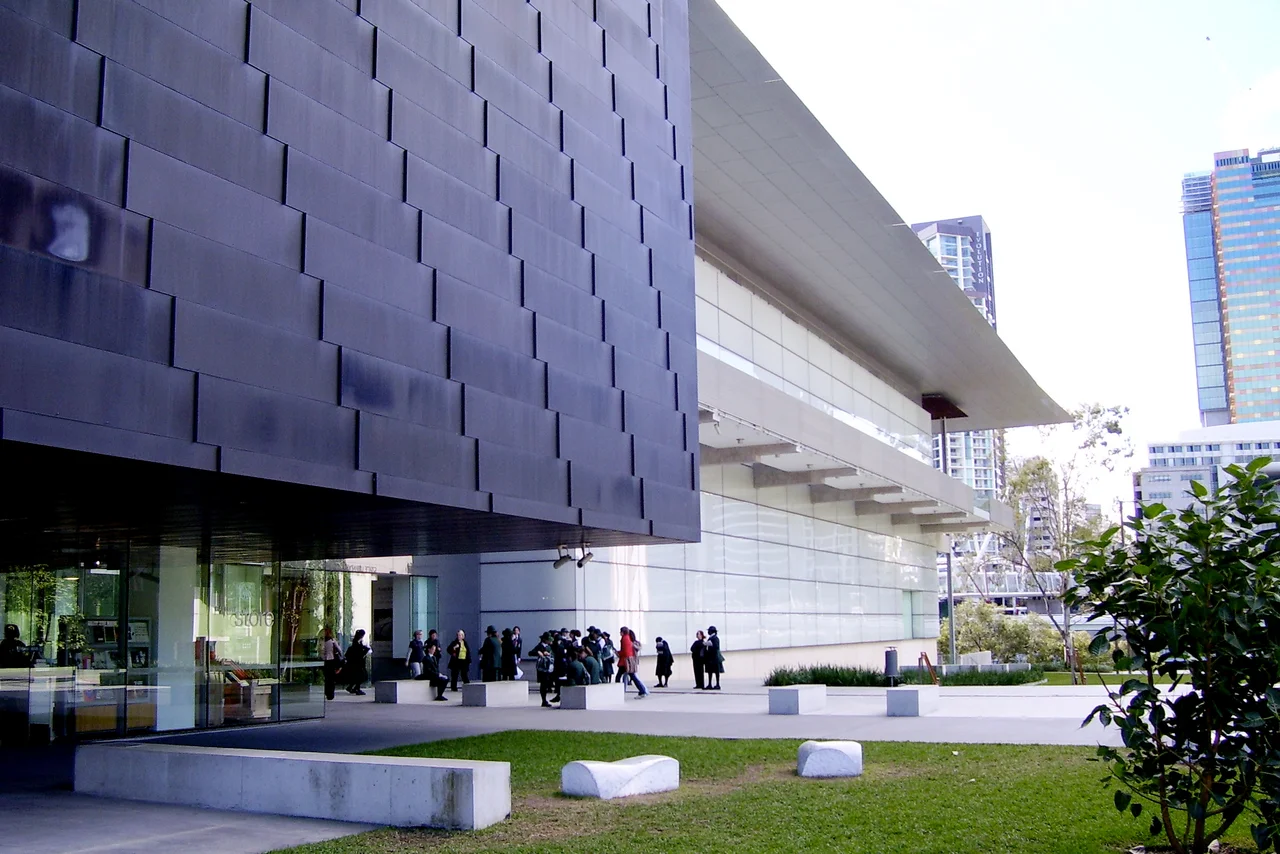

Gallery of Modern Art, Brisbane
Children fill a stark white room with coloured dots until not a single bare surface remains. The piece is by Yayoi Kusama, and watching a sterile space slowly drown in stickers, it is hard to tell where the artwork ends and the audience begins. That is the kind of thing that happens at GOMA, the Gallery of Modern Art, a long low pavilion stretched along the Brisbane River. When it opened on 2 December 2006 it became the largest gallery of modern and contemporary art in Australia, and it announced that this subtropical city, often overlooked in favour of Sydney and Melbourne, intended to be taken seriously as a place where contemporary art happens.
A Pavilion by the River
GOMA was conceived as a building that belongs to its setting rather than dominating it. The Sydney firm Architectus won an architectural competition in 2002, commissioned by the Queensland government to design a second home for the state's art collection beside the existing Queensland Art Gallery. Their answer was a pavilion in the landscape: a horizontal, light-filled structure on Kurilpa Point that opens toward the water and the city skyline beyond. Rather than announce itself with height, it spreads out, anchoring the cultural precinct of galleries, library, and theatres that lines this stretch of South Bank. The design earned the firm a national architecture award in 2007. The final building cost around 107 million dollars and offers more than 25,000 square metres of floor space, with a single exhibition hall large enough to swallow installations on an industrial scale.
Facing the Asia-Pacific
GOMA's defining idea is a matter of geography as much as art. Rather than look first toward Europe and North America, as Australian galleries traditionally had, it turned to its own region. The institution co-hosts the Asia Pacific Triennial of Contemporary Art, a sprawling survey of work from across Asia, the Pacific, and Australia that had begun at the Queensland Art Gallery in 1993 and moved here when GOMA opened. The triennial brings artists and audiences from across the region into a single conversation, and it has shaped the gallery's identity as a genuine crossroads. In a country whose art establishment had long faced the far side of the world, GOMA chose to face its neighbours, and built much of its reputation on that choice.
Crowds and Spectacle
What sets GOMA apart from a more austere museum is its appetite for the popular and the immersive. Its summer blockbusters have ranged from a retrospective of Andy Warhol to an exhibition built around the making of Marvel's cinematic universe, drawing crowds who might never otherwise set foot in an art gallery. It has shown the hyperreal sculptures of Ron Mueck, the eerie creatures of Patricia Piccinini, and the room-filling spectacles of Yayoi Kusama. The building also houses the Australian Cinematheque, the only dedicated film facility inside an Australian art museum, screening the kind of cinema rarely seen on commercial screens. GOMA treats contemporary art as something to be experienced and even played in, not merely contemplated from a respectful distance behind a velvet rope.
A Collection of the Now
Walk the galleries and the breadth of GOMA's ambition shows in the names on the walls. There is the German painter Georg Baselitz, the Chinese artists Xu Bing and Ai Weiwei, the Danish-Icelandic experimenter Olafur Eliasson, and the American Cindy Sherman. James Turrell works with nothing but light; Anish Kapoor with voids that seem to swallow it. Nam June Paik built sculptures out of television sets decades before screens ruled daily life. These are not safe, settled masterpieces but works that argue, provoke, and sometimes baffle, gathered from across the globe and the recent past. For a gallery barely two decades old, GOMA has assembled a portrait of contemporary art that punches far above the size of the city it calls home.
From the Air
The Gallery of Modern Art stands at about 27.471 degrees south, 153.017 degrees east, on Kurilpa Point in the South Bank cultural precinct on the southern side of the Brisbane River, directly across the water from the central business district. From the air, look for the tight bend of the Brisbane River wrapping around the South Bank parklands; GOMA is part of the cluster of cultural buildings, alongside the Queensland Art Gallery and the State Library, on the inside of that curve. The CBD towers rise immediately across the river to the northeast. Brisbane Airport (ICAO YBBN) lies roughly 12 kilometres to the northeast, and Archerfield (ICAO YBAF) sits to the south-southwest; both serve this controlled inner-city airspace.
Nearby Stories
- Redcliffe Peninsula 2.7 km away
- Tamborine National Park 12 km away
- Cressbrook Homestead 27 km away
- Main Range National Park 31 km away
- 2010-2011 Queensland Floods 38 km away
- Cape Byron 96 km away
- Cape Byron Light 126 km away
- HMS Porpoise (1799) 588 km away