.JPG)
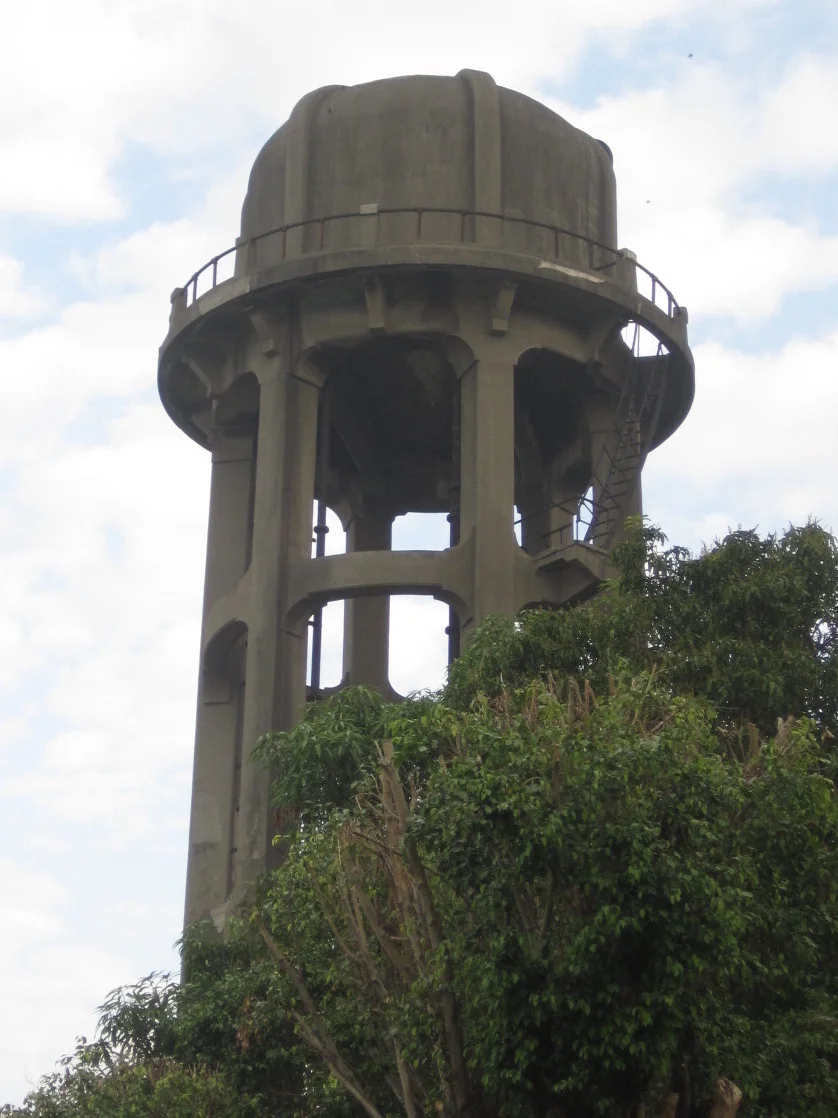
Gangshan Water Tower
Running water is easy to take for granted until you consider how recently it became ordinary. In the 1920s, Gangshan Street was the beating economic heart of its district — a meeting place for traders, a node in southern Taiwan's commercial network — and the people who gathered there needed reliable water. The solution came in phases: first an aqueduct completed in 1926, drawing on Qing-dynasty canal-building traditions; then, as the district grew and the original system proved too small, a tower completed in April 1938. That tower still stands, thirty-four years after it was finally turned off, a relic of the colonial infrastructure project that made modern Gangshan possible.
Gangshan Street and the Logic of Water
During Taiwan's Japanese colonial period, Gangshan District's main commercial corridor was one of those places where the business of the surrounding region converged. Merchants, traders, and residents gathered on Gangshan Street, and where people gather in numbers, water systems follow. The colonial administration's approach to municipal infrastructure in Taiwan was systematic — railways, roads, water systems, and electrical grids were built with the efficiency and ambition of an industrial power trying to demonstrate its capacity to govern. Gangshan's water supply was part of this broader project. The 1925-1926 Gangshan Aqueduct drew on design principles from the Qing dynasty canal tradition while incorporating modern purification technology, a characteristic hybrid of old and new methods that appears throughout infrastructure built in Taiwan during the transition between Chinese and Japanese administration.
The Tower That Replaced What Wasn't Enough
By 1929, the Gangshan Aqueduct's limitations had become clear. A growing town demands more water than a growing town anticipated, and expansion was necessary. Work began that year, but the tower itself took nearly a decade of planning and construction to complete, finally entering service in April 1938. Water towers of this period were functional monuments as much as engineering structures — they needed to hold enough water at sufficient height to create pressure throughout the distribution network, and they needed to last. The Gangshan Water Tower fulfilled both requirements with apparent thoroughness: it supplied water to the district for fifty-four years, from 1938 until its decommissioning in 1992. For more than half a century, the tower was as much a part of daily life in Gangshan as the street it overlooked.
A Structure That Outlasted Its Purpose
When the Gangshan Water Tower went out of service in 1992, it joined a category of structures that cities must decide what to do with: things built to do a specific job that are too substantial, too old, or too interesting to simply demolish. The tower has been recognized by heritage authorities — the Bureau of Cultural Affairs of Kaohsiung City Government listed it as a historic site — and it remains standing in the district as a preserved artifact of the colonial infrastructure era. Preservation of water towers is less common than preservation of railway stations or government buildings, partly because their function is so utilitarian that it can be hard to make the case for their cultural significance. The Gangshan Water Tower makes the case by virtue of simple survival: it is what it was, still standing where it stood.
Architecture of Utility
Water towers from the Japanese colonial period in Taiwan tend toward a particular functional aesthetic — cylindrical or slightly tapered forms in reinforced concrete or brick, built to specifications rather than to impress. The Gangshan Water Tower fits this profile. Its visual interest comes less from ornament than from the quality of survival itself: concrete that has weathered subtropical humidity and decades of disuse, textures and staining that accumulate on structures left standing after their primary purpose is gone. Colonial-era infrastructure in Taiwan occupies a complicated historical position — it was built in service of an imperial project that involved the displacement and marginalization of existing communities, and at the same time it created lasting physical systems that the island's residents continued to depend on long after the colonial period ended. The water tower holds both of those truths.
Visiting Gangshan Today
Gangshan District is in the northern part of Kaohsiung, roughly 20 kilometers north of the city center, and the water tower is accessible on foot from Gangshan Station, which serves both the Taiwan Railway network and the Kaohsiung Metro. The district retains some of the character of a secondary commercial center — smaller-scale, less polished than downtown Kaohsiung — and the water tower sits within this context rather than dominating it. Coming from the station, a short walk northwest brings you to the site. The tower doesn't announce itself dramatically; it is an old structure in a working neighborhood, preserved but not particularly displayed. That quality is part of what makes it worth finding.
From the Air
The Gangshan Water Tower is located at approximately 22.798°N, 120.296°E in Gangshan District, northern Kaohsiung. From the air, Gangshan is the flat urban district visible north of the larger Kaohsiung metropolitan area, approximately 20 km north of Kaohsiung Harbor. The water tower is not prominently visible from cruising altitude but can be identified at lower altitudes in clear conditions; Gangshan Station is a useful reference landmark for locating the area. Nearest airport is Kaohsiung International (RCKH), approximately 18 km to the south-southeast. The flat agricultural plain surrounding Gangshan District is visible from flight paths approaching RCKH from the north, with the tower sitting near the station at the district's commercial core.
Nearby Stories
- Huang Family Historical Residence 3.1 km away
- Taivoan Language 9 km away
- Zhiben Hot Spring 12 km away
- Bunun Cultural Museum 26 km away
- Dongji Island 33 km away
- South Penghu Marine National Park 58 km away
- Orchid Island 79 km away
- Hong Kong 12 550 km away