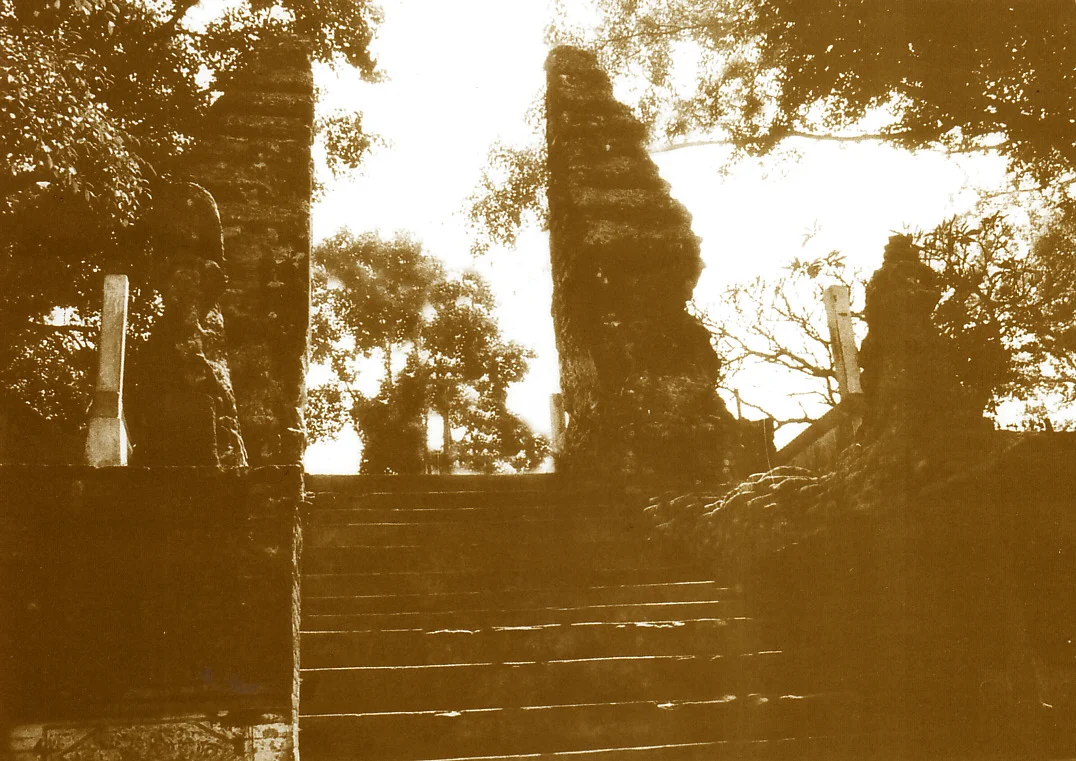

Giri Kedaton: Java's Pope on the Hilltop
No sultan in Java could sit on his throne until a man on a hilltop in Gresik said so. For more than 150 years, from the late fifteenth century into the early seventeenth, the rulers of Giri Kedaton held a form of power that no army could easily replicate: the authority to legitimize kings. Prospective sultans from Demak, Pajang, and early Mataram all made the journey to this small principality perched in the hills above the Java Sea coast, seeking the blessing of Sunan Giri before they dared call themselves sovereign. Historians have compared the arrangement to the relationship between medieval European monarchs and the Pope in Rome - except that this particular pope governed from a modest hilltop settlement rather than a vast basilica, and his authority rested not on institutional bureaucracy but on the personal sanctity of a single spiritual lineage.
A Handful of Earth
Giri Kedaton's founding story belongs as much to legend as to history, but the outlines are traceable. Its founder was Sunan Giri, born Joko Samudro, a member of the Walisongo - the nine saints credited with spreading Islam across Java. He studied under Sunan Ampel, who gave him the title Raden Paku and sent him to continue his education in Pasai and then in Mecca. In Mecca, Raden Paku met his father, Maulana Ishaq, who taught him political science and gave him a handful of earth. The instruction was specific: find a place whose soil matches this sample, and build your seat of power there. Returning to Java, Raden Paku searched the mountains around Gresik, moving from peak to peak in a prolonged ritual of spiritual seeking. According to tradition, he saw a beam of light during midnight prayers on Mount Petukangan, falling on a ridge between that mountain and a place called Sumber. In 1481, he founded Giri Kedaton on that spot.
The Kingmaker's Golden Age
Under the leadership of Sunan Prapen, who ruled from 1548 to 1605, Giri Kedaton reached its apex. Sunan Prapen did not command large armies or control trade routes. His power was softer and, in some ways, more consequential: he was the man who crowned kings. When Sultan Adiwijaya became the first Sultan of Pajang, Sunan Prapen reportedly presided over the inauguration. In 1568, he mediated a meeting between Adiwijaya and the regents of East Java, who agreed to recognize Pajang's authority as a continuation of the Demak Sultanate. When war broke out between Panembahan Senopati of Mataram and Jayalengkara, the regent of Surabaya, in 1588, Sunan Prapen brokered the peace. His presence at the coronation of Muslim kings across the archipelago was considered essential - not a courtesy but a requirement. Javanese society at that time held that legitimate power descended from God, and the Sunan of Giri was the closest available intermediary.
The Conquest That Required a Genealogy
The arrangement could not last forever. By 1630, Sultan Agung of the Mataram Sultanate had unified much of Java under his rule and wanted Giri Kedaton to submit as a vassal. Sunan Kawis Guwa, then leading Giri, refused. What followed revealed the depth of Giri's spiritual authority: not a single Mataram officer was willing to march against the principality. The soldiers were still terrified of the holiness associated with the Walisongo, even though the council of nine saints no longer existed. Sultan Agung solved the problem with genealogy. He appointed his brother-in-law, Prince Pekik - a descendant of Sunan Ampel, who had been Sunan Giri's own teacher. The logic was precise: if the attacker could claim a line of spiritual descent superior to the defender's, the army's superstitious dread might dissolve. It worked. Mataram conquered Giri around 1636, and Sunan Kawis Guwa was permitted to continue as a subordinate ruler.
The Tomb on the Hill
After the conquest, Giri's prestige faded rapidly. The successors of Sunan Kawis Guwa no longer bore the title Sunan Giri; they were called Panembahan Ageng Giri instead, a diminished honorific that signaled their submission to Mataram. The spiritual authority that had once decided the fate of Javanese kingdoms became a local memory rather than a living political force. Yet the echo carried far - when the ruler of the Tanjungpura Kingdom in distant West Kalimantan converted to Islam, he adopted the title Panembahan Giri Kusuma, borrowing prestige from a principality that no longer wielded it. Today, the site of Giri Kedaton is the Sunan Giri Tomb complex in Gresik, where Sunan Giri, Sunan Prapen, and their family members are buried. Pilgrims still visit. The hilltop is quieter now than it was in the sixteenth century, when would-be sultans climbed it to receive the one thing their armies could not seize: legitimacy.
From the Air
Giri Kedaton's former site and the Sunan Giri Tomb complex sit at 7.17S, 112.63E in Gresik, East Java, on a hilltop approximately 20 km northwest of central Surabaya along the Java Sea coast. The nearest major airport is Juanda International (WARR/SUB), roughly 35 km to the southeast. Gresik's industrial waterfront and the Java Sea coastline provide visual orientation from altitude. The hilly terrain around the tomb complex contrasts with the flat coastal plain. Tropical monsoon climate with best visibility during dry season (May-October).
Nearby Stories
- The Gate That Outlasted Its Kingdom 6.7 km away
- Bengawan Solo: Java's River of Deep Time 11 km away
- Madura: Salt, Bulls, and the Island That Emptied Itself 14 km away
- Where Teak Meets Oil 30 km away
- HNLMS Kortenaer: A Destroyer's Last Two Minutes 42 km away
- The Kedopok War: When Probolinggo Rose Against Its Buyer 45 km away
- The Train Builders of Madiun 74 km away
- Forty Hours in the Masalembo Sea 209 km away