
Goathland
Goathland railway station did not need a set designer. The Victorian platform, the stone footbridge, the gas lamps, the painted ironwork above the booking office, all of it was already there, preserved by volunteers running the North Yorkshire Moors Railway. So when Warner Bros. needed a station from which Harry Potter could catch the Hogwarts Express to a wizarding village, they did not build Hogsmeade. They simply rented Goathland. The opening film shows Harry's first train pulling into a platform that real Yorkshire commuters had used a century earlier, before Beeching's cuts and a thirty-year gap and the volunteers who brought the line back from the dead.
Aidensfield Was Here
Before Harry Potter, Goathland was Aidensfield. From 1992 to 2010, ITV's Heartbeat ran 372 episodes set in a fictional 1960s Yorkshire village, and the production used Goathland as its standing exterior set. The Goathland Hotel pub became the Aidensfield Arms. The garage and funeral directors, the village shop, the moorland views, all of it appeared on screen week after week. The series became enormously popular, and Goathland became a tourist destination on the strength of it. After years of filming interior scenes inside the actual hotel, Yorkshire TV eventually built a replica of the bar in its Leeds studios, a measure of how essential the look of the real place had become to the fiction.
Good Land, or Goda's Land
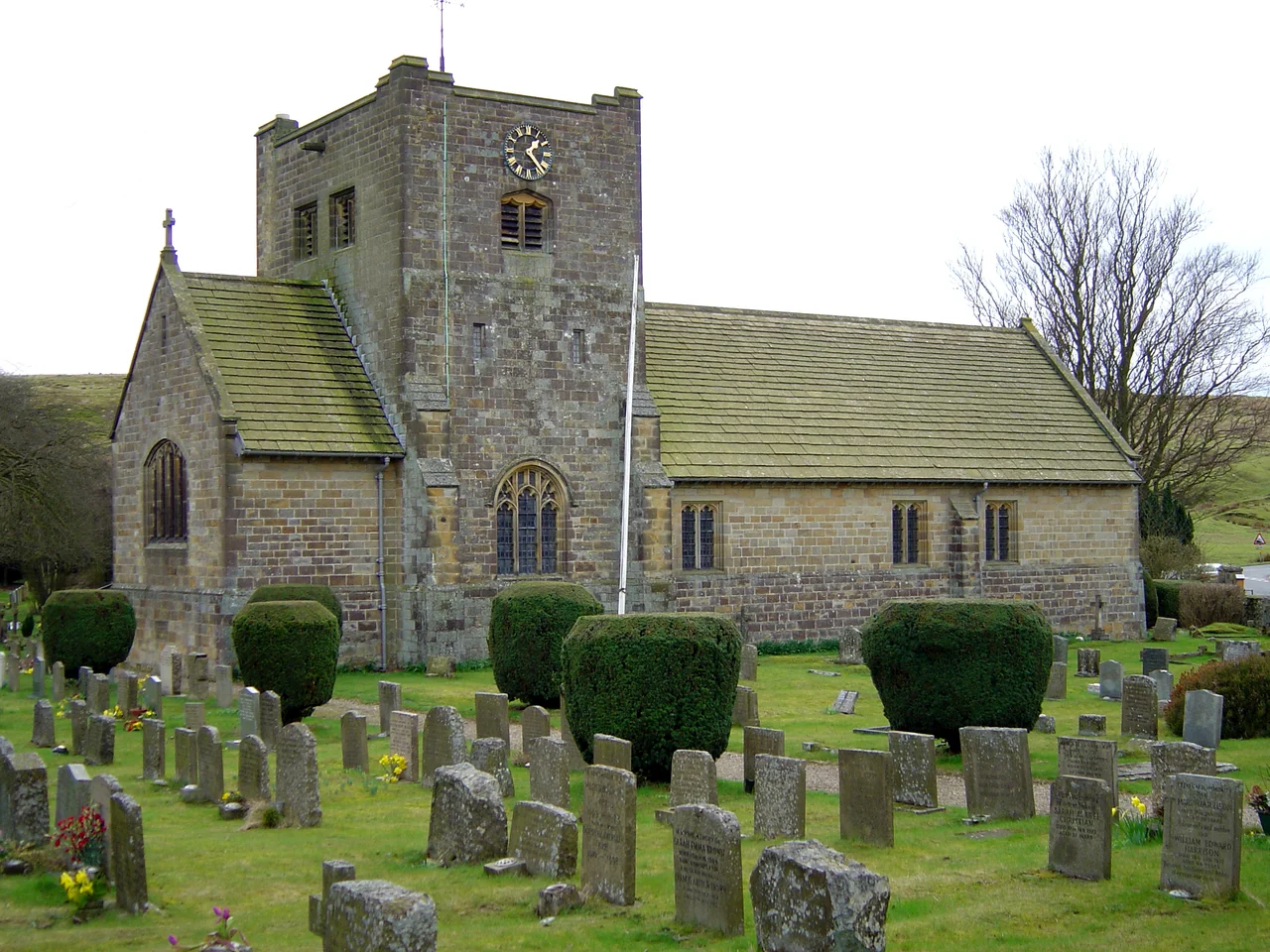
The village sits at 148 metres above sea level on a high shelf between Pickering and Whitby, in the North York Moors National Park. Its name is probably a corruption of good land, though it may instead derive from Goda, an Old English personal name, plus land. Either way the recorded history runs from just after the Norman Conquest, though Goathland was too obscure to make the Domesday Book in 1086. The village had a chapel by 1521 and a stone church by 1821. The current grade II* listed St Mary's was built between 1894 and 1896. Much of the surrounding moorland belongs to the Duchy of Lancaster, and its tenants have grazed black-faced sheep on the green and common by right for centuries. The sheep still wander the village street, indifferent to tourists.
Two Lives of a Railway
The Whitby and Pickering Railway opened in 1836, engineered by George Stephenson himself. The original line at Goathland used a rope-worked drum to haul carriages up a steep incline outside the village. In 1865 a diversionary route opened with a new station east of the village, retiring the rope. Regular passenger service ended in 1965 under the Beeching cuts. A charitable trust reopened the line as the North Yorkshire Moors Railway in 1973, and it is now the second-longest preserved line in Britain, carrying more than 250,000 passengers a year with mostly volunteer crews. Goathland station became Hogsmeade in the early 2000s, and the same platforms had earlier appeared in the 1995 film Carrington. The line links Pickering to Grosmont, with some services through-running to Whitby.
Plough Stots and Other Persistences
Every Plough Monday, the first Monday after Twelfth Night, the Goathland Plough Stots perform a Long Sword dance through the village and the surrounding area, raising money for local hospitals. The tradition is rooted in agricultural ritual, but the Stots have kept it alive as a living performance rather than a museum piece. The village has a primary school of 49 pupils, a volunteer library reopened in 2019 in the village hall, and a cricket club founded in 1874 that still plays in the Scarborough Beckett League. Mallyan Spout, a small waterfall named for a now demolished hotel, drops into the wooded valley below the village. Visitors arrive by Yorkshire Coastliner bus, by car, by steam train, and by the slow walk along old railway tracks now converted to footpath.
Flight Context
Goathland is at 54.40 N, 0.72 W on a high shelf of the North York Moors between Pickering to the south and Whitby on the coast. The village's stone houses and the open village green sit at 148 metres elevation, with the moors rising and falling around them. The North Yorkshire Moors Railway runs through Newton Dale just east of the village, and a steam plume on a clear day makes a useful landmark. Nearest airport is Teesside International (EGNV), about 30 miles north-west. The Yorkshire coast and the dramatic profile of Whitby Abbey ruins are about 8 miles north-east. Best viewing altitude is 2,500 to 4,000 feet AGL in good visibility, especially when steam is running.
From the Air
Goathland is at 54.40 N, 0.72 W on the high moors between Pickering and Whitby. Best viewed from 2,500-4,000 feet AGL. Teesside International (EGNV) about 30 NM north-west. Whitby Abbey ruins about 8 NM north-east on the coast. The North Yorkshire Moors Railway steam plume from Newton Dale is a clear marker on calm days.
Nearby Stories
- Battle of the Standard 5.1 km away
- Kirkham Priory 6.4 km away
- Ripon Cathedral 7.4 km away
- Burton Agnes Hall 9.7 km away
- Durham University Oriental Museum 16 km away
- Hartlepool 21 km away
- Filey Brigg 22 km away
- German submarine U-2367 43 km away