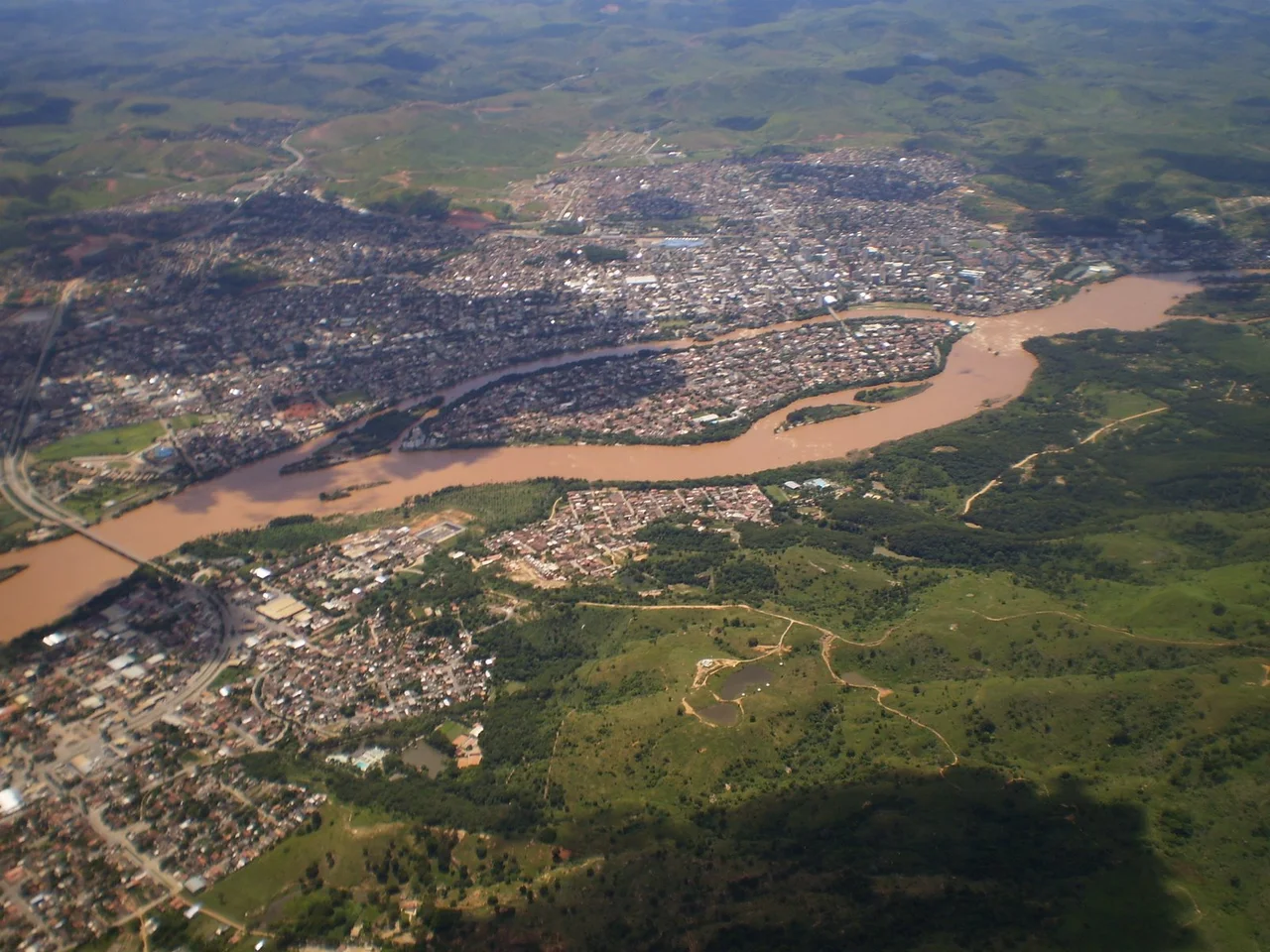

Governador Valadares, Minas Gerais
Fly over the Rio Doce valley and the hill rises almost absurdly out of the flat river plain: 1,123 meters of rock called Ibituruna, with paragliders drifting off its summit like seed fluff on an updraft. Below, a city of 281,000 people sprawls along the Doce River, and the peak is not separate from the city. It defines it. Governador Valadares hosts stages of the Brazilian hang gliding championship and has hosted multiple World Paragliding Championships at Ibituruna. Come for the thermals. Stay for the gems. The city is one of Brazil's major centers for the trade in amethyst, topaz, and a mineral, brazilianite, that is named after the country.
The Hill That Generates Flights
Ibituruna Peak is not tall by world-mountain standards. At 1,123 meters above sea level, it barely registers against the Andes or the Rockies. But the physics of paragliding care about relative height and thermal geometry, and Ibituruna, standing alone above the flat expanse of the Rio Doce valley, generates both in combinations that pilots travel from five continents to experience. The peak is a launch ramp to an open valley. Hot air rises from the sun-heated plain; cool air spills off the hill. The resulting thermals can lift a pilot thousands of meters and carry them tens of kilometers before landing. When the World Paragliding Championships were held here, pilots reported setting personal-best distances with routine frequency. For the city below, all this looks like tiny colored wings circling overhead, most afternoons, most months of the year.
The Gems Beneath the Surface
The ancient rocks around Governador Valadares fractured and recrystallized in ways that produced pegmatites, coarse-grained granite bodies where trace elements concentrate into crystals large enough to cut. Mica and beryl are mined in the area. Gemstones come out of the region by the truckload: amethyst, chrysoberyl, topaz, quartz in many forms, and brazilianite, a rare yellow-green phosphate first described from a Minas Gerais pegmatite in 1944 and named for the country. The Golconda mine, one of the oldest in the municipality, still draws tourists and stone collectors from around the world — collectors who come specifically to hold and sometimes buy specimens at the Brazil Gem Show, the annual trade event that brings Brazilian and foreign buyers to town. The gem trade made Governador Valadares a commercial center long before paragliding gave it a sporting one.
Valadares to Framingham
Read Governador Valadares's list of sister cities and a pattern appears: Framingham, Massachusetts. Everett, Massachusetts. Newark, New Jersey. Bridgeport, Connecticut. These are not tourist exchanges. From the 1960s onward, Valadares became one of Brazil's most significant sources of migrants to the United States, and particularly to Massachusetts. The out-migration was economic, driven by decades of slow growth in the local economy and the difficulty of supporting large families on the mineral and agricultural trades. It became self-perpetuating: the families of Valadares had cousins in Framingham, cousins who had houses and jobs and could sponsor new arrivals. Spiegel and Global Post have both documented the journey, sometimes dangerous and usually undocumented, that carried Valadarenses north. The remittances came back. Houses got built. Walk through certain Valadares neighborhoods and you can identify the homes built with American money. The sister-city formalities recognize a human migration that predated them by decades.
Rivers and Rails
The city sits where the Santo Antônio River joins the Rio Doce, and this confluence made it a settlement long before Brazilian independence. The Portuguese explorer Sebastião Fernandes Tourinho moved up the Doce in the 16th century looking for precious metals, and the Amerindian peoples who had lived along these rivers for at least 10,000 years began to be displaced, slowly and then catastrophically. The settlement that became Valadares started in 1755 as a military barrack, a tool for pushing indigenous residents off the land. The Figueira district, which corresponds to today's city, grew around the barracks. The railway arrived later. The Vitória-Minas line, today run by Vale, still carries ore from Minas Gerais to the Atlantic port at Vitória and remains a major employer in the valley. The BR-116 highway links the city north to Bahia and south to Rio de Janeiro; BR-381 runs west to Belo Horizonte. Governador Valadares is not on the way to one place. It is the crossing of several.
The Doce Disaster
The Rio Doce that flows through Governador Valadares is not the river it once was. In November 2015, the Fundão tailings dam operated by Samarco — a joint venture of Vale and BHP Billiton — collapsed near Mariana, upstream. An estimated 43 to 62 million cubic meters of iron-mining waste poured into the watershed, killing 19 people in the village of Bento Rodrigues and advancing down the Doce for weeks. Governador Valadares, 300 kilometers downstream, lost its public water supply. The mud arrived brown-orange, thick, and laden with heavy metals. The city trucked in water for days. The river's aquatic ecosystem collapsed almost entirely and is still recovering. The story of Valadares cannot be told without this chapter. It is in the water. It is in the memory.
From the Air
Located at 18.85°S, 41.95°W in eastern Minas Gerais, in the Rio Doce watershed. Governador Valadares Airport (SBGV) is a regional facility. The nearest major airport is Belo Horizonte's Confins International (SBCF), about 310 km west. Ibituruna Peak (1,123 m) is the defining landmark visible from cruising altitude, a solitary hill rising above the Doce River valley. Average annual high temperatures reach 40.7°C, among the hottest in Minas Gerais. Recognize the region by the broad Doce floodplain and the reddish scars of iron mining to the west.
Nearby Stories
- Ipanema Park 34 km away
- Serra dos Cocais 64 km away
- Piracicaba River (Minas Gerais) 64 km away
- Mutum, Minas Gerais 71 km away
- Malacacheta 88 km away
- Pico do Itambé State Park 89 km away
- Nanuque 149 km away
- Linhares 159 km away