
Ipanema Park
Ipatinga is a city built around steel. Usiminas - one of Brazil's largest steel manufacturers - shaped the town's population, its economy, and its skyline. In the 1970s, the company and the city administration looked at a strip of undeveloped land along the Ipanema stream and decided it should be a park instead of another industrial site. They hired Roberto Burle Marx - the landscape architect whose sinuous black-and-white waves paved Rio de Janeiro's Copacabana - to design it. The result took nearly twenty years to finish and now covers roughly one square kilometer of green space inside the city, making it one of the largest urban parks in Minas Gerais.
The Last Burle Marx
Roberto Burle Marx was 76 years old when he took on the Ipanema Park commission in 1985. He had already designed the landscape architecture that defined modern Brazil - the Flamengo Park in Rio, the Itamaraty Palace gardens in Brasília, Copacabana's wave-patterned promenade. Ipatinga's park would be among his last major projects; he died in 1994, and the park itself opened in phases through the 1990s. The earthworks had actually begun in 1980, before Burle Marx was involved, but his hiring transformed what would have been a civic lawn into a designed landscape - curving paths, deliberate planting, spatial composition. Some of what had been planted before his involvement was destroyed during the construction pause and had to be replanted. The final design emerged slowly, one expropriation at a time, as the city bought adjacent properties to complete the park's footprint through the 2000s.
Twelve Thousand Trees
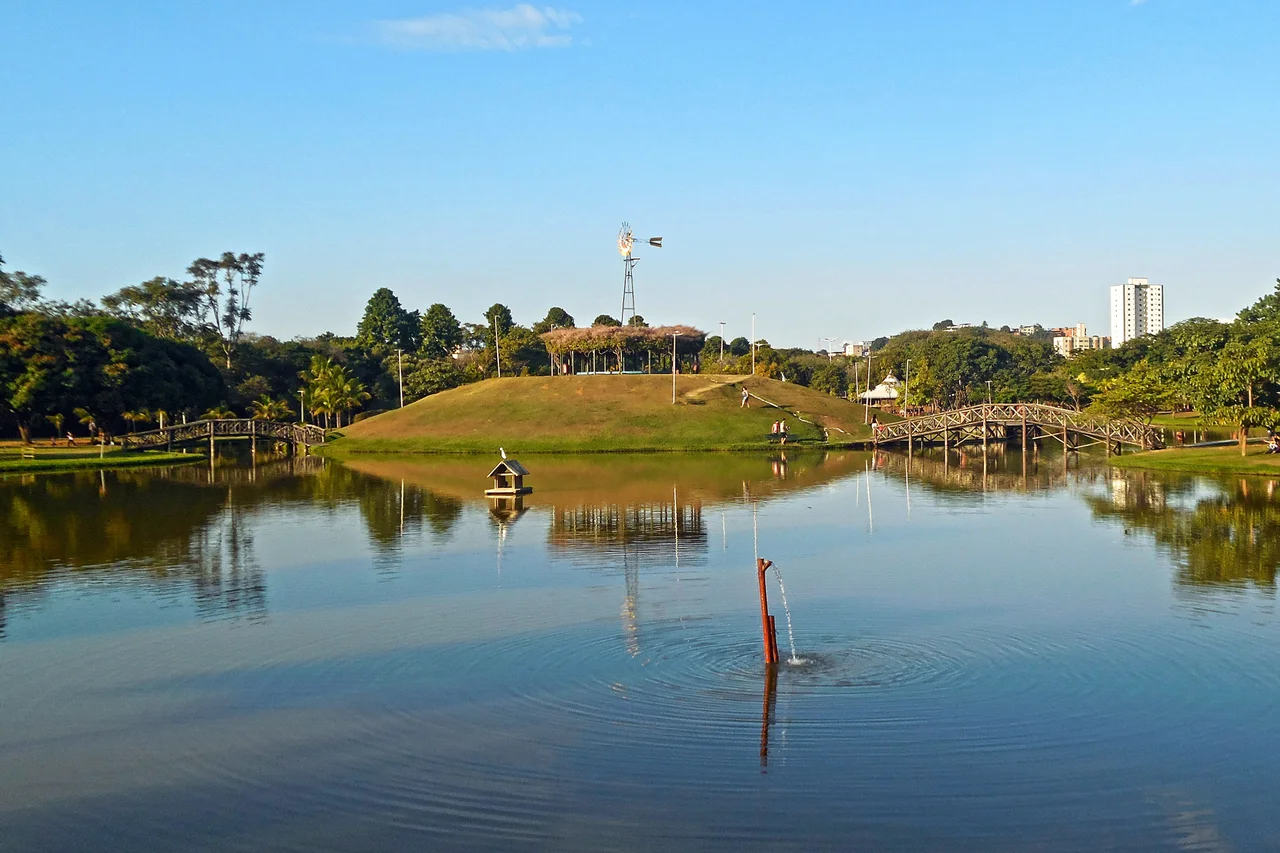
By 2013, city surveys counted approximately 12,000 trees planted across the park's one million square meters, representing about 60 species. Pink trumpet trees - *Handroanthus heptaphyllus*, known in Portuguese as *ipê rosa* - line some of the walking paths and turn whole sections of the park pink in spring. Palms cluster along the central lake. Fruit trees grow where Burle Marx wanted fruit trees, planned for shade and for feeding the birds. The park's 9,347-square-meter artificial lake runs parallel to the Ipanema stream, with a small raised island at its center where a weather vane stands, reached by two wooden walkways. Around the lake sit six food kiosks, each 386 square meters, inaugurated in 2019 after older informal food stalls were removed from a nearby avenue. That removal was controversial: 49 traders were evicted without immediate compensation, and the city justified it on cultural heritage grounds.
A Fittipaldi Connection
Inside the park sits the Emerson Fittipaldi International Karting Track - 1,200 meters of circuit named after the Brazilian Formula One champion. In 1985, a round of the Brazilian Karting Championship drew 40,000 spectators to the stands and the surrounding grass. In 2004 the track was renovated to meet the specifications of the International Automobile Federation, earning the designation of international kart track. The Kart Club of Ipatinga, which runs the facility, is maintained entirely by volunteers. The same park also holds the 2.6-kilometer Caminho das Águas Railroad, a now-deactivated tourist line, and the Municipal Plant Nursery where fruit, ornamental, medicinal, and tree seedlings are grown and distributed to the public. The João Lamego Netto Municipal Stadium - known locally as Ipatingão - seats 23,000 and is the main stadium of the Vale do Aço metropolitan area.
The Calendar
The park is not just designed landscape; it is municipal living room. On 29 April, Ipatinga's birthday, the anniversary festivities fill the grounds - in 2019, as part of the city's 55th-anniversary celebrations, a five-and-a-half-meter steel "Eu Amo Ipatinga" sign (a gift from Usiminas and the São Francisco Xavier Foundation) was installed. New Year's Eve crowds gather here. During Holy Week, the Passion of Jesus is staged inside the park. In Christmas season, decorations go up, Santa's house opens, and Christmas cantatas take place in some years. On specific dates the lake opens for collective fishing. The Science Park occasionally hosts astronomy and science exhibits; in 2002 it received the Francisco de Assis Magalhães Gomes Scientific Dissemination Award. Schools bring children in organized visits throughout the year.
What the Park Is and Isn't
Ipanema Park was declared a municipal cultural heritage site in 2000, protecting Burle Marx's design and the mature tree cover from future development. It is maintained by the Ipatinga City Hall, which has real work to do: graffiti, damaged and occasionally burned garbage cans, broken lamp posts. Drug dealing and assaults on park visitors - including murders - have been reported. Bicycle traffic causes conflicts with pedestrians on shared paths. These are the problems of a working urban park in a working industrial city, not a curated garden in a tourist zone. What remains true is that a steel town in the Rio Doce valley chose to hire one of the greatest landscape architects in the Americas to design its public space, and it stuck with that decision through two decades of staggered construction. Twelve thousand trees are not an accident. They are a civic commitment, slowly paid.
From the Air
Located at 19.47°S, 42.54°W in Ipatinga, Minas Gerais, in the Rio Doce valley. The park covers approximately 1 square kilometer of green space visible against the industrial and residential grid of the surrounding city. Nearest airport: Usiminas Airport (SBIP) just a few kilometers away. Best flown in dry winter months (May-August). Recommended viewing altitude: 3,000-5,000 ft to see the park's lake, forested paths, and the kart track and stadium on the grounds.
Nearby Stories
- Santo Antônio do Rio Abaixo 22 km away
- Santa Bárbara, Minas Gerais 35 km away
- Vila Império 38 km away
- Feliciano Miguel Abdala Private Natural Heritage Reserve 39 km away
- Governador Valadares, Minas Gerais 69 km away
- Pico do Itambé State Park 85 km away
- Robert Quayle (1814 ship) 92 km away
- Rio Preto State Park 128 km away