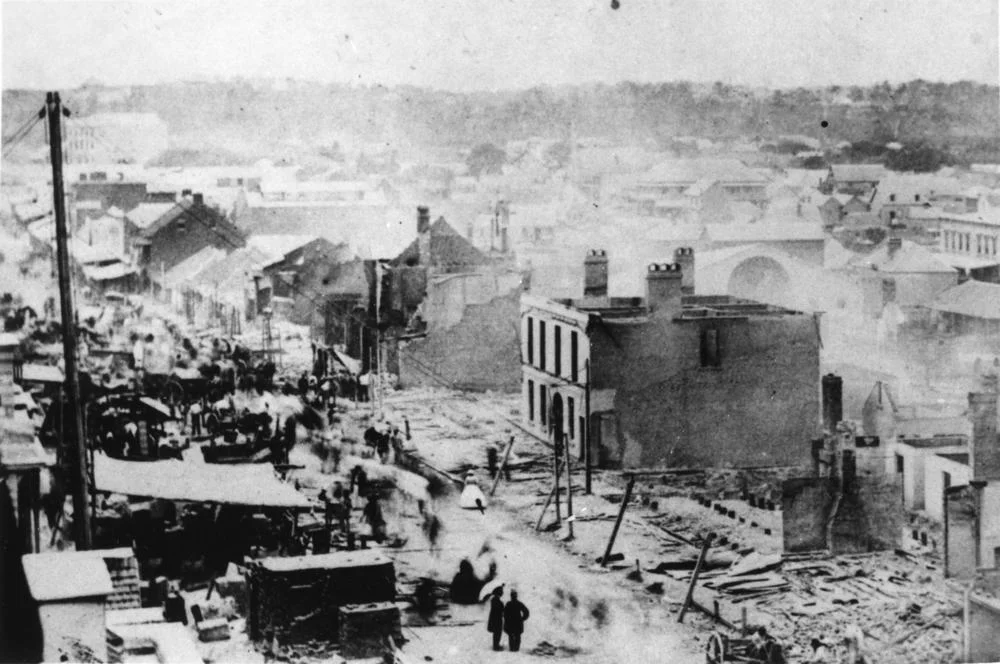

Great fire of Brisbane
It began in a cellar. At about 7:40 on the warm evening of 1 December 1864, fire took hold beneath Stewart and Hemmant's drapery, on the corner of Queen and Albert Streets in the small colonial town of Brisbane. By the time anyone forced the doors open, the inside was already 'one vast sheet of flame.' Brisbane in 1864 was a town built largely of timber, with little water to fight a blaze, and over the next few hours that fire ate the commercial heart of the place block by block. By the time it died, around fifty houses, two banks, three hotels and four draperies were gone, the damage reckoned at sixty thousand pounds. The remarkable thing is what the fire did not take. Not a single person died.
A Town Built to Burn
Brisbane should have seen it coming, because in a sense it already had. Twice that same year fire had run through Queen Street. In April, fourteen buildings burned out. In September, another fourteen went in a blaze that broke out at one in the morning before the Volunteer Fire Brigade beat it down within the hour. After the April fire, an anonymous resident had written to the Brisbane Town Council, urging it to fund a proper fire brigade. The warning was, apparently, ignored. The town kept building in wood, kept crowding its shops together, and kept relying on too little water and the goodwill of volunteers. The conditions for a catastrophe were all in place. It only needed a spark in the right cellar.
The Night the Street Burned
Word reached the police station and the fire bell rang out across town. Hundreds gathered to watch and to help, among them the governor, George Bowen, and the Catholic and Anglican bishops, Quinn and Tufnell, working alongside ordinary clergymen and magistrates. With Stewart and Hemmant's beyond saving, the volunteers turned to dragging stock from the buildings nearby, hauling out tobacco and cigars under the guard of soldiers. The fire moved faster than the men could. On the roof of Williams' Oyster Salon, two volunteers stayed at their work until the building gave way beneath them and dropped them into the flames. They were pulled out alive, though one of their party, Mr Cutbush, was badly hurt in the fall.
Holding the Line
Around half past eight the fire stalled briefly where brick and stone broke its path. Then a north-westerly wind picked it up and pushed it down Albert Street and into Elizabeth Street. The grander frontages of Queen Street get remembered, but it was in a cramped laneway off Albert Street, home to a great many poor families in small wooden houses, that the fire was most total. Every one of those houses was destroyed. Down at the Union Bank, volunteers emptied the vault of books, securities and bullion before the building itself burned. Across Queen Street, shopkeepers hung wet blankets and beat back the embers drifting their way, and that improvised line held.
What Stopped It
By half past eleven the fire reached the last building on Queen Street, the Bank of New South Wales, and consumed it. It was finally halted in George Street, where the demolition of a Mr Pillow's house starved the flames and saved the stone Registrar-General's Office behind it. A half-built structure on the corner of George and Queen survived for a telling reason: its contractor had cleared every scrap of timber from the site. In a town of wood, the absence of wood was salvation. In a few hours, the centre of Brisbane had been turned to ruin, yet for all that destruction the human cost was astonishingly light, just four people taken to hospital with injuries.
Rebuilt in Stone
Brisbane learned its lesson in the rebuilding. The new commercial centre rose in brick and stone rather than timber, a quietly transformative shift that began to give the town the more solid, permanent face a future capital would need. Reform of the firefighting itself came far more slowly. It was not until 1881, seventeen years after the great fire, that a Brisbane Fire Brigade Board was finally established. The first commander was appointed in 1882, and the city did not employ a single full-time fireman until 1889. The anonymous letter-writer of 1864 had been right all along. Brisbane simply took a generation, and one unforgettable night, to agree.
From the Air
The fire swept the original heart of Brisbane around 27.470 degrees south, 153.025 degrees east, in what is now the city's central business district along Queen, Albert, George and Elizabeth Streets, on the north bank of a tight bend in the Brisbane River. From the air today the site is a dense cluster of high-rise towers; the river loops around the CBD peninsula, and the modern Queen Street Mall traces the route of the 1864 blaze. The nearest major airport is Brisbane Airport (ICAO YBBN), about 12 kilometres to the north-east, with Archerfield Airport (YBAF) to the south. Best appreciated by day, when the gridded streets of the old town centre are clearly legible against the river's curve.
Nearby Stories
- Redcliffe Peninsula 2.7 km away
- Tamborine National Park 12 km away
- Cressbrook Homestead 27 km away
- Main Range National Park 31 km away
- 2010-2011 Queensland Floods 38 km away
- Cape Byron 96 km away
- Cape Byron Light 126 km away
- HMS Porpoise (1799) 588 km away