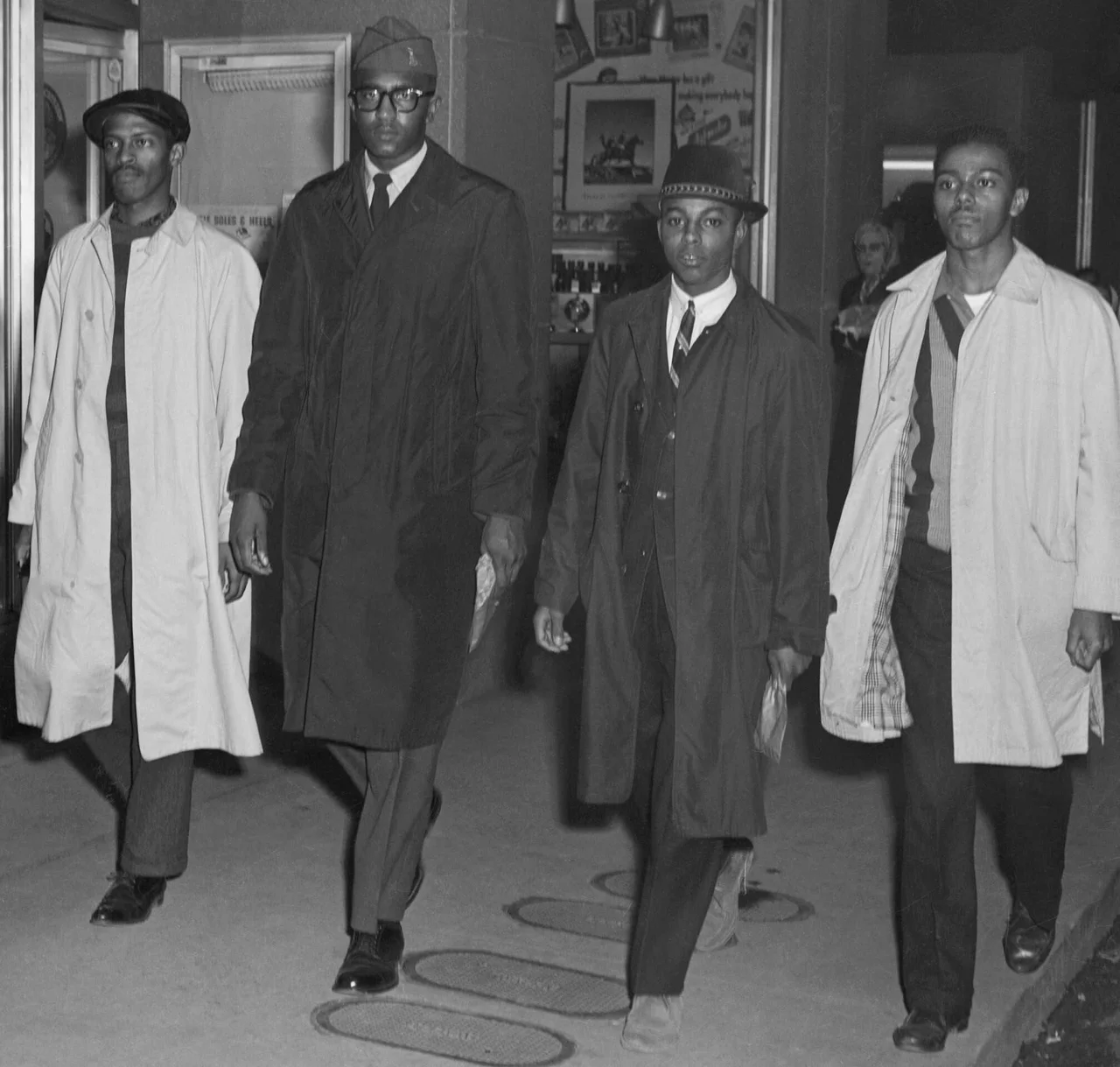

Greensboro sit-ins
At 4:30 in the afternoon on February 1, 1960, four freshmen from North Carolina Agricultural and Technical State University walked into the F.W. Woolworth's at 132 South Elm Street in downtown Greensboro. They bought toothpaste and a few other items from the regular counters - their money perfectly acceptable there. Then they sat down at the 66-seat L-shaped stainless-steel lunch counter and each asked for a cup of coffee and a donut with cream on the side. The waitress refused them, as Woolworth's policy required. They did not get up. Their names were Ezell Blair Jr. (who later took the name Jibreel Khazan), Franklin McCain, Joseph McNeil, and David Richmond. The country would come to know them as the Greensboro Four.
Dorm-Room Conversations
They had been talking about it for months in their dorm rooms at A&T. Joseph McNeil had been refused service trying to buy a hot dog at the Greensboro Greyhound bus station during Christmas vacation 1959 - a small humiliation that became the breaking point. Inspired by Martin Luther King Jr.'s teachings on nonviolent direct action, the four young men worked out a simple plan. They would sit at the local Woolworth's counter, ask to be served, accept the refusal, and stay until closing. They would come back the next day. They would keep coming back. And they would tell the press, because attention was the only currency they had. Earlier sit-ins existed - in Alexandria in 1939, Chicago in 1942, Wichita and Oklahoma City in 1958 - but those had not broken through to national consciousness. Greensboro would.
February 2 Through February 6
On February 2, McNeil and McCain were joined by William Smith and Clarence Henderson, and by the end of the day more than twenty Black students - four of them women - had taken seats at the counter. Reporters and a TV cameraman showed up. By February 3, the count had grown to more than 60, with students from Dudley High School and from Bennett College, the historically Black women's college a few blocks away. Roughly a third of the protesters were women, many of them Bennett students. North Carolina's official Klan chaplain George Dorsett and other Klansmen showed up to glare. Three white women from the nearby Woman's College of UNC - Genie Seaman, Marilyn Lott, and Ann Dearsley - joined the protest on February 4. By February 5, white men were taking counter seats to block the protesters; police arrested three white patrons for harassment. On Saturday, February 6, over 1,400 A&T students met in Harrison Auditorium on campus and voted to continue. They filled the Woolworth's by noon. A bomb threat called in around 1 p.m. emptied both Woolworth's and the Kress store nearby.
The Spread
Within two weeks the sit-in movement was in Winston-Salem, Durham, Raleigh, Charlotte. Within a month it had reached Richmond, Lexington Kentucky, and Nashville, where students trained by James Lawson conducted some of the most disciplined sit-ins of the movement and desegregated downtown Nashville lunch counters by May 1960. In Jackson, Mississippi, on May 28, 1960, Tougaloo College students sat down at a Woolworth's there and were assaulted by a mob, an incident the young Anne Moody would later describe in Coming of Age in Mississippi. The Greensboro action also catalyzed the formation of the Student Nonviolent Coordinating Committee - SNCC - which would carry the work forward through Freedom Summer and beyond. By summer 1960, roughly 70,000 people had participated in sit-ins across the South. President Eisenhower expressed his sympathy on March 16, 1960. Sales at boycotted Greensboro stores dropped by a third.
Four Workers Order Lunch
The Greensboro Woolworth's quietly desegregated its lunch counter on July 25, 1960, almost six months after McNeil sat down. The first people served were four Black Woolworth employees - Geneva Tisdale and her colleagues - who had changed out of their work clothes and ordered a meal at the counter. There was no press release. The Civil Rights Act of 1964 would later make desegregation in public accommodations the law of the land. Geneva Tisdale kept working at that Woolworth's. When the store closed for good in 1993, she was the last remaining employee who had been working there on February 1, 1960. She had been on shift the day the Greensboro Four sat down. She had been there the day Black customers were finally served. She had been there for everything in between.
What Remains
The Greensboro Woolworth's building still stands at 132 South Elm Street. It is now the International Civil Rights Center and Museum, opened in 2010, which preserves the original lunch counter where the Greensboro Four sat. A four-seat section was acquired by the Smithsonian in 1993 and is displayed at the National Museum of American History; a six-seat section sits in the Greensboro History Museum. The street south of the original Woolworth's was renamed February One Place in 1990. In 2002, the February One monument by sculptor James Barnhill went up on the A&T campus, showing the four young men walking toward the camera. In April 2022, the Guilford County Board of Education renamed the Middle College at N.C. A&T as the A&T Four Middle College. Their names are still spoken first in any history of the civil rights movement that takes the late 1950s seriously: McNeil, McCain, Blair (Khazan), Richmond. Four eighteen-year-olds. One Woolworth's counter. Everything else.
From the Air
Coordinates 36.0717 N, 79.7927 W, elevation about 880 feet, at 132 South Elm Street in downtown Greensboro. The International Civil Rights Center and Museum building - the original Woolworth's - sits on the western edge of the downtown grid; the brick storefront is easily picked out from low altitude. NC A&T's campus, where the Greensboro Four lived and where the A&T Four Middle College now operates, lies 1.5 nm east. Piedmont Triad International (KGSO/PTI) is 11 nm west; Smith Reynolds (KINT) sits 22 nm west-southwest in Winston-Salem. Greensboro's regional VFR pattern altitude is typically 2,500 feet MSL. The site is inside the Class C ring around PTI; flight following recommended.
Nearby Stories
- Smith Reynolds Airport 6 km away
- Occoneechee Speedway 6.2 km away
- Hanging Rock State Park 9.8 km away
- 2014 Dan River Coal Ash Spill 14 km away
- Silver Hill Mine 18 km away
- Cary, North Carolina 29 km away
- North Carolina Aviation Museum 33 km away
- Staunton River State Park 51 km away