
Guilford County, North Carolina
The county is named for a man who never visited it. Francis North, the second Earl of Guilford and father of British Prime Minister Frederick North, lent his title to this stretch of central North Carolina in 1771, just five years before the colonies he had administered from afar declared their independence. The history that piled up on his nominal county turned out to be far more rebellious than its English name suggests. Battle of Guilford Courthouse. Underground Railroad with one of the country's most active Quaker abolitionists at its head. The first women's college funded by a state. The first Black land-grant college in North Carolina. The lunch counter sit-in that ignited a movement. Guilford County, population 541,299 at the 2020 census, has spent two and a half centuries refusing to be quiet.
Quakers, Lutherans, and the First Settlements
Before the English settlers came, the Siouan-speaking Cheraw lived in this part of the Piedmont. Beginning in the 1740s, three waves of European migration redrew the map: American Quakers from Pennsylvania, Maryland, and New England arrived at what would become Greensboro; German Reformed and Lutheran settlers took the east; Scotch-Irish Presbyterians pressed into the center. The county was organized in 1771 from parts of Rowan and Orange counties. Friedens Church, whose name means 'peace' in German, was established by Rev. John Ulrich Giesendanner's congregation in 1740 and built its first log structure in 1745. The Quakers' New Garden Friends Meeting, founded in 1754, still operates in Greensboro. Alamance Presbyterian Church, built as a log structure in 1762, has hosted eighteen pastors on the same site. The earliest layers of settlement still preach on Sunday mornings.
Cornwallis Bleeds Here
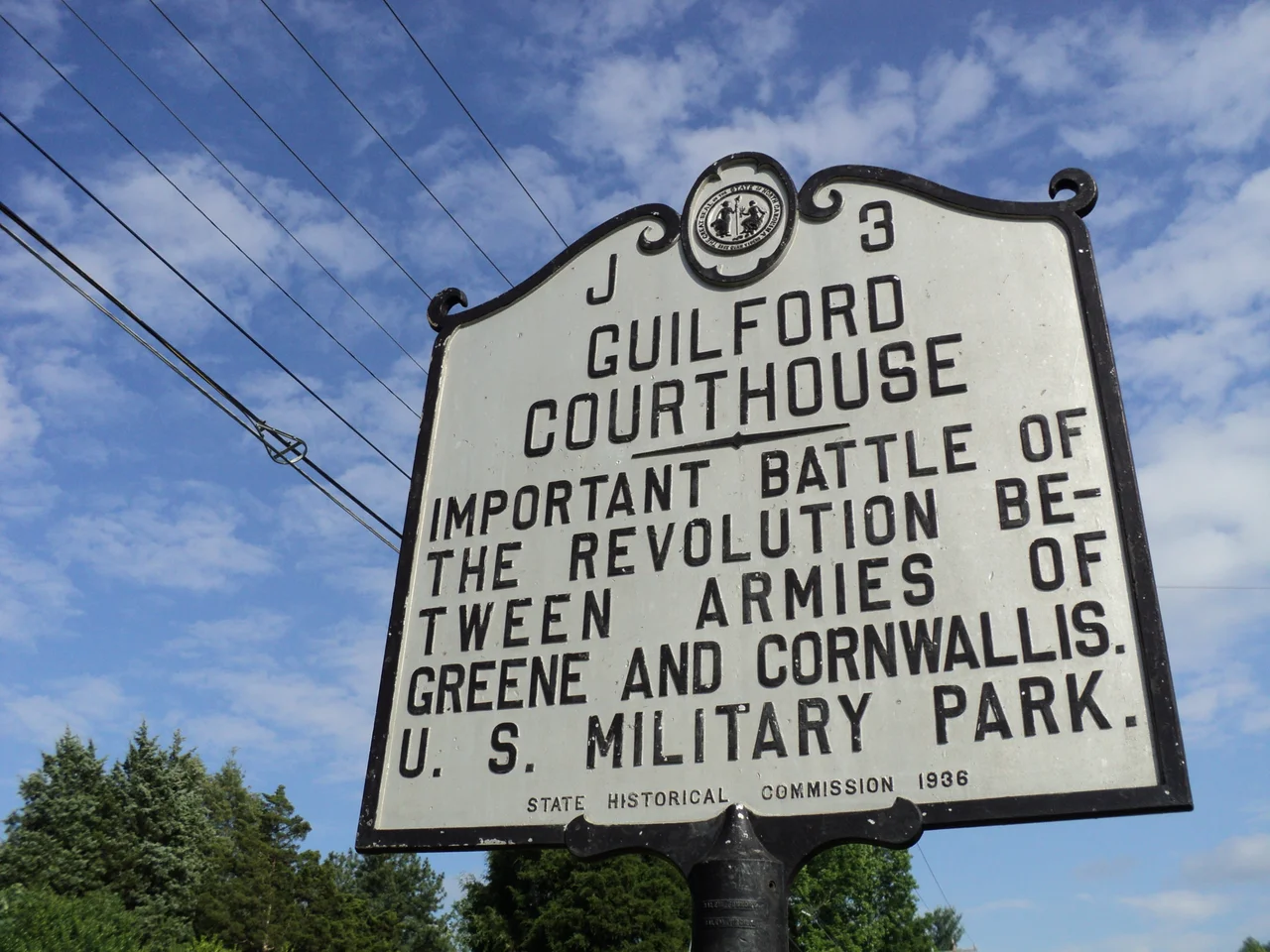
On March 15, 1781 the Battle of Guilford Court House was fought just north of present-day Greensboro between British General Charles Cornwallis and American General Nathanael Greene. Cornwallis held the field at the end of the day - a technical victory - but his army had been so badly mauled that he had to withdraw to the Carolina coast to refit. From there he was drawn north into Virginia and finally trapped at Yorktown, where he surrendered to American and French forces on October 19, 1781. The battle had turned the war. The Quaker Whig David Schenck began preserving the battlefield in 1886; the federal government took it over in 1917 as Guilford Courthouse National Military Park. In 1808, the town of Greensboro replaced the older hamlet of Guilford Court House as the county seat because Greensboro was easier to reach by road.
Levi Coffin and the Underground Railroad
Many Guilford County residents in the antebellum era opposed slavery: Quakers, Lutherans, Methodists. The county became a key stop on the Underground Railroad - the network of safe houses and guides that helped enslaved people reach freedom in the North. Levi Coffin, born in Guilford County in 1798, is credited with personally helping more than 2,000 enslaved people escape before the Civil War. He earned the nickname 'President of the Underground Railroad.' Coffin grew up in the Quaker community around New Garden, where the meeting's longstanding anti-slavery testimony shaped his entire moral education. He moved west to Indiana and later Cincinnati to do most of his work, but the conscience that drove him was forged in Guilford County. Guilford College, founded in 1837 as the New Garden Boarding School, is the third-oldest coeducational institution in the country and the oldest in the South - another product of the same Quaker community.
Two Colleges, One Year
In 1891, Greensboro became simultaneously the home of two institutions that would define American higher education's expansion. North Carolina A&T - then the Agricultural and Mechanical College for the Colored Race - became the second land-grant college established under the Second Morrill Act of 1890 and the first state-supported college for Black students in North Carolina. The State Normal and Industrial School - now the University of North Carolina at Greensboro - opened the same year as the state's first publicly supported college for women. From the 1930s through the 1960s, the Woman's College of UNC was the third-largest women's university in the world. In 1873, Bennett College had already been founded as a coed school for African Americans and became women-only in 1926. Guilford County also hosted Immanuel Lutheran College for Black students from 1905 until 1961. The county had become one of the most densely educated small geographies in the American South.
February 1, 1960
The defining day in Guilford County's modern history came at 4:30 in the afternoon on February 1, 1960, when four NC A&T freshmen - Ezell Blair Jr. (Jibreel Khazan), Franklin McCain, Joseph McNeil, and David Richmond - sat at the F.W. Woolworth's lunch counter in downtown Greensboro and asked for coffee. Refused service, they stayed until closing. They returned the next day with more students. Within weeks, the sit-in movement had spread to 54 cities in nine states. White students from the Woman's College joined the protest by the third day. Bennett College women filled out the line. Woolworth's eventually integrated. The Civil Rights Act of 1964 made the principle law. Greensboro's quiet conscience - Quaker, Lutheran, Methodist, abolitionist, suffragist, civil rights - had produced one more decisive intervention in the long American argument about who belongs at the counter.
Greensboro Massacre and Modern County
Not all of Guilford County's twentieth-century history was triumphant. On November 3, 1979, a march protesting the Ku Klux Klan and other white-supremacist groups in southeastern Greensboro was attacked by Klan and American Nazi Party members. Five marchers from the Communist Workers Party were killed and seven wounded. In 1980, an all-white jury acquitted the six shooter defendants. A 1985 civil case finally won damages against the city police and other officials for failing to protect the marchers. The episode is remembered as the Greensboro massacre and remains a wound the city has worked to address through truth-and-reconciliation processes. Today Guilford County is a 657-square-mile bellwether - it has voted for the winner of every presidential election since 1928 except four - anchored by Greensboro, High Point, and a dense network of suburbs and small towns. The Piedmont Triad International Airport carries the region's commerce. The county's notable natives include broadcaster Edward R. Murrow, the short-story writer William Sydney Porter (O. Henry), abolitionist Levi Coffin, and First Lady Dolley Madison.
From the Air
The county centroid lies near 36.08 N, 79.79 W in the rolling Piedmont, with Greensboro (county seat) and High Point as anchor cities. Piedmont Triad International (KGSO/PTI), elevation 925 feet, sits in the county's western half and serves as the regional commercial airport - third busiest in North Carolina by aircraft movements. Smith Reynolds (KINT) at Winston-Salem is 22 nm west of Greensboro for general aviation diversions. Total county area is 657.63 square miles, mostly land. Major waterways visible from altitude include the Haw River along the eastern boundary and the Deep River draining the county's southwest. The Class C airspace around PTI dominates VFR transit through the county - flight following strongly recommended.
Nearby Stories
- Smith Reynolds Airport 6 km away
- Occoneechee Speedway 6.2 km away
- Hanging Rock State Park 9.8 km away
- 2014 Dan River Coal Ash Spill 14 km away
- Silver Hill Mine 18 km away
- Cary, North Carolina 29 km away
- North Carolina Aviation Museum 33 km away
- Staunton River State Park 51 km away