.jpg)
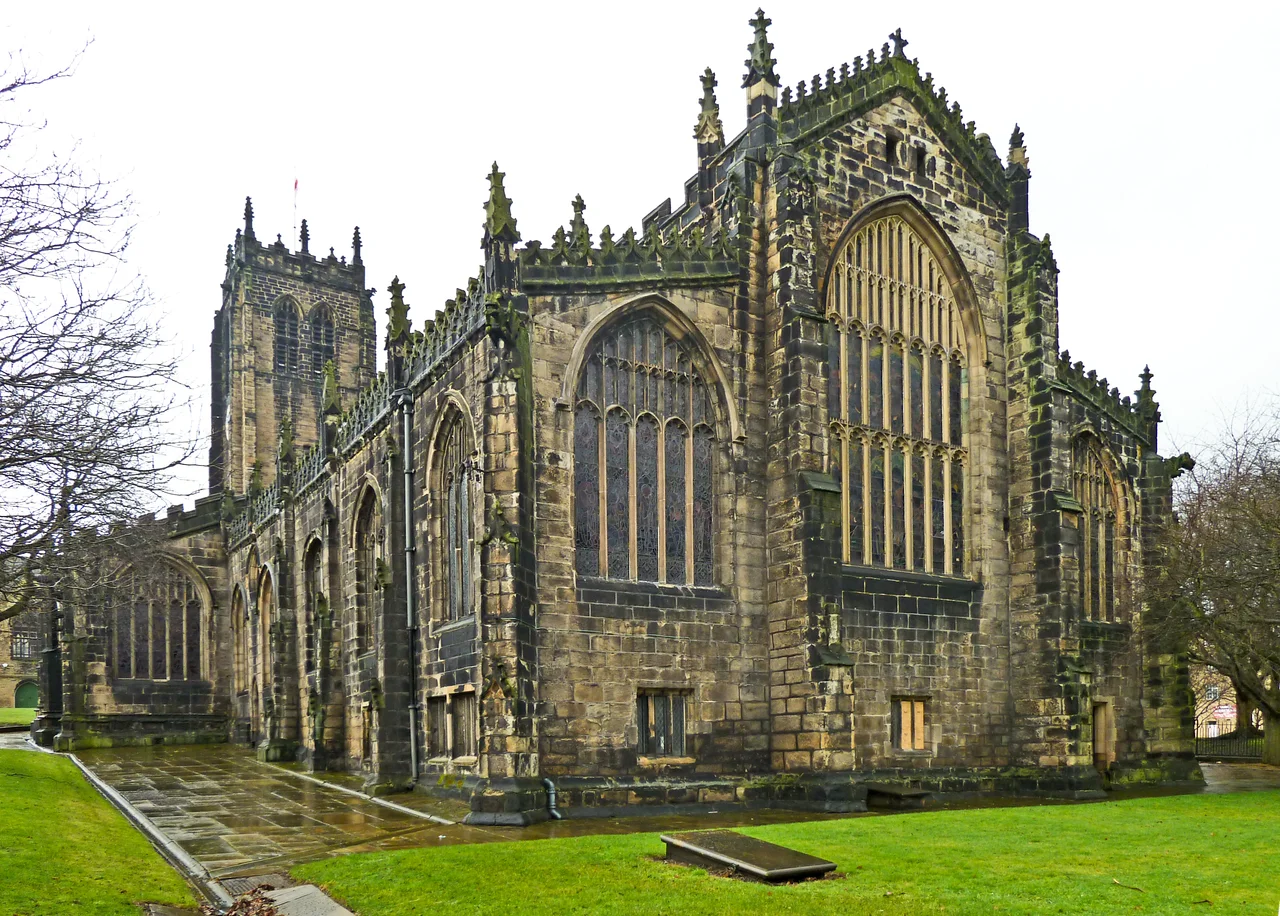
Halifax Minster
William Rokeby's heart and bowels are buried under the chapel he paid for. The rest of him lies elsewhere; his will was very specific. He had been a vicar of Halifax before climbing to become Archbishop of Dublin, and when he died around 1521 he wanted parts of himself returned to the church he had built. The Rokeby Chapel, completed around 1530 in the south aisle of Halifax Minster, contains those parts still. It is one of many odd, specific, beautifully preserved things about this church.
Norman Bones
The Minster stands on the site of an earlier Norman church thought to date from around 1120, which was owned and operated by the Cluniac monks of Lewes Priory. Some of that older stonework survives within the present building: carved chevron stones still visible in the north wall of the nave, and several early medieval grave covers. One section of the present north wall may actually have been the south wall of the Norman church, simply incorporated into the larger 15th-century rebuild. Work on the church tower began in the 1440s and dragged on for over three decades; it was still under construction in 1482. The Rokeby and Holdsworth Chapels, paid for by former vicars William Rokeby and Robert Holdsworth, were finished around 1530, the last major medieval addition before Henry VIII's reformation changed everything.
The Box Pews
Most of the Jacobean box pews in the nave date from 1633 to 1634, when wealthier parishioners paid to enclose their own private boxes for worship. A pew in the centre aisle still bears the remains of a memorial brass to John Waterhouse, who died in 1539 or 1540. Another carries the carved arms of Richard Sunderland of High Sunderland, who died in 1634. Several ancient pew nameplates are mounted on a board on the inner north wall of the tower. The oldest dates to 1615 and reads: "This stall made at the cost of Robert Fisher of Halifax." These boxes are unusually intact for an English parish church, partly because Halifax escaped the worst Victorian restorations that swept other churches clean of their post-Reformation furniture.
The Puritan Windows
The Puritans of 17th-century Halifax believed stained glass with its painted images was an abomination. During the Commonwealth, between 1649 and 1660, plain-glass leaded windows of a unique design were installed throughout the church, paid for by Dorothy Waterhouse. Most were later replaced with Victorian stained glass, but the survivors were carefully rebuilt in 1958. Today, five of these plain Commonwealth-era windows survive on the south side of the chancel, with one remaining on the north. A small portion of medieval stained glass also survives in the upper westernmost clerestory window, salvaged from other windows during a mid-19th-century reorganisation. The great east window, by George Hedgeland, was completed in 1856 and is based on the prize-winning stained-glass design from the Great Exhibition of 1851. It depicts the crucifixion and resurrection.
Gentleman Jack
Anne Lister, the 19th-century diarist whose 4-million-word coded journals chronicled her romances with other women and her management of the Shibden Hall estate, is buried in the Minster. Her tombstone has had a complicated history; for many years its exact location was uncertain, then mislaid, then rediscovered. Lister was a Halifax woman of immense determination who travelled across Europe, climbed mountains in the Pyrenees, and in 1834 took part in what she considered a marriage with Ann Walker, exchanging rings at Holy Trinity Church in York. The BBC series Gentleman Jack, written by Sally Wainwright, dramatised her life and brought renewed visitors to the Minster looking for her resting place. The church has handled this new attention with grace, recognising that the Anne Lister now drawing pilgrims would have surprised the Victorian vicars who buried her.
Font, Sedilia, and Snetzler
The medieval font cover is acknowledged to be one of the finest in England. The stone font bowl itself may also date from the 15th century or earlier. Before the 1879 restoration, traces of paint and gilding were still visible on both font and cover; the cover was originally designed to prevent thieves from stealing the baptismal water, which was believed to have curative powers. The 15th-century wooden sedilia in the sanctuary contain three misericords and may have been brought here from a nearby abbey, perhaps Kirkstall, after the dissolution. Six more 15th-century misericords, including a Green Man, sit under the chancel return stalls. The organ was built by John Snetzler in 1763 and installed in 1766, and although it has been enlarged repeatedly, a small amount of Snetzler's original pipework still sounds within the current instrument, rebuilt by Harrison and Harrison of Durham in 1928. The Minster was granted its honorific status on 23 November 2009, one of only three minsters in West Yorkshire.
From the Air
Halifax Minster sits at 53.72°N, 1.85°W in the centre of Halifax, West Yorkshire, with its 15th-century tower a clear landmark in the Calder Valley. Best viewed at 2,000-3,000 feet AGL; look for the dark stone tower close to the imposing Halifax Town Hall and the Piece Hall just to the south. Nearest airports: Leeds Bradford (EGNM) 12 nm east, Manchester (EGCC) 25 nm south, Doncaster Sheffield (EGCN) 35 nm east. The Pennines rise immediately to the west; Halifax sits in a dramatic bowl ringed by hills.
Nearby Stories
- Ribston Hall 1.5 km away
- Bolton Priory 3.5 km away
- Clifton Park and Museum 4 km away
- Blackburn 5 km away
- Nostell Priory 5.5 km away
- Mellor Mill 9.4 km away
- Warrington bombings 10 km away
- Ashton Memorial 23 km away