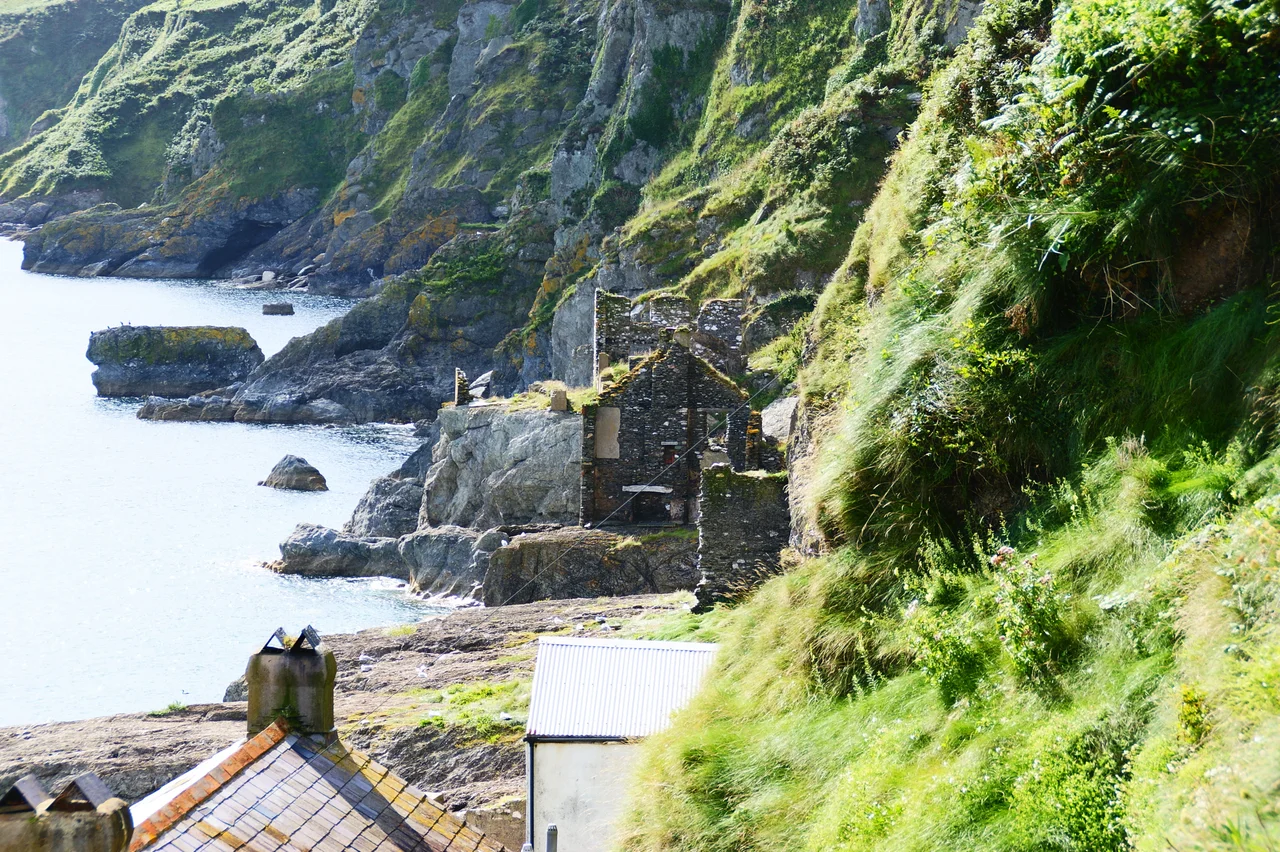

Hallsands
On a January night in 1917, while gales drove the English Channel against the south Devon coast, the people of Hallsands climbed onto the cliffs above their own houses and watched the sea finish what gravel contractors had begun two decades earlier. Walls came down. Waves crashed clean through roof rafters. By morning, of thirty-seven houses, only one was still habitable. No one died that night - the villagers got out in time - but a community that had fished the Skerries Bank for crab for more than three centuries was finished. They had warned the Board of Trade for years that this would happen. They had been told they were wrong.
Village on a Ledge
Hallsands sat on a rocky shelf between cliff and tideline on a stretch of coast between Beesands and Start Point, a precarious place from the beginning. A chapel had stood there since at least 1506, but few people seem to have lived on that ledge before 1600. The village grew through the 18th and 19th centuries as the crab fishery prospered. By the 1891 census there were 37 houses, a spring, a single public house called the London Inn, and 159 souls. They fished the Skerries Bank for crab and lobster; they brought in immense catches of pilchards. A sea wall and a wide bank of sand and shingle stood between their cottages and the Channel - not much by modern standards, but enough, for centuries, to break the worst seas before they reached the walls of home.
The Gravel and the Dockyard
In the early 1890s the Royal Navy decided to expand its dockyard at Keyham, on the Plymouth waterfront. The contractor needed enormous quantities of sand and shingle. They found it free for the taking, off the beach at Hallsands. The villagers protested almost immediately - first because the dredging would damage their crab pots and disturb the fish, then, more urgently, because they could see the shingle bank that protected their village steadily disappearing. The Board of Trade held a local inquiry. The inquiry concluded that dredging the beach would not significantly threaten the village. Dredging continued. The fishers were paid 125 pounds a year as compensation for the disturbance to their pots. Year after year the suction pipes pulled away the natural defence that had stood between the cottages and the storms of the open Channel.
The Night the Village Went
By 1917 the beach in front of Hallsands was meters lower than it had been when the dredging started. A combination of high spring tides and a winter gale on 26 January did what the villagers had spent twenty years predicting. Eyewitnesses afterwards described the sea coming tumbling in, shaking everything all to pieces - we became greatly alarmed. The gales rose; walls collapsed; waves went over the rafters of the houses. Families scrambled up the cliff in the dark with what they could carry. By daylight only one cottage remained inhabitable. Among those rescued from the sea that night was Ella Trout, a Hallsands fisherwoman who in September 1917 rowed out to a vessel that had struck a German mine off Start Point and helped rescue nine men - an act of bravery for which she later received the OBE. The villagers fought for years afterward for compensation from the government whose contractor had taken away their beach. It came, eventually, and grudgingly. The village itself was never rebuilt.
Ruins on a Living Coast
More than a century later the ruins are still there, slumped along the ledge above the surf, slowly being unbuilt by the same sea that took them. A few stone walls remain. Doorways open onto thin air. Coastal landslips around the site are still moving; in recent years a remaining clifftop house has been threatened by fresh slippage. South Devon's coast path passes a viewing platform above the village, and visitors come to look down at what is left. It is a particular kind of English ruin - not romantic and overgrown, but bare and recent, with the names of the families who lost their homes still on the memorial. Children born in Hallsands lived to see the place where their school used to stand fall, stone by stone, into the Channel.
An Echo in Song and Story
Writers have come to Hallsands since the village was still standing. John Masefield, who would become poet laureate, included a poem called Hall Sands in his 1903 Ballads, noting already that the land was beginning to slip and settle. William Oxley's The Hallsands Tragedy followed in 1993. The 1964 Michael Winner film The System filmed scenes among the ruins with Oliver Reed and Jane Merrow. In 2003 BBC Radio 4 broadcast David Gooderson's Death of a Village, drawn from contemporary records, that laid out clearly what the storm had only finished: the dredging was the cause. The opera Whirlwind, the play Silent Engine, songs by Harbottle and Jonas and Kaprekar's Constant - the village has had more attention in death than it ever did in life. It deserves, at minimum, to be remembered for what it was: a community of fishermen and women who knew the sea, knew their beach, and were told by their government not to worry.
From the Air
Hallsands sits at approximately 50.237 degrees N, 3.659 degrees W on the south Devon coast, on a rocky ledge between Beesands village to the north and Start Point lighthouse a short distance to the south. The ruins are visible from low altitude as a line of stone walls along the cliff edge. Start Point's white lighthouse on its dark headland is the main navigation reference, and the long shingle bank of Slapton Sands runs to the north - itself a fragile beach with its own erosion story. Nearest airports are Exeter (EGTE) about 30 miles to the north and the closed Plymouth City Airport (EGHQ) about 22 miles west. Cruise altitudes of 1,500-3,000 feet give the best views of the cliffs and the Skerries Bank just offshore. Expect frequent sea fog along this coast even in summer; the Channel weather changes fast.
Nearby Stories
- Dartington Hall 0.3 km away
- Eddystone Lighthouse 3.4 km away
- Cotehele 5.2 km away
- HMS Formidable (1898) 7.8 km away
- Lyme Bay Canoeing Disaster 34 km away
- HMS Affray 48 km away
- Casquets Lighthouses 61 km away
- Battle off Lizard Point 72 km away