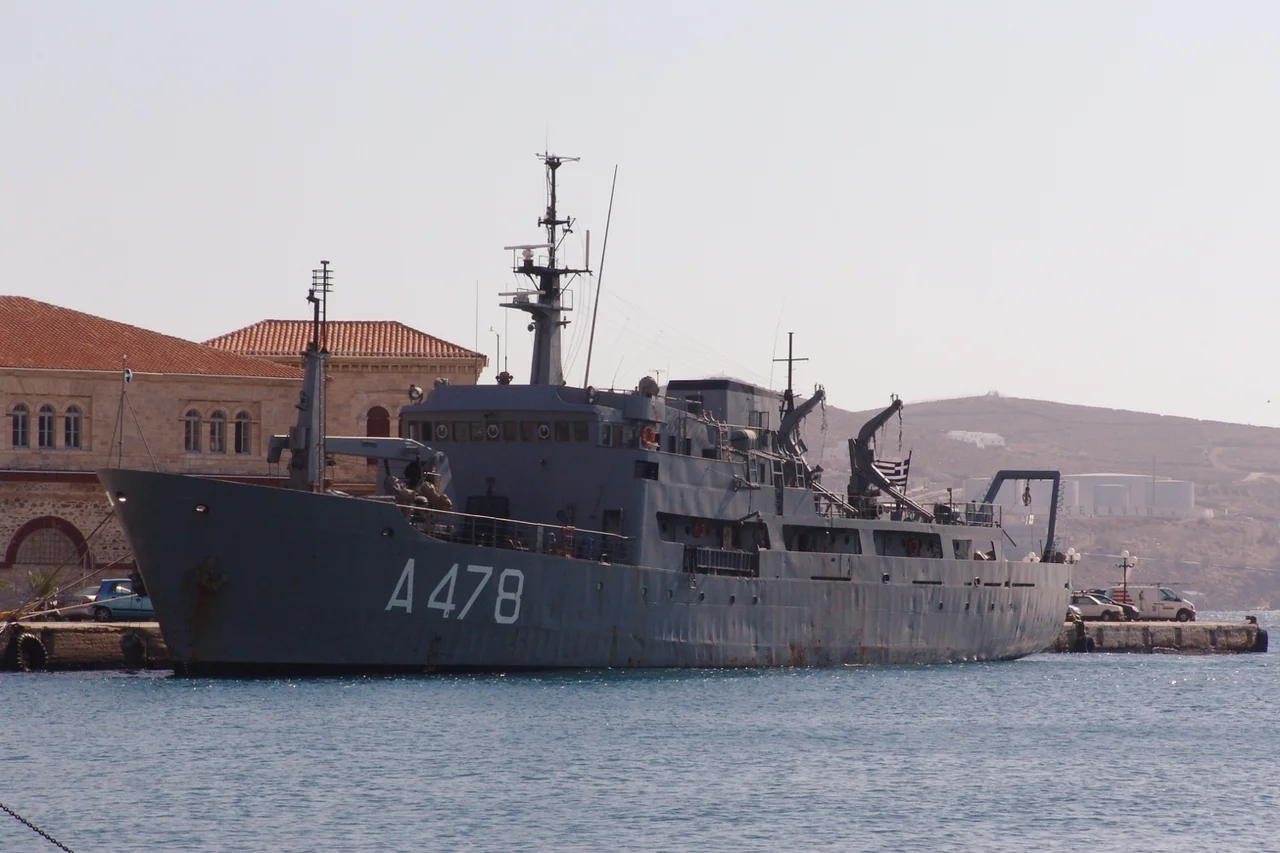

Hellenic Navy
Bolted to a frigate's deck on the Hellenic Navy flagship HS Psara are three reliquaries. Two hold the preserved hearts of admirals who fought the Ottomans for Greek independence, Konstantinos Kanaris and Andreas Miaoulis. The third holds the remains of Laskarina Bouboulina, a woman made a rear admiral two centuries after her death. No other modern navy carries its founders into battle quite so literally. But then no other navy traces its lineage to the wooden ships that turned back an empire at Salamis 2,500 years ago.
Mega to tes thalasses kratos
The motto of the Hellenic Navy is a line lifted straight from Thucydides, from the speech Pericles gave on the eve of the Peloponnesian War: "Mega to tes thalasses kratos," usually rendered as "the rule of the sea is a great matter." For Greece this has never been an abstraction. The country is a scatter of islands and a coastline measured in thousands of kilometers; whoever controls the water controls the nation. The modern navy was born not from a king's decree but from the merchant captains of Hydra, Spetses and Psara, who turned their armed trading ships against the Ottoman fleet during the War of Independence in the 1820s and gave Greece its first victories at sea.
From Sail to Steam
Independence won, the new fleet was modest and troubled. When the young King Otto arrived at Nafplion in 1832, the entire Greek navy amounted to a single corvette, three brigs, six schooners, two gunboats and a handful of smaller craft. The first naval school was founded in 1846 aboard the corvette Loudovikos, but for decades the fleet was caught between reformers who wanted modern ships and veterans loyal to the old ways of the revolution. Progress came in the 1850s, and in 1855 Greece ordered its first iron, propeller-driven steamships from England. The age of sail, which had won the country's freedom, was giving way to steam and steel.
The Ship That Sailed Home Broken
The navy's hardest test came in the Second World War. When Nazi Germany invaded in April 1941, the Luftwaffe sank 25 ships in a matter of days, and the remnants of the fleet, one cruiser, three destroyers and five submarines, escaped to join the British at Alexandria. What followed became legend. One Greek destroyer was the most successful Allied destroyer in the Mediterranean before being lost at Leros in 1943. But the story sailors still tell is that of the Adrias. Off Kalymnos in October 1943 she struck a mine that tore away her entire bow, flinging her forward gun turret over the bridge. After rough repairs in a Turkish bay, the Adrias sailed roughly 730 nautical miles back to Alexandria with her front end simply gone, missing everything forward of the bridge, and made it.
The Oldest and the Newest
Today the Hellenic Navy is built around frigates and some of the world's most advanced conventional submarines, the German-designed Type 214 boats with hydrogen fuel cells, based at Salamis near Piraeus and at Souda Bay on Crete. Yet it also commissions the two oldest ships in any navy on Earth. One is the cruiser Georgios Averof, launched in 1910, the only armored cruiser of her kind left in the world, now a museum ship at anchor but still ceremonially flying a rear admiral's flag. The other is the Olympias, a full-scale reconstructed Athenian trireme, oar-powered, built by the navy in the 1980s and formally commissioned, making the Hellenic Navy the only force afloat with a warship of antiquity on its active rolls.
A Navy Made New
The fleet that carries those relics is in the middle of its largest renewal in decades. After years of deliberation, Greece chose French-built FDI frigates as its new Kimon class, and on 15 January 2026 received the first, HS Kimon, named for an Athenian admiral, with sister ships Nearchos and Formion to follow during the year. New corvettes, upgraded Hydra-class frigates and fresh submarines are reshaping a force stretched thin by tensions in the eastern Mediterranean over maritime boundaries with Turkey. The names change, the technology leaps ahead, but the inheritance does not: a seafaring people who decided, twenty-five centuries ago, that the rule of the sea was a great matter, and have never let go of it.
From the Air
The Hellenic Navy's principal bases are at Salamis Island near Piraeus (roughly 37.96°N, 23.50°E, just southwest of Athens) and at Souda Bay on Crete (roughly 35.49°N, 24.15°E). The museum ship Georgios Averof and the trireme Olympias are moored at Faliro/Marina Zeas near Piraeus and are visible landmarks along the Athenian coast. Nearest major airport to the Salamis/Piraeus area is Athens International (LGAV); for Souda Bay, Chania International (LGSA) is adjacent. Expect busy maritime and air traffic around the Saronic Gulf.
Nearby Stories
- Elefsina 1.9 km away
- Temple of Aphaia 4.7 km away
- Theatre of Thorikos 6.6 km away
- Battle of Andros (1790) 7.2 km away
- Amarynthos 19 km away
- Siege of Thebes (292–291 BC) 20 km away
- Gyaros 22 km away
- Aegean Sea 63 km away