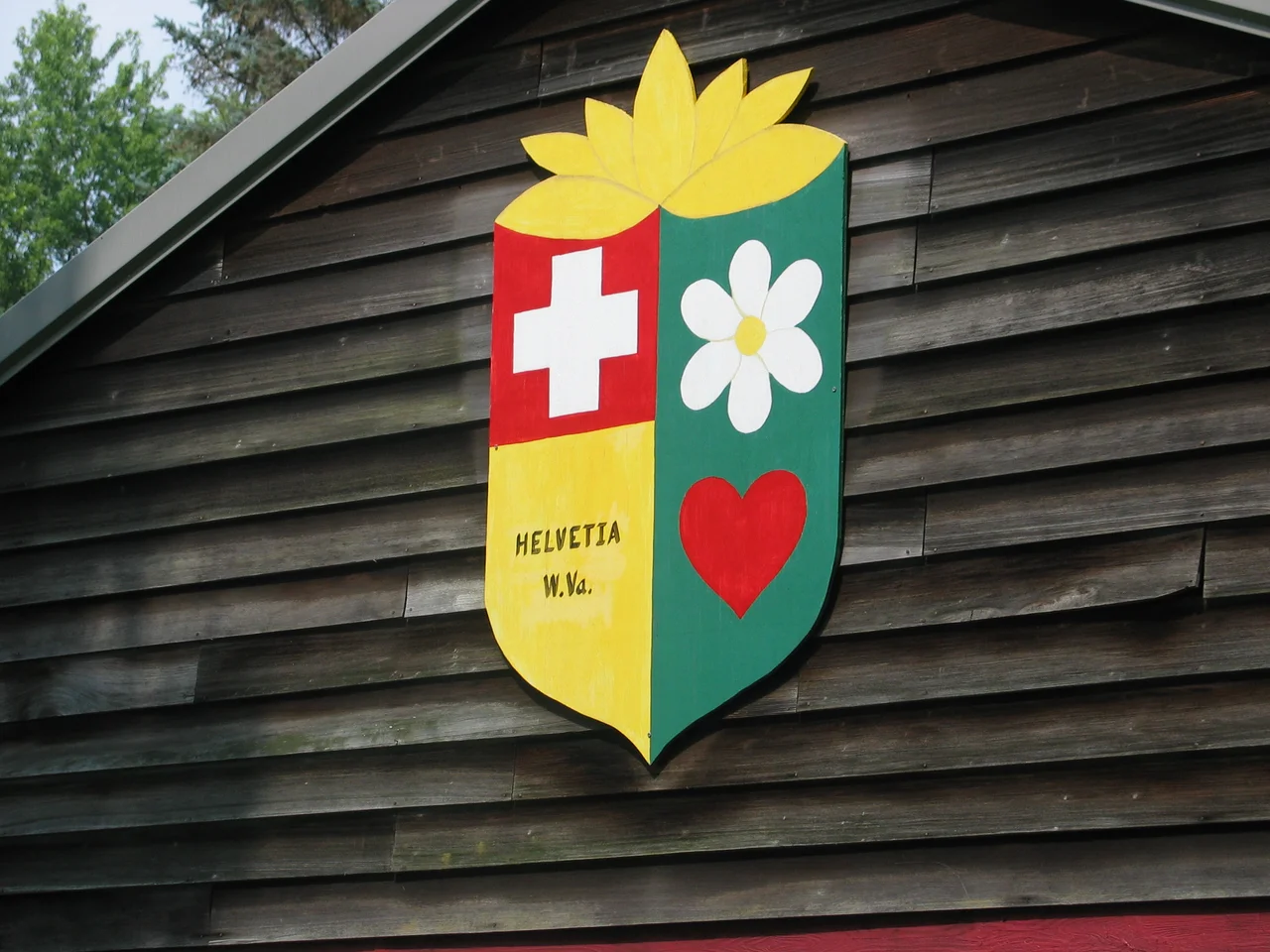

Helvetia Village Historic District
The settlers stepped off a train at Beverly in the spring of 1869, climbed into wagons, and were driven up into the mountains until the road ran out. They had come from Switzerland through New York looking for cheap farmland and found themselves in a steep, wooded hollow in Randolph County, West Virginia, at an elevation of about 2,500 feet. They named the place Helvetia, the Latin name for Switzerland, and set about reproducing as much of an Alpine village as the West Virginia landscape would allow. Twenty-six of the buildings they and their descendants put up are still standing. The whole cluster - log cabins, the Carpenter Gothic church, the cheese house, the bandstand - was added to the National Register of Historic Places in 1978 as the Helvetia Village Historic District.
1869 and the First Cabins
The original settlement consisted of log structures, built quickly in the customary Appalachian manner because the new arrivals needed shelter before winter. One of those original cabins, dating to 1870, still stands at the edge of the village green. So does the building now known as the Swiss Museum, also from the 1869-70 period, which interpretive signs say served first as a settler's home and then as a multi-purpose community space. The walls are squared logs, joined at the corners with the V-notch favored by German-speaking carpenters; the roof is split shingle; the doorways are low. To duck through one is to enter the physical world of the first Helvetians - close, smoky, lit only by daylight through small windows and by candles when the daylight was gone.
The Church and the Carpenter Gothic Eye
As the settlement stabilized, the original log buildings were joined by frame construction. The most important of these is The Church, built in 1882 in the Carpenter Gothic style - the picturesque, scroll-sawn, pointed-arch Victorian church style that traveled the American countryside in pattern-book form during the second half of the nineteenth century. Helvetia's version is small, white, and impeccably proportioned, with a steeply pitched roof and the simple pointed windows that the style dictates. A bell hangs in the tower; congregants still gather here for Sunday services and, on certain holidays, for the German-language hymns the settlers brought with them. Other frame buildings of the same period include the Huber Inn (around 1880), Star Band Hall, the Cheese Haus, and Rudolph's Carpenter Shop - the workshop of the village's master woodworker.
Twentieth-Century Layers
The village did not freeze in 1900. The Post Office and Store, with attached living quarters for the postmaster, was built in the 1920s and is still in use - it remains a working post office, a small general store, and an unofficial community gathering point. The Helvetia Community Hall went up in 1939 as a WPA-style civic building and has been the site of community dinners, Fasnacht celebrations, dances, and meetings ever since. Each of the twenty-six contributing buildings represents a decade in which Helvetia kept choosing to remain itself - a Swiss village in the West Virginia hills - rather than dissolving into the general fabric of rural Appalachia. The choice was made repeatedly and is still being made.
Fasnacht and the Cheese
What keeps Helvetia recognizably Swiss is not just the buildings but the practices the buildings host. Every winter the village celebrates Fasnacht, the pre-Lenten carnival that has been observed in the Alpine cantons for centuries. Costumed celebrants in elaborate hand-carved wooden masks parade through the village, gather at the Community Hall, dance and feast, then burn an effigy of Old Man Winter at midnight. Visitors come from Pittsburgh, Morgantown, and farther afield to witness it - one of the few Fasnacht celebrations in the Eastern United States, a tradition that was revived and reinvigorated as a public celebration in 1968 and has been held annually ever since. Throughout the year, the village's small restaurant serves Swiss-influenced food, including Helvetia cheese produced from local dairy herds. The cheese is a serious matter: it has won regional awards and supplies a small mail-order business that keeps the village's name circulating in food circles.
A Village That Stayed
Helvetia is small - the year-round population is perhaps fifty-some people - and remote. The roads in are paved but narrow and slow; the nearest town of any size, Pickens, is twenty minutes away; the regional center at Elkins is more than an hour. None of that is accidental. The settlers chose this hollow because it was cheap and steep and out of the way, and the village's continuing isolation is the principal reason its nineteenth-century fabric has survived intact. Most other ethnic settlements of the period in Appalachia were either absorbed or abandoned by the late twentieth century. Helvetia did neither. It remained, sustained by stubbornness, by the cheese, by Fasnacht, by the National Register listing, and by an ongoing community of descendants and newcomers who continue to think that this is the place a Swiss village in West Virginia should be.
From the Air
Helvetia sits at 38.71 N, 80.20 W in Randolph County, West Virginia, at an elevation of approximately 2,500 feet in a high mountain hollow. Best appreciated at 3,500-5,500 feet AGL where the village's small cluster of buildings in a hollow surrounded by forested ridges is recognizable - look for the white church spire among the trees and the small green at the village center. Nearest airport: Elkins-Randolph County (KEKN) about 20 nm northeast. The Monongahela National Forest surrounds the area; Pickens to the south and Mill Creek to the east are the nearest small towns. Visibility into the hollow can be limited by terrain - approach from the east-southeast for the best view.
Nearby Stories
- Battle of Camp Allegheny 7.4 km away
- Weston Colored School 12 km away
- Appalachia 13 km away
- Sinks of Gandy 15 km away
- Clay, West Virginia 20 km away
- Tucker County, West Virginia 22 km away
- Cranberry Wilderness 24 km away
- North Bend Rail Trail 31 km away