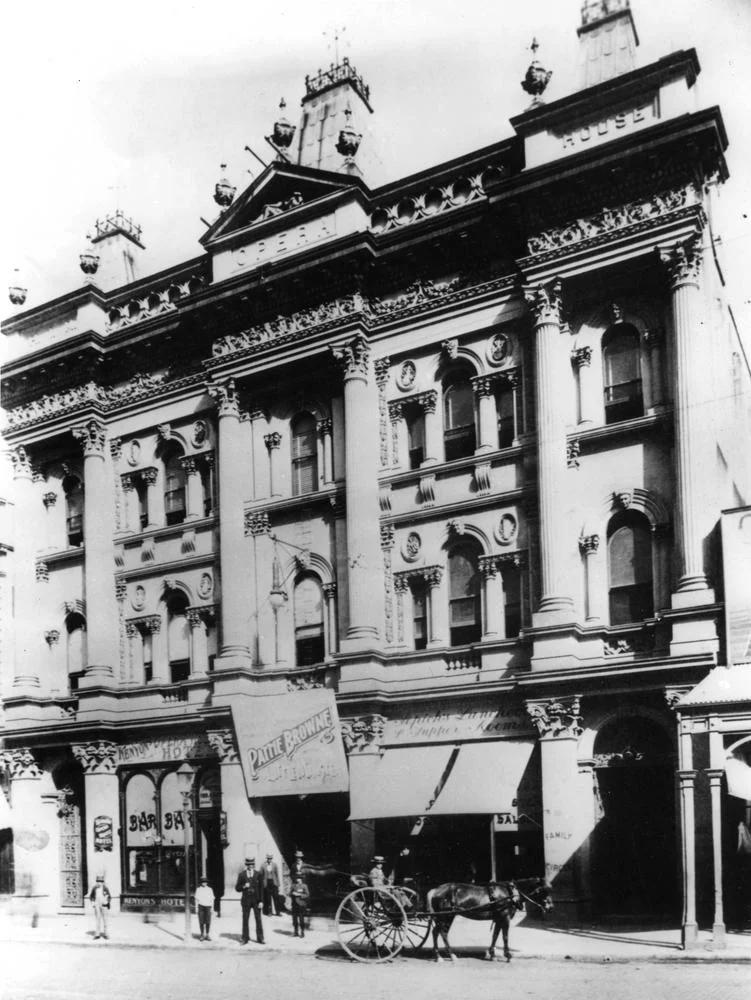

Her Majesty's Theatre, Brisbane
Stand on Queen Street today, outside the Wintergarden shopping centre, and there is nothing to tell you what stood here. For ninety-five years this was the address of Her Majesty's Theatre, the largest stage Brisbane had, its Italian Renaissance facade rising over the street with Corinthian columns and a ceiling clever enough to vent its own heat through a sliding panel. It opened in 1888 as Her Imperial Majesty's Opera House, and across the decades it carried a procession of the world's great performers through a colonial city far from anywhere. Then, on a single day in October 1983, it was gone, demolished despite a public promise that at least its grand face would be saved.
A Stage Fit for the Empire
When it opened in 1888, the theatre announced that Brisbane intended to be taken seriously. Its name tracked the monarchy with almost comic literalness: it became His Majesty's in 1901 and clung to that title for over half a century, still calling itself His Majesty's well into the reign of a queen. The building was made to impress and made to last, with O'Keefe and Company as chief builders and James Lang and Company supplying the decorative work. In 1901 the architect William Pitt added the self-ventilating ceiling, a sliding section that let the heat of a packed house escape. Through it all, one name held steady: the theatrical firm of J.C. Williamson kept the lease for eighty years, an extraordinary run that made the theatre and the company nearly synonymous in Brisbane.
Everyone Came Through
The roll of performers who stood on this stage reads like a history of the early-twentieth-century touring circuit. The Russian ballerina Anna Pavlova brought her company through in the 1920s. The Polish pianist and statesman Ignacy Paderewski toured in 1928. The British contralto Dame Clara Butt sang here in 1925, and the Australian soprano Dame Nellie Melba appeared alongside the home-grown star Gladys Moncrieff. In 1948, Laurence Olivier and Vivien Leigh, then perhaps the most famous couple in the English-speaking theatre, performed on these boards. For audiences in a city at the far edge of the touring world, a night at Her Majesty's was a rare thread connecting Brisbane directly to the great stages of London and beyond.
Rebuilt to Keep Up
A working theatre is never finished, and this one was reshaped again and again. A 1920 remodel reorganised the seating, stripping out the old gallery and dress circle to fit more patrons. In 1929 the building was substantially modernised, rebuilt and reopened under the architects Cedric Ballantyne and George McLeish. Another round of renovations followed in 1941. Four theatre companies staged plays here over the years, and as tastes shifted the screen joined the stage, with films shown alongside live performance. Each remodel was a vote of confidence, an assumption that the theatre would keep earning its keep on Queen Street for decades more. For a long time that assumption held.
The Stage That Outgrew Its Home
Ironically, it was the theatre's greatest asset that helped seal its fate. Her Majesty's had the only stage in Brisbane large enough to take the scenery and staging of the big touring productions. As the Queensland government planned a new arts precinct in the 1970s, that very need, a venue with a stage to match, helped drive the creation of the Queensland Performing Arts Centre at South Bank. A purpose-built modern complex was coming. The old theatre on Queen Street, increasingly valuable as real estate, suddenly looked less like an institution and more like a redevelopment site waiting to happen.
A Promise Broken in a Day
The end came in October 1983. The final performance, on the 16th, was the Lord Mayor's Command Performance, compered by Bobby Limb before a bill of Australian and English entertainers. One week later, on 23 October, the demolition crews moved in to make way for the expansion of the Wintergarden centre and a new Hilton Hotel. There had been a fight to save it. A union ban over the preservation of the facade held up the work, and assurances were given that the grand frontage would be folded into the new building. Those assurances meant nothing. When the dust settled, the demolition had destroyed the entire complex, facade and all, leaving Brisbane a little poorer in memory and richer in retail.
From the Air
The theatre stood at 193 Queen Street, around 27.469 degrees south, 153.026 degrees east, in central Brisbane on the north bank of the river. The site is now occupied by the Wintergarden shopping centre and adjacent Hilton Hotel within the dense CBD high-rise cluster, fronting the pedestrianised Queen Street Mall; from the air the area reads as solid towers wrapped inside a tight loop of the Brisbane River. The nearest major airport is Brisbane Airport (ICAO YBBN), roughly 12 kilometres to the north-east, with Archerfield Airport (YBAF) to the south. As a vanished landmark there is nothing to spot directly; the interest is in the gridded streets of the old town centre below.
Nearby Stories
- Redcliffe Peninsula 2.7 km away
- Tamborine National Park 12 km away
- Cressbrook Homestead 27 km away
- Main Range National Park 31 km away
- 2010-2011 Queensland Floods 38 km away
- Cape Byron 96 km away
- Cape Byron Light 126 km away
- HMS Porpoise (1799) 588 km away