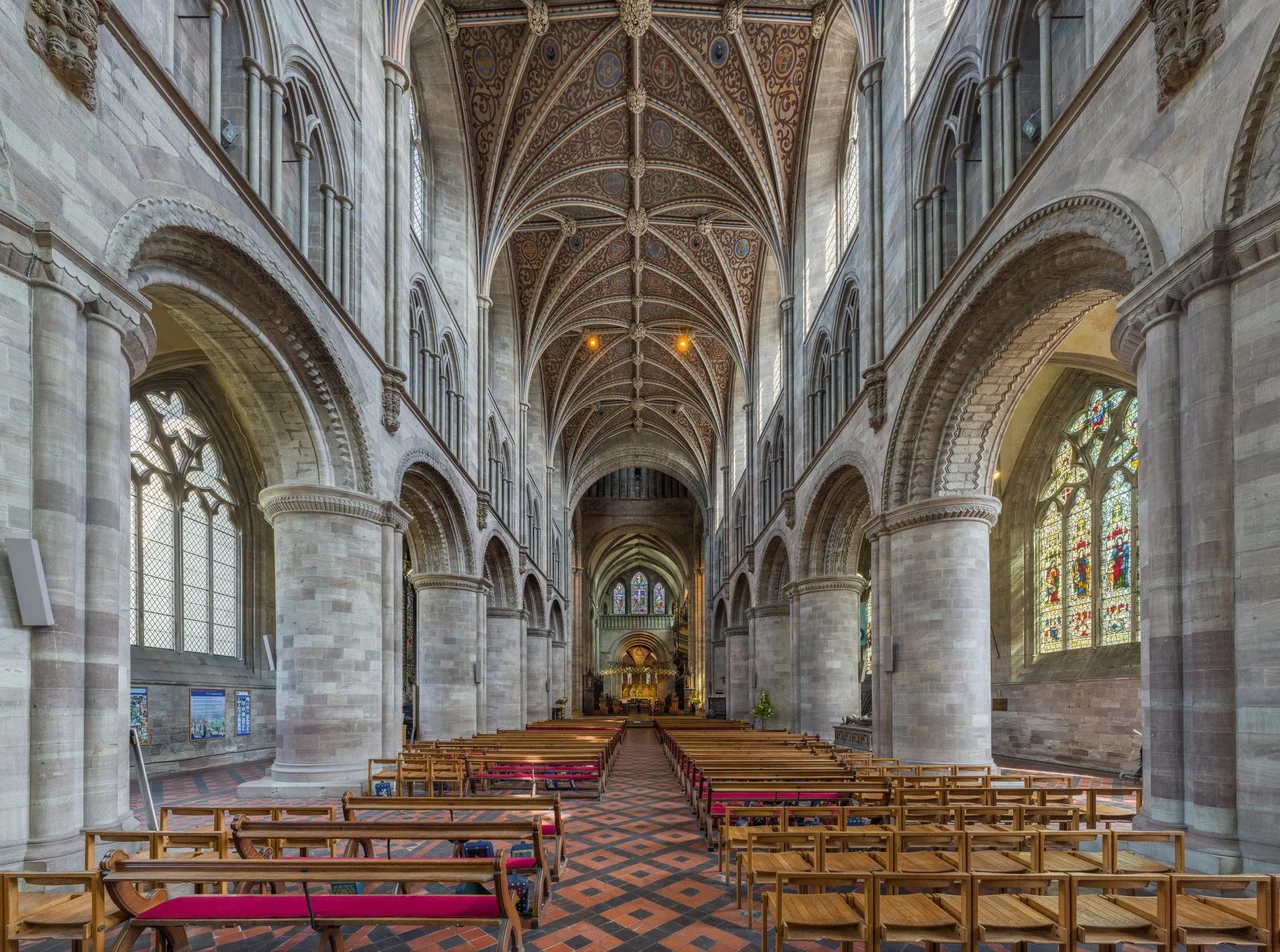

Hereford Cathedral
The map is the size of a small dining table, drawn on a single sheet of calfskin, and it places Jerusalem dead-center with Paradise at the top. Around 1300, a man named Richard de Bello bent over this vellum and tried to fit everything he knew about the world onto it - Babylon, Troy, Rome, the river of Eden, a Day of Judgment with the Virgin Mary pleading for souls climbing out of their graves. Seven centuries later, the Hereford Mappa Mundi still hangs in the cathedral on the bend of the River Wye, the largest medieval world map to survive intact anywhere, and most days you can stand close enough to read the captions.
A Church Older Than the Building
There was a place of worship on this site by the 8th century, possibly earlier, when Hereford was already the Saxon capital of West Mercia and a frontier against the Welsh kingdoms across the river. The current building was begun in 1079, after the Norman Conquest, and then it kept being begun for the next 440 years. Bishop succeeded bishop, mason succeeded mason, and each one added something - a chapter house in the 14th century, a great tower studded with ball-flower ornaments, three chantries built by 15th-century bishops, a north porch finished by Charles Booth before 1535. The result is a building you read like sediment. Norman piers carry pointed Gothic arches, which carry Decorated tracery, which carries Perpendicular vaulting. Nothing inside Hereford Cathedral is from one time.
The Map of Everything
The Mappa Mundi is not really a map in the modern sense. It is a picture of the medieval world as the medieval world understood itself - geography fused with theology, history layered on top of myth. East is at the top because that is where Paradise is. Adam and Eve are being expelled from a circular Eden. Troy and Babylon get more ink than London. There are dog-headed people in the margins, and a sphinx, and the four great cities of antiquity in gold. Richard de Bello drew himself into the bottom-right corner on horseback, attended by a page and a pair of greyhounds, riding off to a hunt. In the 1980s, a financial crisis in the diocese forced the Dean and Chapter to consider selling it. Public outcry and donations from the National Heritage Memorial Fund, Paul Getty, and thousands of ordinary people kept it here, and a new library was built to hold it. The library opened on 3 May 1996.
Books on Chains
Next to the map sits the largest chained library in the world. Hundreds of medieval manuscripts and printed books still tethered to their shelves by iron chains, the way every important library used to keep its books in the centuries when books were worth stealing. The Hereford Gospels, a thousand years old in Anglo-Saxon script, sits in this collection. So does a unique 13th-century antiphonary. So does one of only four surviving copies of the 1217 Magna Carta - which is itself one of the finest of the eight oldest texts of the charter still in existence. Hereford sometimes displays the Magna Carta beside the Mappa Mundi, and on those days you can stand within arm's reach of two of the most important documents in the medieval West.
Falling Towers and Bishops Behaving Badly
Hereford Cathedral has not always been lucky. In 1645, during the English Civil War, the city was besieged and sacked; the conquerors ran riot in the cathedral and did damage that could never be fully repaired. Bishop Philip Bisse, trying to support the central tower in the 1710s, allowed the Chapter House to be quarried for stones to renovate his palace - a decision later called inexcusable. Then on Easter Monday 1786, the west tower fell. It took the whole west front with it and at least one bay of the nave. James Wyatt was called in to fix it, and his ornate Victorian replacement, often called Wyatt's Folly, was itself replaced after Queen Victoria's Diamond Jubilee. The cathedral has been restored, then restored again, then restored a third time. The 19th-century work alone cost around 45,000 pounds and ran from 1841 to 1908.
What the Restoration Found
When landscaping work began in 2015, funded by the Heritage Lottery Fund, the cathedral's burial precinct gave up its secrets. From the Middle Ages until the 19th century, anyone who died on church grounds had to be buried within the precinct, and thousands had been. Archaeologists reburied corpses from 12th- to 14th-century stone-lined graves. One was a knight whose bones suggested he had jousted in tournaments. One was a man with leprosy, which was extraordinary - lepers were usually buried far from any cathedral because of the stigma their disease carried. One was a woman with a severed hand, the typical medieval punishment for theft. She should not, by the rules of her time, have been buried here at all. Someone, eight centuries ago, had quietly chosen mercy over rules.
Music in the Nave
In 1724, the chancellor Thomas Bisse organized a Music Meeting that joined the cathedral choirs of Hereford, Worcester, and Gloucester into what became the Three Choirs Festival - one of the oldest continuously running music festivals in Europe, still rotating among the three cities every summer three centuries later. The organ on the south side of the choir was built in 1892 by Henry Willis, considered one of his finest. The bells in the central tower include a sixth dating from the 13th century. On the south transept's east wall hang three tapestries designed by John Piper, woven by artists in Namibia in 1976, depicting the Tree of Life, the Tree of Knowledge, and the Deposition. The cathedral is quiet most afternoons, except for those tapestries, which never stop talking.
From the Air
Hereford Cathedral stands at 52.054 N, 2.716 W on the north bank of the River Wye, in the centre of the small cathedral city of Hereford. The 165-foot central tower is the tallest point in the city centre and is a useful visual landmark from the air. Best viewed from 1,500-3,000 ft AGL on a south-easterly approach. Nearest airports: Gloucestershire (EGBJ) about 30 nm east-south-east, Shawbury (EGOS) about 35 nm north, Wolverhampton/Halfpenny Green (EGBO) about 30 nm north-east. Maritime climate; expect low cloud and rain in winter, clearer conditions in summer.
Nearby Stories
- Pershore Abbey 2.4 km away
- Halifax V9977 Crash, Welsh Bicknor 3.4 km away
- Halesowen Abbey 6.5 km away
- Ebbw Vale Steelworks 9.8 km away
- Chedworth Roman Villa 13 km away
- Stokesay Castle 14 km away
- Builth Castle 16 km away
- Dolforwyn Castle 19 km away