
Hereford Museum and Art Gallery
The facade is carved with the signs of the zodiac and a small zoo of animals and plants, none of which look quite like they belong in Hereford. Frederick Robertson Kempson designed the building in 1873 in the Venetian Gothic style - as if a piece of the Doge's Palace had been picked up, lightly weathered, and dropped onto Broad Street between a Tesco and a pedestrianised market square. For 149 years the museum behind that facade has held an unlikely mix of treasures: a two-headed calf, a two-metre fish, Roman floor mosaics rescued from a vanished town, and the seals that the Welsh rebel Owain Glyndwr once pressed into hot wax. The doors closed in July 2023. Behind them, an 18-million-pound redevelopment is underway.
The Naturalists Who Built a Museum
In 1851, in a meeting of Hereford's Literary, Philosophical and Natural History Institution, a group of local gentlemen founded the Woolhope Naturalists' Field Club. They named it for the Woolhope Dome, an outcrop of Silurian rocks at the village of Woolhope south-east of the city, and they set themselves the practical study, in all its branches, of the Natural History of Herefordshire. They collected fossils, walked the hills, identified mosses, argued about geology, and accumulated artefacts. By 1869, the club's president Sir James Rankin - a Member of Parliament and a man of considerable means - announced at his retirement speech that he would pay for a library and museum to house everything they had gathered. He put up 6,115 pounds toward the 7,600-pound cost. The City Council raised the rest. The foundation stone was laid in March 1873; the doors opened on 8 October 1874.
An Ornament of the City
The Hereford Times called the new building truly an ornament of the city, and the Times was not wrong. Kempson had visited Venice. His design borrowed pointed arches, polychrome stonework, and a riot of carved zoology and botany around the entrance. On the ground floor were rooms meant for reading and committees - but money for display cases had not been included in the budget, so they were rented out as shops to raise the cash. A double-height lending library filled the rear. The museum and the Woolhope Club Room occupied the second floor. The third and fourth floors held the librarian and curator's apartment, with kitchen, scullery, sitting rooms, and bedrooms - because in 1874, that is where a curator lived. The whole arrangement is recognisably Victorian: a public institution stuffed with private lives and improvised funding.
What the Cases Held
The collection grew the way Victorian collections did - through donations from members of natural history societies, antiquarian groups, and gentleman amateurs. In 1927 a public appeal raised money to mount two Roman floor mosaics from Kenchester, a long-abandoned Roman town just west of Hereford, in the building's stairwell. By the time the museum closed in 2023, the cases held a startling range of things: a two-headed calf preserved as a curiosity, a two-metre fish, ceremonial swords, embroidered textiles, prehistoric tools, Victorian dolls, and during the summer months a working bee colony. The art gallery, added in 1912 with funding from Sir Joseph Pulley and his nephew Sir Charles Pulley, held a permanent display of works by Brian Hatton, the Hereford-born artist who painted horses and rural England before being killed in Egypt in 1916 during the First World War.
Glyndwr's Seals and the Vanity of Small Differences
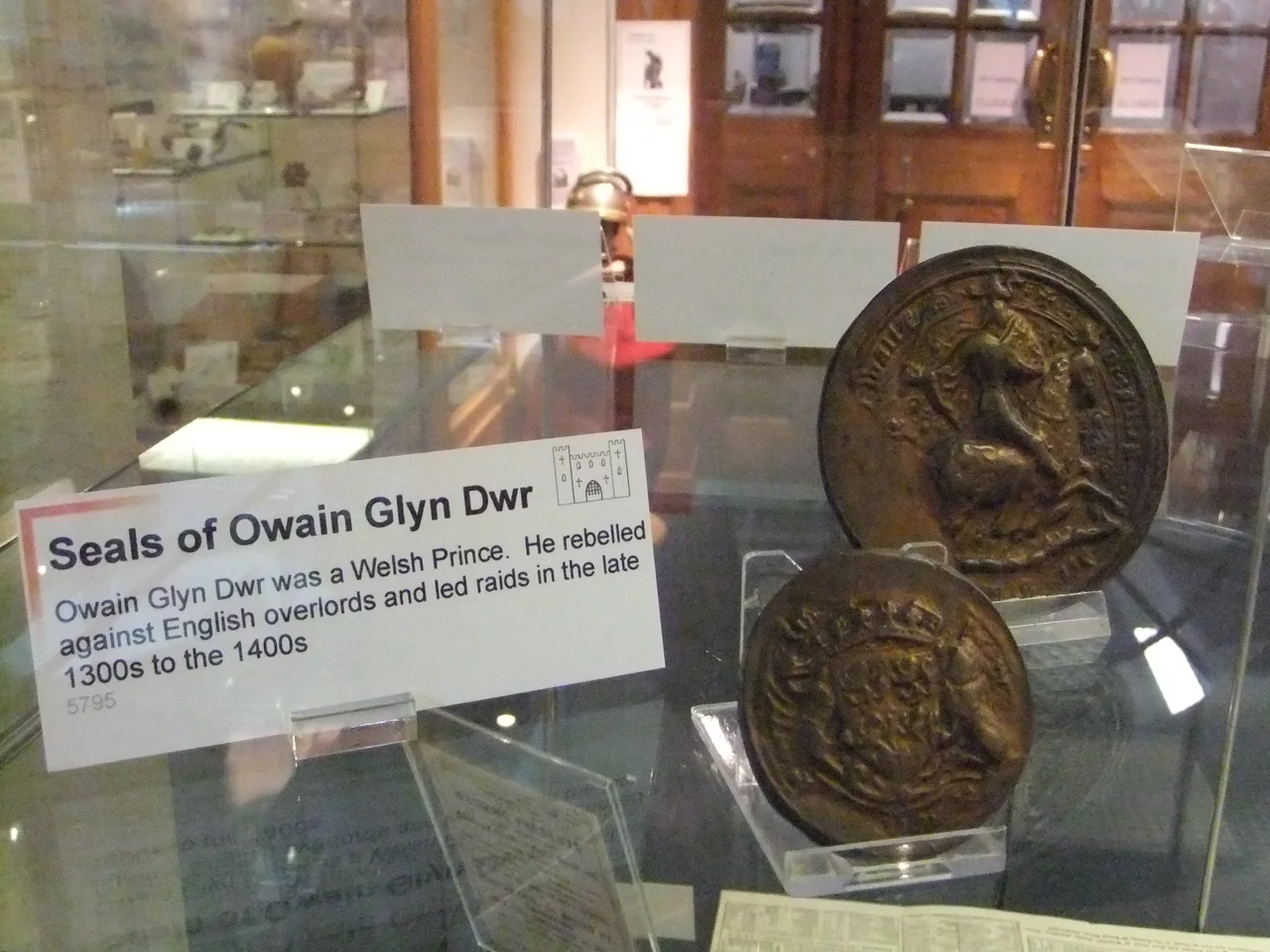
The museum's exhibitions could be unexpected. In 2006 the bicentennial of the watercolourist Joseph Murray Ince was celebrated. In 2007 the gallery hosted the designs of Christopher Dresser, the Victorian who is sometimes called the first industrial designer. In autumn 2020, during the brief gap between Covid lockdowns, The Ice Age in Herefordshire put a full-sized woolly mammoth replica in the centre of the room and asked visitors to imagine the county under ice. The following year, Grayson Perry's tapestry cycle The Vanity of Small Differences hung in the gallery - six large works inspired by Hogarth's A Rake's Progress, tracing class mobility through contemporary England. Among the permanent treasures: the original seals of Owain Glyndwr, used by the Welsh prince to authenticate documents during his early 15th-century revolt against English rule.
Closed for Reinvention
By the 2020s the building was straining. Asbestos removal in 2015 had forced a two-year closure. Post-Covid fire regulations capped the number of visitors at ten people at a time. In July 2023 the doors closed for a full redevelopment funded by 5 million pounds from the National Lottery Heritage Fund, 8 million from Herefordshire Council, and 5 million from the Stronger Towns Fund. The plans are ambitious: new galleries, restoration of the Woolhope Club Room, a temporary exhibition space, a rooftop cafe, and a new floor with a viewing beacon and roof terrace that will give 360-degree views over the city. When it reopens, visitors will be able to look out across Broad Street toward the cathedral and the bend of the Wye - the same view Sir James Rankin saw in 1870 when he decided Hereford needed a museum.
From the Air
Hereford Museum and Art Gallery sits at 52.055 N, 2.717 W on Broad Street in central Hereford, two blocks west of Hereford Cathedral and just south of High Town. Its Venetian Gothic facade is visible from the air as part of the dense red-brick city centre. The cathedral tower is the better landmark from altitude; the museum is essentially next door. Best viewed from 1,500-2,500 ft AGL. Nearest airports: Gloucestershire (EGBJ) about 30 nm east-south-east, Shawbury (EGOS) about 35 nm north, Wolverhampton (EGBO) about 30 nm north-east.
Nearby Stories
- Pershore Abbey 2.4 km away
- Halifax V9977 Crash, Welsh Bicknor 3.4 km away
- Halesowen Abbey 6.5 km away
- Ebbw Vale Steelworks 9.8 km away
- Chedworth Roman Villa 13 km away
- Stokesay Castle 14 km away
- Builth Castle 16 km away
- Dolforwyn Castle 19 km away