
Heros von Borcke
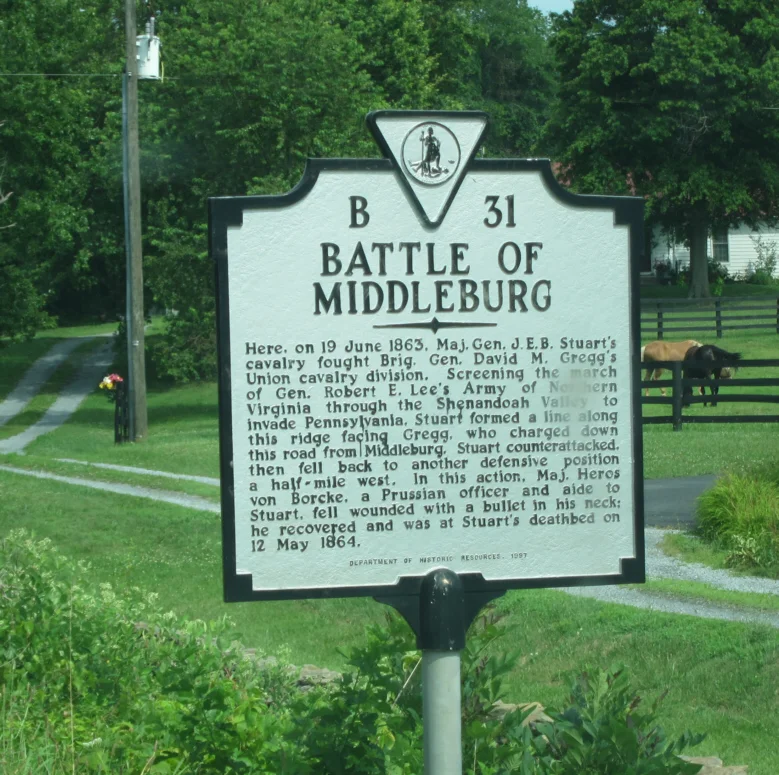
The bullet that killed Heros von Borcke entered his neck at Middleburg, Virginia, on 19 June 1863. It took thirty-two years to finish. Surgeons never got it out. He carried it through the rest of the American Civil War, a second European campaign, two marriages and a career as a Pomeranian landowner, and in May 1895 the infection it had been quietly feeding turned to sepsis and killed him in Berlin. He was buried at Giesenbrugge, his family's estate east of the Oder - a village called Gizyn today, in Poland, where a Prussian nobleman's mausoleum sits in an old cemetery because of a war fought four thousand miles away.
A Lieutenant Out of Money
He was born on 23 July 1835 inside the fortress of Ehrenbreitstein on the Rhine, into the von Borckes, an old Pomeranian noble family. His father Theodor owned the manor at Giesenbrugge in the New March and sat in the Prussian House of Lords from 1856; his mother Therese died in 1847, when he was a boy. He was schooled at the Franckesche Stiftungen in Halle, commissioned into the Prussian cavalry in 1855, served with the Guards Cuirassiers, and returned from a spell of study to active duty with the 2nd Brandenburg Dragoons. Then the money ran out. Debt forced a second lieutenant with an aristocratic name and no income to resign, and in 1862 he sailed for the Confederate States - a government that had seceded to preserve slavery, and one short enough of trained cavalry officers not to ask hard questions of anyone offering to serve. He ran the Union blockade carrying a straight sword of Solingen steel so large that it became famous on its own account.
The Giant in Gray
By the end of the month he had reached Richmond, and on 1 June 1862 the Secretary of War, George W. Randolph, commissioned him captain and posted him to Major General J.E.B. Stuart. He was enormous - tall, heavy, and swinging that Solingen blade - and the Confederate cavalry named him the giant in gray almost immediately. Reporting on the celebrated ride around McClellan's army, Stuart wrote that von Borcke, a Prussian officer who had lately run the blockade, joined in the charge of the First Squadron in gallant style and by his energy, skill and activity won the praise and admiration of all. Promotion to major came that August, and he rode as Stuart's adjutant general through the Northern Virginia and Maryland campaigns. When the young artillerist John Pelham was killed at Kelly's Ford, it was von Borcke that Stuart detailed to escort the body home to Richmond. Three months later came Middleburg and the neck wound that took him out of the war for the rest of the year.
The Memoir
He recovered enough to resume staff work in the spring of 1864 and was at Yellow Tavern in May when Stuart was shot and killed. In December he was made lieutenant colonel and voted the official thanks of the Confederate Congress, then sent by Jefferson Davis on a diplomatic errand to Great Britain - a mission for a cause with weeks left to run. What came out of it all was a book. Memoirs of the Confederate War for Independence appeared in 1866 from William Blackwood and Sons of Edinburgh, and it is the reason anyone outside Pomerania still knows his name. Written by an outsider with access to Stuart's headquarters and a European's eye for what Americans took for granted, it remains one of the most quoted foreign accounts of the war - and, like most memoirs from that side, a document of loyalty to comrades that says little about what those comrades were fighting to keep.
The Flag Over Giesenbrugge
Prussia took him back. He fought in the Austro-Prussian War of 1866 on the staff of Prince Friedrich Karl and was decorated with the Order of the Red Eagle, then retired in 1867 with his wounds still troubling him. He bought an estate at Sichts, now Zychce, and after his father's death moved back to Giesenbrugge to run the family land. He married Madalene Honig at Gralow in 1867; they had three sons. When she died in 1883 he married her younger sister Tony, and their daughter, born at Giesenbrugge in 1885, was christened Caroline Virginia Magdalene - Virginia for the state where he had spent two years of his life. He is said to have raised the Confederate flag over the estate as a matter of routine. In 1884 he crossed the Atlantic again to see old comrades: Wade Hampton, William H. F. Lee, Matthew C. Butler. Then he went home and stayed there.
The Grave at Gizyn
He died in Berlin on 10 May 1895, of sepsis traced to the projectile still sitting in him from Middleburg, and was laid in a mausoleum in the old cemetery at Giesenbrugge. Half a century later the war reached him anyway. Red Army troops destroyed the headstone during the Second World War, and afterwards the border moved west: the New March became Polish, the village became Gizyn, and the German families who had farmed there for generations were gone. The grave stayed. In 2008 the Sons of Confederate Veterans installed a replacement stone in a Polish village cemetery - the last odd turn in a life made almost entirely of odd turns. Gizyn is a scatter of houses among fields and small lakes east of Mysliborz, and the visitors who come looking for the grave are usually American.
From the Air
The Gizyn cemetery and the site of the von Borcke manor lie at 52.941 degrees north, 15.001 degrees east, in West Pomeranian Voivodeship, about 9 km east of Mysliborz and roughly 70 km south-east of Szczecin. Best viewed at 1,500-3,000 ft AGL. This is glacial country and the lakes are the navigation: Lake Mysliborskie sits long and narrow just west of the town, with a scatter of smaller kettle lakes and blocks of forest running east toward Barlinek. The village itself is small enough to be easy to miss - look for the church and the walled cemetery on its edge. The Oder is about 45 km west, and the German border with it. Nearest airports: Szczecin-Dabie (EPSD), a grass aeroclub field about 55 km north-west, Szczecin-Goleniow Solidarnosc (EPSC) about 70 km north, Zielona Gora-Babimost (EPZG) about 105 km south-east, and Berlin Brandenburg (EDDB) about 120 km west-south-west. Ground fog forms readily over the lake basins on autumn mornings.
Nearby Stories
- Oderbruch 12 km away
- Battle of Zorndorf 21 km away
- Kingdom of Prussia 28 km away
- Ducal Castle, Szczecin 31 km away
- Battle of Prenzlau 37 km away
- Lubiaz Abbey 178 km away
- Battle of Leuthen 223 km away
- Stutthof Concentration Camp 270 km away