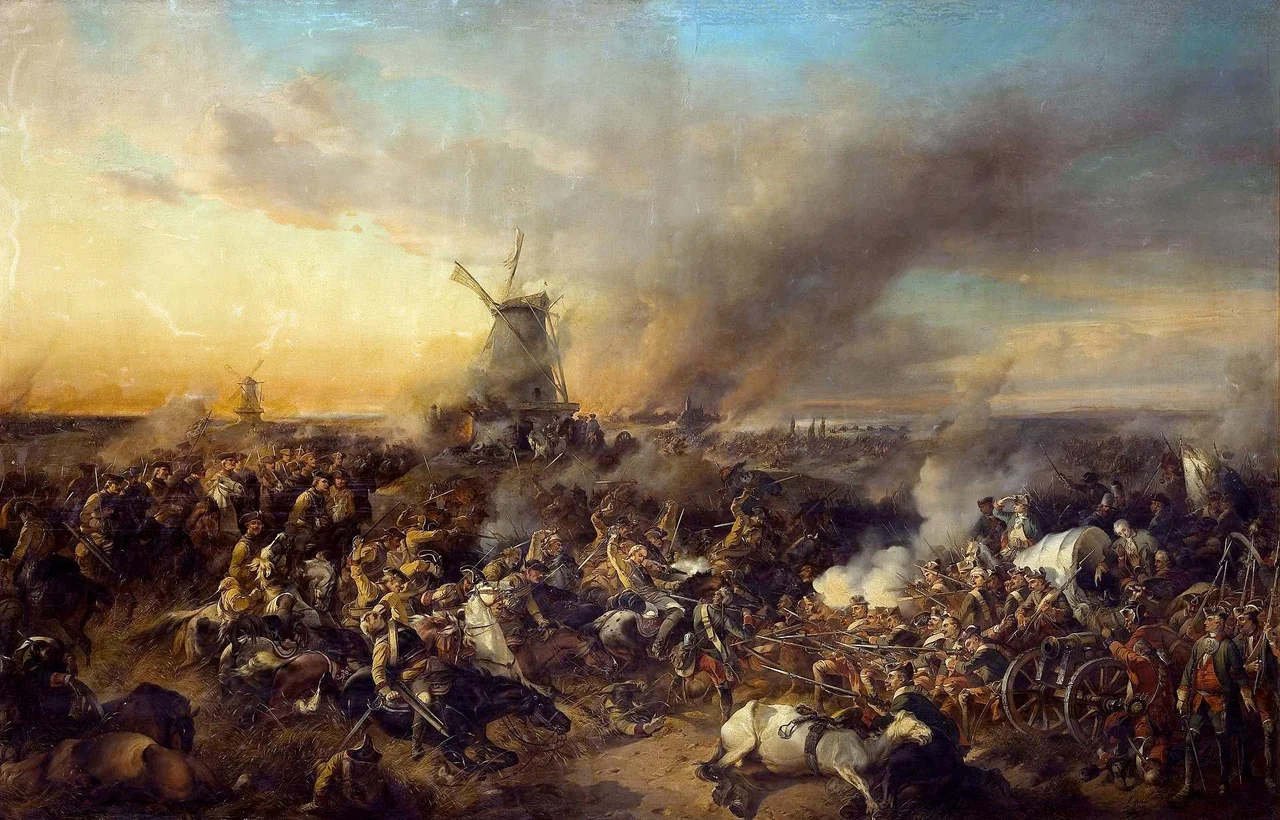

Battle of Zorndorf
The dust rose so thick that the Russian gunners could not tell whose horsemen were coming at them. Their own cavalry, broken by Friedrich Wilhelm von Seydlitz's Prussian squadrons and streaming back toward the infantry line, arrived through the smoke as shapes rather than men — and the Russian artillery opened fire on them. That was the shape 25 August 1758 took at Zorndorf, a village in Brandenburg-Neumark that is now Sarbinowo in Poland: a battle fought at arm's length on ground too narrow for anyone's plan, and remembered by the men who lived through it as the bloodiest day of the century.
The Crown of a Morass
Zorndorf sat in a peat wilderness — scraggy firs, heath, and cultivated patches that showed as light green islands in a mass of dark fir. In the mid-eighteenth century the country was thoroughly marshy, threaded with bog pools and sluggish creeks, and the firm broad road the Prussians would later build across it was not yet imagined. Thomas Carlyle toured the ground a hundred years afterward and went through the old records; he called the marshes "leakages," two to three miles broad, mostly bottomless. The hamlet lay at the crown of that morass. Almost everything that happened on 25 August followed from a single fact about the terrain: neither army had anywhere to go.
Why Frederick Rode East
Prussia had spent 1757 winning. Rossbach and Leuthen had gone spectacularly well, Silesia was largely back in Frederick's hands, and Britain had just committed to an annual subsidy of £670,000. Then, in August 1758, Austria's ally Russia came west. Count William Fermor pushed 42,590 troops toward Berlin, close enough to join Field Marshal Daun's Austrians, and Frederick understood exactly what that junction would mean for his capital. He moved into the Russian rear. Fermor, then besieging the fortress of Küstrin — today Kostrzyn nad Odrą — learned of the maneuver from a Cossack patrol, lifted the siege, and took up position at Zorndorf to the northeast. Frederick brought 36,000 men. At the war's outset his infantry could deliver four musket volleys a minute and some companies could manage five, a rate of fire no army in Europe could match. It would matter for about an hour.
The Plan That Would Not Fit
Frederick's infantry opened against a Russian formation called the Observation Corps, made up entirely of young conscripts. They held longer than anyone expected, until Seydlitz's cavalry came down on them and the Russian horse broke — into the friendly artillery fire that opened this account. Meanwhile the Prussian infantry fell on the Russian left. Frederick meant to repeat the oblique order that had won him Leuthen: strike hard on one flank at an angle and roll the enemy line up from the end. The ground would not permit it. Swamp lay behind the Russians, so they could not withdraw even when they wanted to, and the same terrain plus stubborn Russian resistance kept the Prussian left from closing around them. A maneuver battle collapsed into a head-on collision inside a narrow box.
When the Powder Ran Out
Both armies shot themselves dry and finished the day with bayonets, sabers and musket butts. When Prussian battalions began to falter, Frederick took up a regimental standard and led them forward himself — the image that would follow him through two centuries of German art. A Prussian officer wrote afterward that "bodies of Russians covered the field row by row; they kissed their cannons while their bodies were cut to pieces by our sabers, but still they would not retreat." Many of the men he was describing were the conscripts of the Observation Corps, in the first battle of their lives, standing on ground that offered them no way back. Frederick's own verdict came later, and it was bleak: "it's easier to kill the Russians than to win over them." He had come east expecting a lesser army. What he found unsettled him for the rest of the war.
The Victory Both Sides Claimed
The Prussians counted 11,390 of their own casualties, then announced that they had faced 70,000 Russians and inflicted 20,000 to 22,000 losses. Two days later the claim had grown to 80,000 engaged and 26,000 killed; by the time Frederick wrote to his sister the figure stood at 30,000 dead. Actual Russian losses were about 16,000 men — sons and husbands enough to put a very long shadow over households from the Baltic to the Volga. Neither army was driven from the field, so both could call it a win, and Saint Petersburg, Vienna and Paris all celebrated. Fermor, to his credit, did not join them. He reported heavy losses and a decisive victory missed, then withdrew in good order.
What Was Left on the Ground
The Russians had to leave regardless. Their own requisitions on the way in had stripped the countryside so completely that nothing remained to keep man or horse alive. Frederick ended the day holding the terrain with his supply lines intact, shadowed the Russian columns without attacking again, and called their withdrawal a rout — though the Russians marched off in perfect order and nobody harried them. Nineteenth-century historians largely accepted his version; historians since have argued about it continuously. In 1904 Carl Röchling painted Frederick the Great in the Battle of Zorndorf Before the Frontline of the von Bülow Regiment, and the picture of a king carrying a flag into the smoke became a fixture of early twentieth-century German ideas about soldierly heroism — a clean and gallant image of a day that was neither.
From the Air
The battlefield lies at 52.67°N, 14.65°E, around the Polish village of Sarbinowo in West Pomeranian Voivodeship, roughly 10 km northeast of Kostrzyn nad Odrą. Best viewed at 2,000-4,000 ft AGL. The unmistakable navigational feature is the confluence of the Warta and the Oder at Kostrzyn, with the vast Warta Mouth wetlands spreading east of it — the same drained and undrained marshland that trapped both armies in 1758. Nearest airports: Berlin Brandenburg (EDDB) about 85 km west, Zielona Góra-Babimost (EPZG) about 100 km southeast, Szczecin-Goleniów (EPSC) about 100 km north. Terrain is flat and unobstructed; ground fog forms readily over the river meadows on calm mornings.
Nearby Stories
- Słubice 4 km away
- Kingdom of Prussia 11 km away
- St. Mary's Church, Chojna 12 km away
- Gorzów Wielkopolski 13 km away
- Storkow Castle 17 km away
- Swiss International Air Lines Flight 850 20 km away
- Stalag Luft III 88 km away
- Stutthof Concentration Camp 309 km away