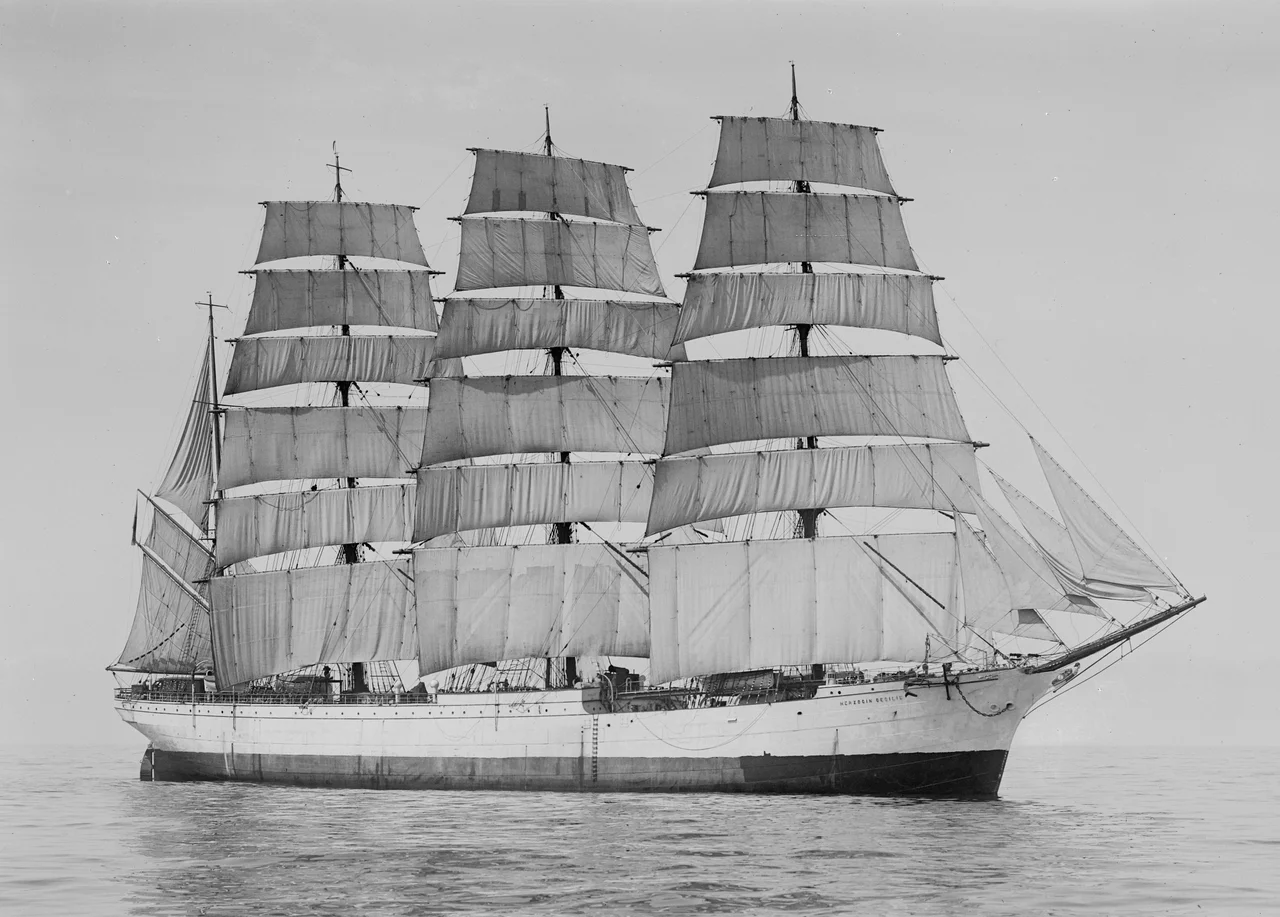

Herzogin Cecilie
She had just made one of the fastest grain runs ever sailed - Port Lincoln, South Australia to Falmouth in 86 days, around Cape Horn under full canvas. On the morning of 25 April 1936, the four-masted barque Herzogin Cecilie was making for Ipswich in dense fog when she struck the Ham Stone rock and drifted ashore against the cliffs of Bolt Head, on the south Devon coast. She was still afloat after the cargo was partly unloaded. Six weeks later they towed her around the headland to Starehole Bay at the mouth of the Kingsbridge Estuary, beached her there, and walked away. The Herzogin Cecilie, one of the last great working windjammers on the planet, finished her days as a tourist curiosity in a Devon cove.
A Ship from Another Age
She had been built in 1902 at Rickmers Schiffbau in Bremerhaven - 334 feet of steel-hulled iron-rigged sailing ship, four masts, square-rigged on the first three. The Germans named her Herzogin Cecilie - Duchess Cecilie - for the Crown Princess of Mecklenburg-Schwerin. She sailed under the German flag, then briefly the French, and finally the Finnish, ending up homeported at Mariehamn in the Aland Islands and owned by the Finnish shipping magnate Gustaf Erikson. By the 1920s the world had already changed past her. Steam and then oil had broken the back of merchant sail everywhere except in the long-haul grain trade from Australia, where wind was still cheaper than fuel for the four-month run around the Horn. Erikson kept a small fleet of these windjammers working that route, and the Herzogin Cecilie became their flagship.
Falmouth for Orders
The grain race was a real race, though no one had organised it. Every November the windjammers loaded sacks of wheat at South Australian ports and shoved off, the first home to a European port winning bragging rights and sometimes a small premium on price. The ships sailed under Falmouth for Orders - they made for Cornwall first, found out from the cable office where their cargo was actually wanted, and then went on to unload. In 1927 the Herzogin Cecilie raced the Swedish ship Beatrice from Port Lincoln to Falmouth and won. A young Australian named Alan Villiers was aboard, and the experience produced Falmouth for Orders, one of the best books ever written about the last days of commercial sail. Eight years later she sailed her famous 86-day passage. The next time she left South Australia would also be her last.
Fog at Bolt Head
Sven Erikson was her captain that voyage, Elis Karlsson his first mate. They left Port Lincoln on 21 January 1935 - the date in some sources is given as 1936, the discrepancy due to how the grain season is dated; the ship reached the Channel in April of 1936 - and made Falmouth on the 18th of May after a southerly Horn passage of 86 days. Orders sent her on toward Ipswich. The Channel was thick with fog the morning of 25 April. At three in the morning, with visibility almost nothing, she struck the Ham Stone, an isolated rock just off Bolt Head on the south Devon coast. The tide and a freshening wind pushed her onto the cliffs. The crew got off without loss of life. After weeks of work salvaging what cargo could be reached, she floated again on a high tide in June and was towed around the headland to Starehole Bay near Salcombe to be beached and made safe. There she capsized in a gale on 18 January 1939. Her hull settled into seven metres of water, where it lies today.
Pieces of a Duchess
Almost everything portable was carried off her before the sea took her. The chart room was lifted bodily off the deck, brought ashore, and reassembled inside the Cottage Hotel at Hope Cove on the same coast - timber walls and brass portholes intact, hung today with photographs and yellowing press cuttings of the wreck. Sven Erikson's family kept their own small museum at the Pellas farmhouse on Lemland in the Aland Islands. The captain's saloon - paneled, carved, the finest interior aboard - was salvaged carefully and now sits restored in the Aland Maritime Museum at Mariehamn, where the ship was registered. The wreck itself lies in Starehole Bay at seven metres, broken up by tides but still recognisable to divers - frame timbers and steelwork laid out across the seabed like the bones of something enormous.
Last of the Windships
Alan Villiers titled one of his later books Last of the Windships - and the Herzogin Cecilie was one of the last of those. The grain race kept going for a few more years after she beached at Starehole, but by 1949 the trade was over. Of the great commercial four-masters that had hauled bulk cargo under sail, only a handful survive anywhere in the world - Pommern at Mariehamn, the Peking now back at Hamburg, a few others as museums or training ships. The Herzogin Cecilie is the loss that travellers along the south Devon coast still notice. The folk singer Ken Stephens wrote a song called Herzogin Cecile that the American sea-music group Bounding Main recorded for their 2006 album Lost at Sea. Stand on the cliffs above Starehole Bay on a still day and the wreck is visible through clear water - the last of her, where she lay down.
From the Air
The wreck of the Herzogin Cecilie rests in Starehole Bay at approximately 50.2145 degrees N, 3.7803 degrees W, just south of Salcombe at the mouth of the Kingsbridge Estuary on the south Devon coast. Bolt Head, where she first grounded, lies a short distance to the west. The Salcombe estuary is a dramatic break in the otherwise cliff-bound coastline. Nearest airports are Exeter (EGTE) about 30 miles to the north and the closed Plymouth City Airport (EGHQ); Newquay Cornwall on the north Cornish coast and Bournemouth (EGHH) are alternatives. Cruise altitudes of 1,500-3,000 feet over the South Hams coast give superb views of the cliffs from Prawle Point west to Bolt Tail. Devon coastal weather is changeable: low cloud, sea mist, and the kind of fog that put the Herzogin Cecilie on the rocks are all year-round hazards.
Nearby Stories
- Dartington Hall 0.3 km away
- Eddystone Lighthouse 3.4 km away
- Cotehele 5.2 km away
- HMS Formidable (1898) 7.8 km away
- Lyme Bay Canoeing Disaster 34 km away
- HMS Affray 48 km away
- Casquets Lighthouses 61 km away
- Battle off Lizard Point 72 km away