
Hijr Ismail
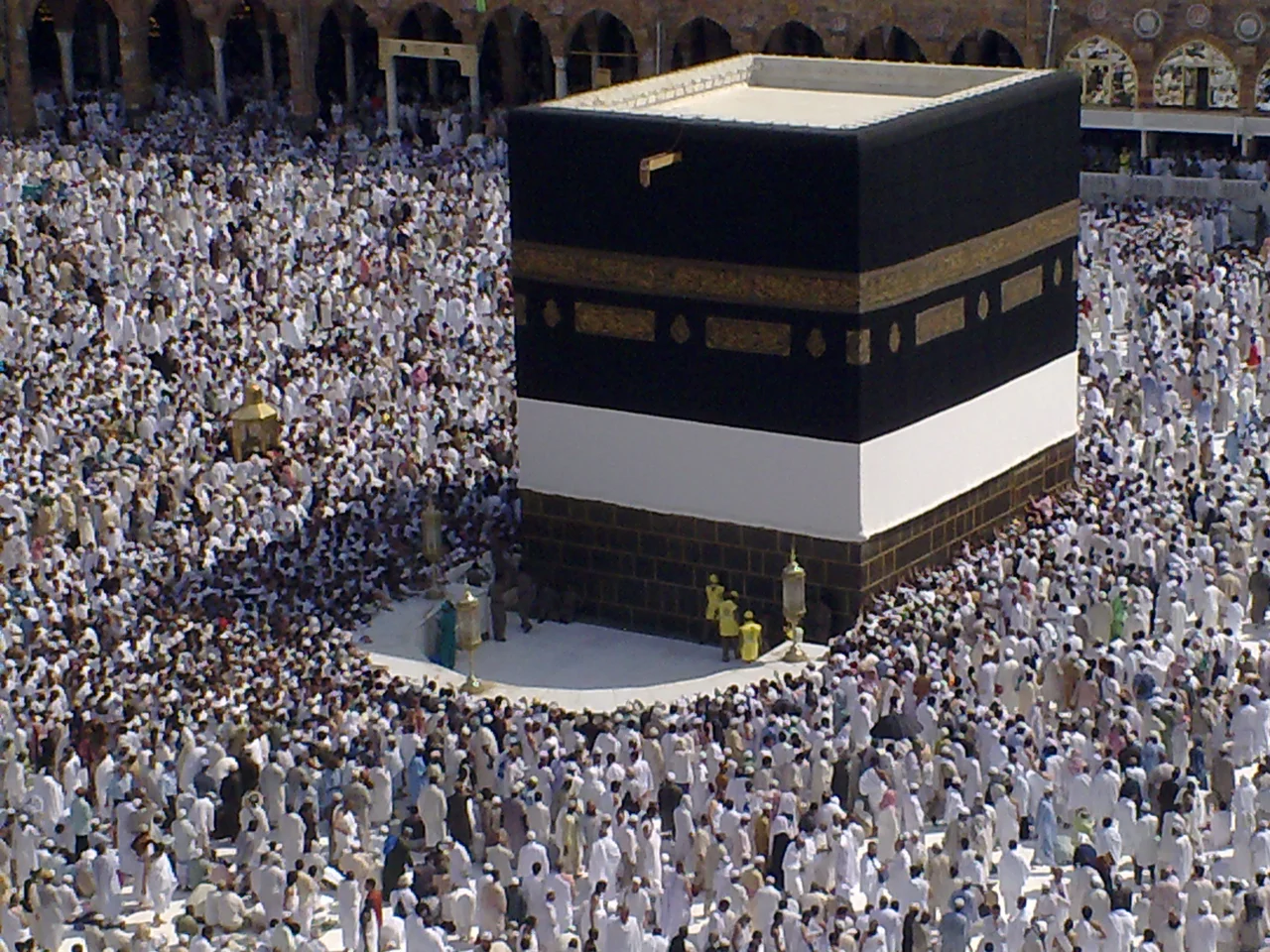
The wall is 1.33 meters high and 90 centimeters wide, made of white marble, curving in a crescent against the northwest face of the Kaaba without quite touching it. Pilgrims performing the Tawaf - the seven circuits around the Kaaba - walk outside it. Inside the crescent, bounded by that modest low wall, is a space no foot may press during pilgrimage. This is the Hijr Ismail, also called the Hateem. Millions pass within meters of it every year. Relatively few know why it is there, but the answer is one of the most grounded, strangely economic stories in early Islamic memory - a story about tribes running out of money.
The Shelter of a Mother and a Son
According to Islamic tradition, this crescent of ground is the place where the prophet Ibrahim (Abraham) built a shelter for his son Ismail (Ishmael) and Ismail's mother Hajar (Hagar) - the same family left in the desert, the same Hajar who ran between Safa and Marwah searching for water, the same Ismail beneath whose small foot the Zamzam spring first rose. The shelter itself is long gone, but the ground is remembered. In another layer of the tradition, Muhammad's grandfather Abdul Muttalib liked to sleep in this crescent beside the Kaaba, and one night a shadowy figure came to him in a dream and told him where the Zamzam well had been buried, forgotten since the time of the Jurhum tribe. He dug where the vision said, and the spring returned.
The Flood and the Roman Ship
When Muhammad was 35 - about 605 CE - a flood damaged the Kaaba, which had already been weakened by an earlier fire. The Quraysh, Mecca's ruling tribe, decided to rebuild it. They took a principled stand: they would not use money gained from usury or from any non-halal source. That decision constrained the budget. Word reached them of a Roman ship wrecked at a nearby port, its timber still salvageable. A delegation went out to buy the wood. They also hired one of the ship's passengers, a Greek or Coptic carpenter named Baqoom, who happened to be on board. The tribes each took on specific duties, and the nobles - including Muhammad and his uncle Abbas - personally carried stones. But when all the halal funds were gathered, they did not cover rebuilding the Kaaba to its original Abrahamic foundations. A section had to be left outside the walls. The Quraysh built the low crescent marker to indicate where the true foundation had once extended.
Aisha's Question
The early Islamic community remembered this explicitly. A hadith recorded by Bukhari describes a conversation between Muhammad and his wife Aisha. She asked whether the Hateem was part of the Kaaba. He said yes. She asked why then it was not inside the walls. He answered: "Because your people - the Quraysh - did not have sufficient funds." Aisha also reported that she once told Muhammad she wished to pray inside the Kaaba itself. He took her by the hand, led her into the crescent, and said: "Perform salah here if you wish to enter the Ka'bah, because this is part of the Baytullah" - part of the House of God. In another tradition, Muhammad told Aisha: "Had your people not very recently been in the Period of Ignorance, I would have had the Ka'bah demolished and included the left-out portion within its walls." He chose not to, to avoid unsettling new converts. The asymmetry remains.
The Rule of the Tawaf
About three meters of the ground adjacent to the crescent wall count, in legal terms, as part of the Kaaba itself. Scholars determined that pilgrims performing Tawaf must circle the complete area of the Hateem - meaning the crescent of ground as well as the cube. If you watch the endless slow motion of Tawaf, millions of white-clad figures circling counter-clockwise, you can see the path swing wide around that arc. There is a small detail on the Kaaba's roof, too: a golden waterspout called the Meezab-e-Rahmah, the "water outlet of mercy," originally installed by the Quraysh. When it rains over Mecca, rainwater from the Kaaba's roof pours down directly into the Hateem. Pilgrims fortunate enough to be standing there during a rare rain will sometimes touch the water and wipe it on their faces.
A Small Wall That Holds the Memory
Architecturally, the Hijr Ismail is nothing - a low crescent of white marble a pilgrim could step over without thinking. Theologically, it is a piece of the Kaaba. Historically, it is a monument to a community that chose ritual purity over completeness: a tribe that said we will rebuild God's house only with honest money, and if there is not enough, we will mark the gap and trust that God will understand. Today, pilgrims pray the voluntary two-rakat prayer in the crescent whenever they can get close - a near-substitute for praying inside the Kaaba itself, which is only opened ceremonially. For the Tawaf, they swing wide around it. For fourteen centuries, a tribe's budget shortage has been physically present in the architecture of Islam's holiest space, preserved as a gesture toward people long dead who chose, in 605 CE, to do things the right way even when they could not do them entirely.
From the Air
Located within the Grand Mosque of Mecca at 21.42°N, 39.83°E. Mecca airspace is restricted to all aircraft. The Hijr Ismail is a small feature within the larger mosque complex, invisible from the air even if overflight were permitted. Pilgrims and visitors who reach the Grand Mosque see it immediately beside the Kaaba's northwest face, marked by the white marble crescent wall. Nearest airport for pilgrims: King Abdulaziz International (OEJN) at Jeddah.
Nearby Stories
- Al-Balad, Jeddah 23 km away
- Jeddah Tower 33 km away
- Battle of Turubah 123 km away
- Red Sea Rift 143 km away
- Ghadir Khumm 159 km away
- Al-Baha 162 km away
- Thee Ain 206 km away
- Hejaz 214 km away