
Holy Name Cathedral, Brisbane
Thirty-five thousand people gathered in Fortitude Valley on 14 September 1928 to watch a cardinal lay a foundation stone. The cathedral that stone was meant to anchor would have been the largest church of any Christian denomination in the entire Southern Hemisphere, a vast English Baroque pile inspired by St Paul's in London, crowning a rise just outside the city centre. Its champion, Archbishop James Duhig, had the vision and the will to match the ambition. What he never quite had was the money. The Holy Name Cathedral was never built. Almost a century later, all that survives of the grandest church Brisbane never had is a length of perimeter wall along Ann Street.
The Archbishop's Grand Design
James Duhig was a builder by temperament, and Brisbane is dotted with his works, convents, schools, the hospital, churches in Toowong and Nundah, all commissioned during a career of relentless construction. The cathedral was to be his masterpiece. He turned to the Sydney firm of Hennessy, Hennessy and Co, whose design bore a strong family resemblance to St Joseph's Oratory in Montreal, then rising in Canada. The Brisbane cathedral would have been only slightly smaller than that landmark. First sketched in 1925 and refined into final plans by 1927, it was conceived on a scale meant not just to serve a congregation but to declare the permanence and ambition of the Catholic Church in a young Australian city.
Clearing the Ground for a Dream
The chosen site had history of its own. On a rise bounded by Gotha, Gipps, Ann and Wickham Streets stood a house called Dara, built in 1850 and, from 1859, home to Brisbane's Catholic bishops, first James Quinn, then Robert Dunne, then Duhig himself from 1917. To make way for his cathedral, Duhig had the bishop's own residence demolished. The land had come to the Church through a piece of municipal horse-trading: in 1914 the Brisbane mayor, choosing to build the City Hall elsewhere, sold the Fortitude Valley site to the Archdiocese. Duhig now had his hill. Concrete foundations went down in 1927, and the great public ceremony of 1928 followed, the cardinal, the crowd, the stone, all the confidence in the world.
A Stone Made for the Dream
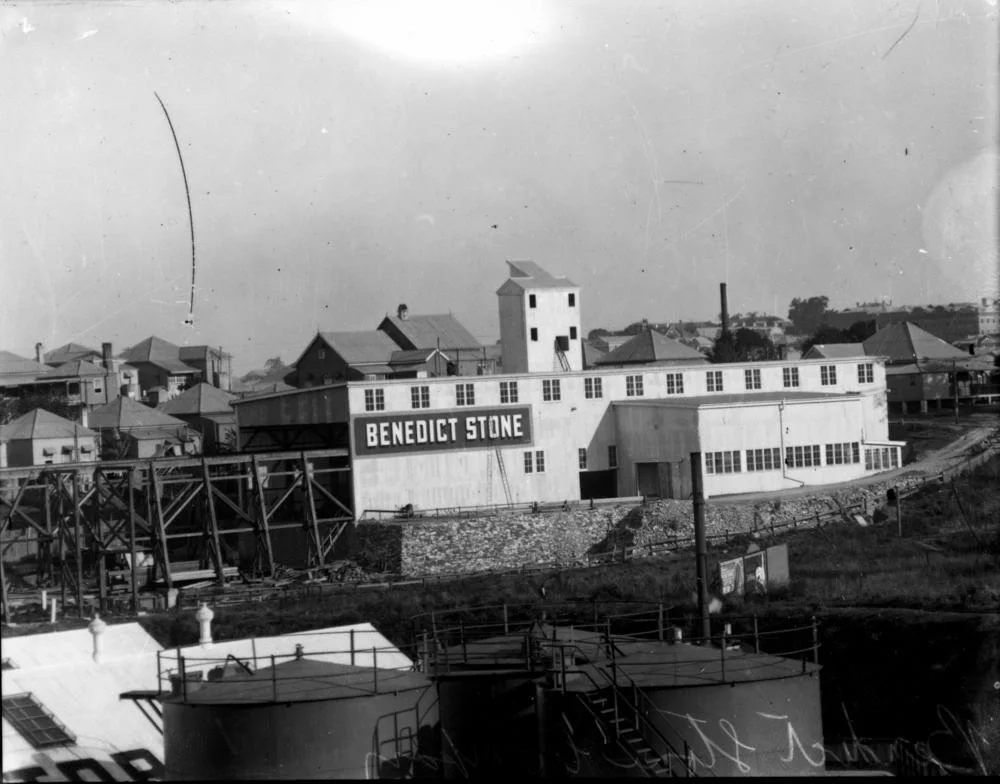
Duhig even manufactured his own building material. Benedict stone, a mixture of cement and crushed local Brisbane tuff, offered a cheaper alternative to solid stone facing, and Duhig obtained an American licence and opened a Benedict Stone works at Bowen Hills in August 1929. It tangled him in a web of obligation. An insurance company, Colonial Mutual Life, took a mortgage over Duhig's properties, including the stone works, and in turn used Benedict stone in its own offices and employed his architect and contractor, a circular arrangement meant to keep the money moving. The factory was a clever idea. But a clever supply chain cannot conjure funds out of an economy in freefall, and the timing could hardly have been worse.
When the Money Ran Out
Two disasters arrived in close succession. The Great Depression took hold in late 1929, and fund-raising for so enormous a project simply collapsed. Worse, Duhig had gambled Church money on oil shares in the Roma wells out west, an investment that failed and drained funds the cathedral desperately needed. The grand design was now impossible. Duhig salvaged what he could, scraping together enough to complete a single piece of the whole, a crypt, finished around 1934, with its altar consecrated the following year. Through the 1930s, services were held down in that crypt chapel, the only fragment of the great cathedral ever to rise. Above it, the hilltop stayed empty, the foundations waiting for a building that would never come.
The Cathedral That Never Was
The dream outlived its realism by decades. Even after Duhig died in 1965, the project was not formally abandoned until the 1970s, kept nominally alive long after everyone understood it was finished. In 1985 the Archdiocese sold the site, the crypt was demolished, and an apartment complex, fittingly named Cathedral Place, was built where the great church should have stood. Today only the perimeter walls along Ann Street and part of Gotha Street remain, topped by their balustrades, heritage-listed in 1992, a boundary around nothing. Duhig's foundation stones were carried to St Stephen's Cathedral in the city, which remains the seat of Brisbane's archbishop. They sit there now, a quiet monument to the most ambitious building Brisbane ever began and never finished.
From the Air
The cathedral site occupies a rise in Fortitude Valley around 27.463 degrees south, 153.029 degrees east, just north-east of central Brisbane, on a block bounded by Ann, Gotha, Gipps and Wickham Streets. From the air the spot is now the Cathedral Place apartment complex; the surviving heritage-listed perimeter walls trace the old cathedral boundary along Ann and Gotha Streets, with All Hallows' School nearby and the CBD towers rising to the south-west. The nearest major airport is Brisbane Airport (ICAO YBBN), about 10 kilometres to the north-east, with Archerfield Airport (YBAF) to the south. Best viewed by day, when the dense Valley streetscape and the rectangular footprint of the apartment block are clearly defined.
Nearby Stories
- Redcliffe Peninsula 2.7 km away
- Tamborine National Park 12 km away
- Cressbrook Homestead 27 km away
- Main Range National Park 31 km away
- 2010-2011 Queensland Floods 38 km away
- Cape Byron 96 km away
- Cape Byron Light 126 km away
- HMS Porpoise (1799) 588 km away