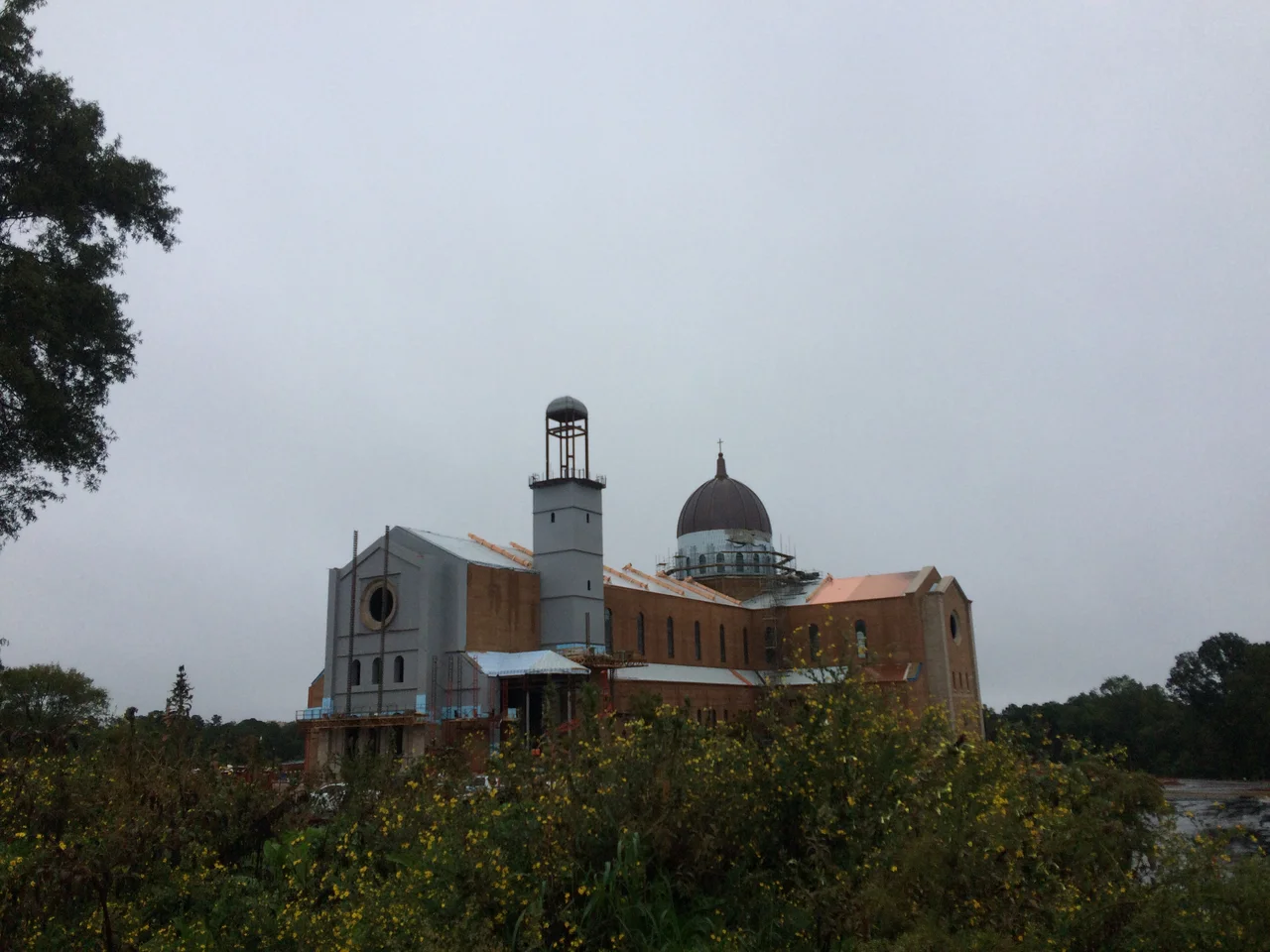

Holy Name of Jesus Cathedral
The dome went up first. Engineers at Clancy & Theys assembled the 162-ton copper-clad ribbed structure on the ground in west Raleigh, then crane-lifted it into place atop the still-rising sanctuary walls. From its finial it stood 173 feet above the ground. Underneath, two thousand seats waited. When Holy Name of Jesus Cathedral was dedicated on July 26, 2017, it became the fifth-largest Catholic cathedral in the United States, a Romanesque Revival vessel for the half a million Catholics of eastern North Carolina who had outgrown their previous cathedral six times over.
From Orphanage to Cathedral Campus
In 1899, Father Thomas Frederick Price and his sister, Sister Mary Agnes of the Sisters of Mercy, founded a Catholic orphanage on land Father Price had purchased at the edge of Raleigh. The Nazareth Orphanage served boys first, then girls; in the early 1950s, Bishop Vincent Waters ordered the diocese to integrate, and Nazareth's high school students transferred to Cathedral Latin at Sacred Heart. Two years later the elementary school closed. In the 1960s, Bishop Waters built Cardinal Gibbons High School on part of the property. The diocesan offices stayed on site until 2014. When Bishop Michael Burbidge announced a new cathedral in 2011, it would rise on the same ground where the orphanage had stood for a century.
Forty-Six Million Dollars and a Roman Plan
Designed by the architecture firm O'Brien & Keane of Arlington, Virginia, and built by Clancy & Theys of Raleigh, the cathedral cost $46 million. Construction began with a January 3, 2015 groundbreaking. The plan is cruciform, oriented east-west in keeping with Catholic tradition. The nave holds a thousand worshippers, each transept five hundred more. The barrel-vaulted ceiling above reaches just under seventy-eight feet. The exterior is wood-mold rose-colored brick with grapevine mortar joints, a deliberate echo of older Carolina churches, accented with cast stone. The four cardinal facades are punctuated by twenty-two bays of paired arched windows, with single arched clerestory windows above. Forty-nine of the fifty bells in the carillon were cast by Verdin Bells & Clocks; the fiftieth was salvaged from the original Holy Name of Jesus Chapel that once stood on the same property.
Salvaged Windows, a Pope's Blessing, and the Diamond Motif
Many of the stained-glass windows came from a closed Philadelphia parish, the Church of the Ascension of Our Lord. Originally designed by Paula Balano, they were restored by Beyer Studios and reinstalled in Raleigh, where smaller windows that once flanked larger ones at the clerestory level were repositioned to the ground floor but kept in their original pairings. Beyer Studios designed alternating new windows whose diamond-patterned fields echo the diamond motif that runs through the cathedral, including the lighting fixtures and interior door glazing, and which references the seven diamonds on the Diocese of Raleigh's coat of arms. The cornerstone, cut from Santafiora stone and inscribed with a gold Christogram and the year 2017, was blessed personally by Pope Francis in December 2015 when Bishop Burbidge presented it to him at the Vatican. It was installed July 21, 2017, five days before dedication.
Marble, Saints, and a Tabernacle Like a Tiny Cathedral
Inside, the sanctuary sits beneath the dome. The altar, ambo, and cathedra are carved Bianco Carrara C marble with Giallo Siena marble accents. The baptismal font, six feet across, rests on an octagonal pattern of Bardiglio Nuvolato marble laid so the natural veins appear to radiate outward like water. The tabernacle, set on a high platform in the eastern apse, was designed as a miniature idealized cathedral, complete with a lapis lazuli and mother-of-pearl roundel standing in for a rose window and a gold door. Twenty-four statues of saints line the side aisles, with one niche reserved for Father Thomas Price, the first native North Carolinian ordained a Catholic priest. His cause for canonization is under review in Rome. The fourteen Stations of the Cross are restored painted wood of similar vintage to the Philadelphia windows. The carillon bells are inscribed with the personal mottos of the five bishops of Raleigh, ranging from "Emitte Spiritum Tuum" to "Walk humbly with God."
From the Air
Holy Name of Jesus Cathedral stands at 35.777°N, 78.670°W in west Raleigh, just south of Western Boulevard and east of NC State's Centennial Campus. Raleigh-Durham International (KRDU) is six miles northwest. The copper dome reaches 173 feet and the bell tower 154 feet, making the cathedral the most prominent religious landmark on Raleigh's western skyline. From 2,000 feet AGL on a clear afternoon, the green-bright copper of the dome catches sun visibly from miles away.
Nearby Stories
- Sanford, North Carolina 7.6 km away
- Wilson, North Carolina 12 km away
- Cherry Hospital 13 km away
- Campbell University 19 km away
- North Carolina Tornado Outbreak of April 2014 21 km away
- Neuse River 23 km away
- Coal Glen Mine Disaster 26 km away
- Alamance County, North Carolina 27 km away