.jpg)
Huddersfield
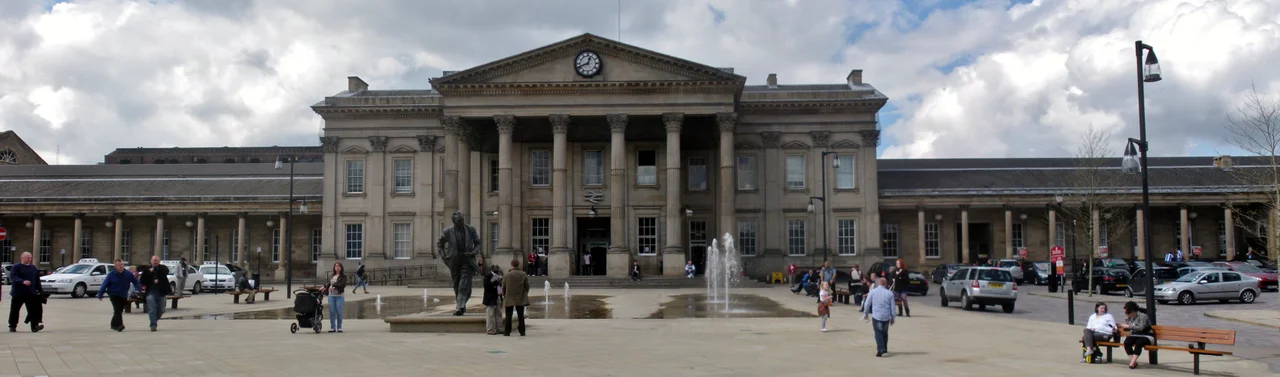
The poet John Betjeman, who made a career of finding beauty in unfashionable places, declared that Huddersfield Railway Station had the finest facade of any such building in England. Arrive by train from Manchester or Leeds and you will see what he meant. The colonnaded stone front opens onto St George's Square like a Roman senate house dropped into a Yorkshire mill town, and the surprise of it sets the tone for everything that follows. Huddersfield has spent two centuries being underestimated by people who have not yet bothered to look.
The Town That Bought Itself
Huddersfield is in the metropolitan borough of Kirklees in West Yorkshire, in the foothills of the Pennines where the Colne and Holme rivers meet before joining the Calder. Historically it was a textile town, one of the great Victorian centres of wool, and the soft Pennine water that came down off the moors made it possible. The mills are mostly gone now, but the buildings the wool money built remain. Only Westminster and Bristol have more listed buildings than Huddersfield, a fact that surprises visitors who arrive expecting a grimy northern relic. What they find instead is sandstone, cornices, and the unmistakable air of a place that took itself seriously when it had every reason to.
Rugby League, Born in a Hotel Bar
On 29 August 1895, twenty-one northern clubs met in a room at the George Hotel in St George's Square and broke away from the Rugby Football Union over the question of paying working men for time lost from work on match days. What they hammered out over the next few hours became rugby league, the working-class cousin of the union game, and the room where it happened is still there. The Founders Bar at the George remains an unassuming corner of an unassuming hotel, but the city's Huddersfield Giants still carry the inheritance, playing at the John Smith's Stadium they share with Huddersfield Town. Football matters too. In the 1920s, Huddersfield Town became the first English club to win the league championship three years running, a feat only four other clubs have ever matched.
Famous Sons, Quiet Pubs
Harold Wilson, the Labour Prime Minister who won four general elections, was born in Huddersfield and attended Royds Hall School; his bronze statue stands at the railway station's entrance. The actor James Mason came from here too, as did Gordon Kaye, the warm-hearted star of Allo Allo. None of them gets much fanfare in the town itself. Huddersfield does not boast. It prefers to leave you to discover, in your own time, that the unassuming pub at the end of a steep lane in Linthwaite, the Sair Inn, brews its own beer and feels like 1850. It prefers to let you stumble into Byram Arcade, a three-storey Victorian shopping arcade on Westgate, and realise it has been there longer than your country has existed. The Pulse FM signal on 102.5 still tells you what is on tonight.
Out the Door, Up the Hill
What people forget about Huddersfield is how quickly you can leave it. Buses run from the central station off Westgate to the Colne and Holme valleys, climbing into countryside that has been called the most filmed in Britain. The Holme Valley around Holmfirth was the home of Last of the Summer Wine; Slaithwaite and Marsden hosted The League of Gentlemen and Where the Heart Is. Beyond them rise the moors of the South Pennines, with the Peak District a short drive south and the Yorkshire Dales an easy day to the north. York and Harrogate are equally reachable. Huddersfield sits in the middle of all this and provides what every good base provides: a place to come back to that turns out to be worth staying in.
From the Air
Located at 53.645 N, 1.780 W in the eastern foothills of the Pennines. Cruising altitude of 4,000-6,000 ft offers fine views of the Colne and Holme valleys converging east of the town. Nearest major airports are Leeds Bradford (EGNM) about 15 nm northeast and Manchester (EGCC) 22 nm southwest. Castle Hill, topped by the Victoria Tower, is a conspicuous visual landmark southwest of the centre. Weather is temperate oceanic, with frequent low cloud over the moors in winter.
Nearby Stories
- Ribston Hall 1.5 km away
- Bolton Priory 3.5 km away
- Clifton Park and Museum 4 km away
- Blackburn 5 km away
- Nostell Priory 5.5 km away
- Mellor Mill 9.4 km away
- Warrington bombings 10 km away
- Ashton Memorial 23 km away