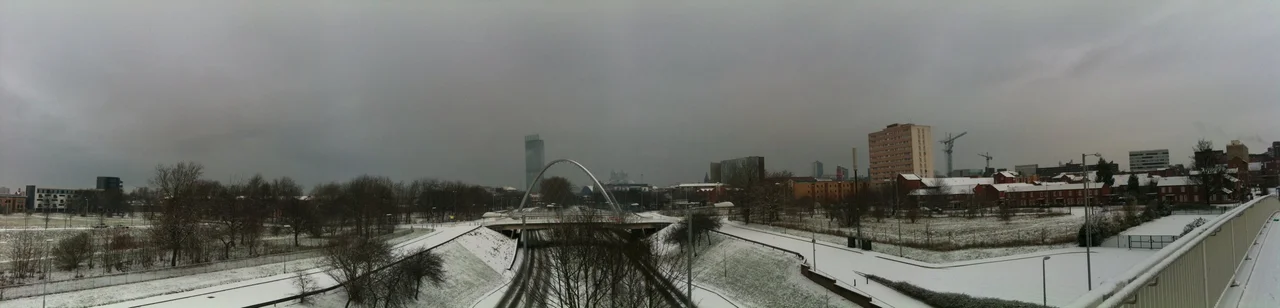

Hulme
In 1884, in a workshop at the corner of Cooke Street, a fastidious young engineer named Henry Royce was building electric crane parts. Twenty years later, he would meet Charles Rolls at the Midland Hotel a mile away and assemble the first Rolls-Royce motor cars on the same Hulme street. The Silver Ghost rolled out of here. So did the V-8. Operations moved to Derby within a few years, but Hulme had already stamped itself onto an industry it would never see again. The street names remember: Royce Road, Rolls Crescent, Bentley House.
The Norse Island
The name itself is a relic of Vikings. Hulme comes from the Old Norse holmr, meaning a small island or a patch of dry land surrounded by water and marsh. Look at a map of medieval Manchester and the description fits: the rivers Irwell, Medlock, and Corn Brook hemmed the area on three sides. Place-name scholars have long argued that the cluster of Danish names south of Manchester points to a small Scandinavian colony on the north bank of the Mersey, an outpost of the Danelaw. For centuries after, the holm stayed rural. Pictures from the early 18th century show crops, hedgerows, and country lanes where tower blocks would later rise. Then the Bridgewater Canal arrived in the 1760s, the Duke's cheap Worsley coal arrived with it, and the textile mills of Manchester began their hungry climb.
The Smoke That Blocked the Sun
By 1801 Hulme had 1,677 people. By 1871 it had 74,731. The population had multiplied fiftyfold in fifty years, and the housing built to absorb that flood was rapid, cheap, and bad. Cotton mills crowded together with terraces and railway viaducts; contemporary accounts describe air so thick with smoke and chimney fumes that it 'blocked out the sun' for days at a stretch. Just over the Medlock sat Little Ireland, a slum so notorious that Friedrich Engels, working at his father's mill nearby, made it the centrepiece of The Condition of the Working Class in England. The Medlock itself, raised by embankments to protect the factories, hung above the surrounding hovels and flooded them with filthy water whenever it rained. By 1844 Manchester Borough Council had to pass a law banning further building in Hulme. Thousands of those slum houses were still occupied a hundred years later.
Cities in the Sky
After the war the planners decided to start again. In the 1960s and early 1970s, much of Victorian Hulme was demolished and replaced with the Hulme Crescents, a curved sweep of deck-access concrete blocks designed to house 13,000 in what architects called 'cities in the sky'. The Crescents went wrong almost immediately. Damp, vermin, broken lifts, asbestos in the council stock, and a creeping reputation for crime hollowed out the official tenancy and refilled it with squatters, students, and artists who paid no rent and asked no questions. By the 1980s Hulme had become a counterculture island in the middle of Manchester, a place where bands rehearsed in empty flats and the Hacienda generation served its apprenticeship. The decision to demolish the Crescents in the early 1990s was, depending on who you ask, either an act of mercy or the end of something irreplaceable.
After the Concrete
Between 1990 and 2002 more than £400 million of public and private money was poured into Hulme and neighbouring Moss Side. Low-rise houses replaced tower blocks. The Birley Fields campus of Manchester Metropolitan University arrived, then the Zion Arts Centre in the old Congregational Church where Pavarotti once sang and where Warren Beatty filmed a mass rally for Reds. The Hulme Community Garden Centre grows food on land that used to be a car park. Asbestos campaigner John Shiers, who fought for years over the toxic council housing in the area, died of mesothelioma in 2011; Manchester City Council admitted limited liability as his landlord. The neighbourhood today is a 15-minute walk from the city centre and full of young professionals chasing cheaper rents, but the older pubs and the murals on Hulme Library still keep a memory of what was here before.
Hulme's Children
The list of people Hulme has raised is uncommonly long for a square mile of inner-city Manchester. Morrissey grew up here and in neighbouring Stretford before fronting the Smiths. Billy Duffy of The Cult was a Hulme boy. The poet Lemn Sissay spent the first 17 years of his life in care in Hulme and the surrounding areas; the film critic Mark Kermode lived here as a student. Albert Scanlon, the Manchester United winger who survived the 1958 Munich air disaster, was born in Hulme in 1935. So was John Foulds, the largely self-taught Edwardian composer. Hulme has always been the kind of place that produces voices first and respectability afterwards, which is perhaps the most Mancunian thing about it.
From the Air
Hulme sits at 53.4636°N, 2.25°W, immediately south of Manchester city centre across the River Medlock. Recommended viewing altitude 1,500-3,000 ft AGL. From the air, look for the Mancunian Way flyover bounding it to the north, the green wedge of Hulme Park, and the residential street grid that replaced the curved footprints of the demolished Crescents. Nearest ICAO airports: Manchester (EGCC) 8 nm south-southwest, Manchester Barton (EGCB) 5 nm west-northwest. Greater Manchester's frequent low cloud and drizzle often limit visibility; clearer flying weather typically comes in late spring or early autumn.
Nearby Stories
- National Science and Media Museum 0.2 km away
- Jodrell Bank Observatory 3.2 km away
- Siege of Lathom House 5.6 km away
- Chester Zoo 6.2 km away
- Whalley Abbey 8.9 km away
- Haddon Hall 10 km away
- Wentworth Castle 16 km away
- Blackpool 16 km away