
Iglesia de San Francisco, Santiago de Chile
Count the earthquakes this church has survived and you start to understand why Santiago treats it as something close to a miracle. Roughly fifteen tremors of magnitude seven or greater have shaken the city since the Iglesia de San Francisco was consecrated in 1622, and the thick masonry body of the church has weathered nearly all of them, even as towers fell and were rebuilt around it. On the busy Alameda, where modern Santiago rushes past, the oldest building in the city stands its ground, anchored, the soil beneath it suggests, on foundations older than the Spanish themselves.
A Stone from the First Days
The story reaches back to the very founding of Santiago. Conquistador Pedro de Valdivia is said to have carried a small wooden image of the Virgin, the Virgen del Socorro, when he arrived in 1541, and a hermitage to house it rose on this spot in the city's earliest years. The Franciscans took up the site, and work on the church and its convent followed. The image still rests on the high altar today, one of the oldest objects in Chile to remain where centuries of worshippers have sought it out, a thread of continuity running from the conquest to the present.
Built to Endure
Chile sits on one of the most violent seismic zones on Earth, and the church's survival is no accident of luck alone. Its nave was widened with side aisles over time, turning the original cross-shaped plan into a sturdy rectangle of solid masonry. The towers proved the weak point. The first bell tower fell in the earthquake of 1647, damaging part of the choir while the body of the church held. A rebuilt tower was badly hurt in 1730 and torn down in 1751. Researchers studying the ground beneath the church have even suggested it rests on a pre-Hispanic stratum that helps it ride out the shaking.
The Ceiling and the Clock
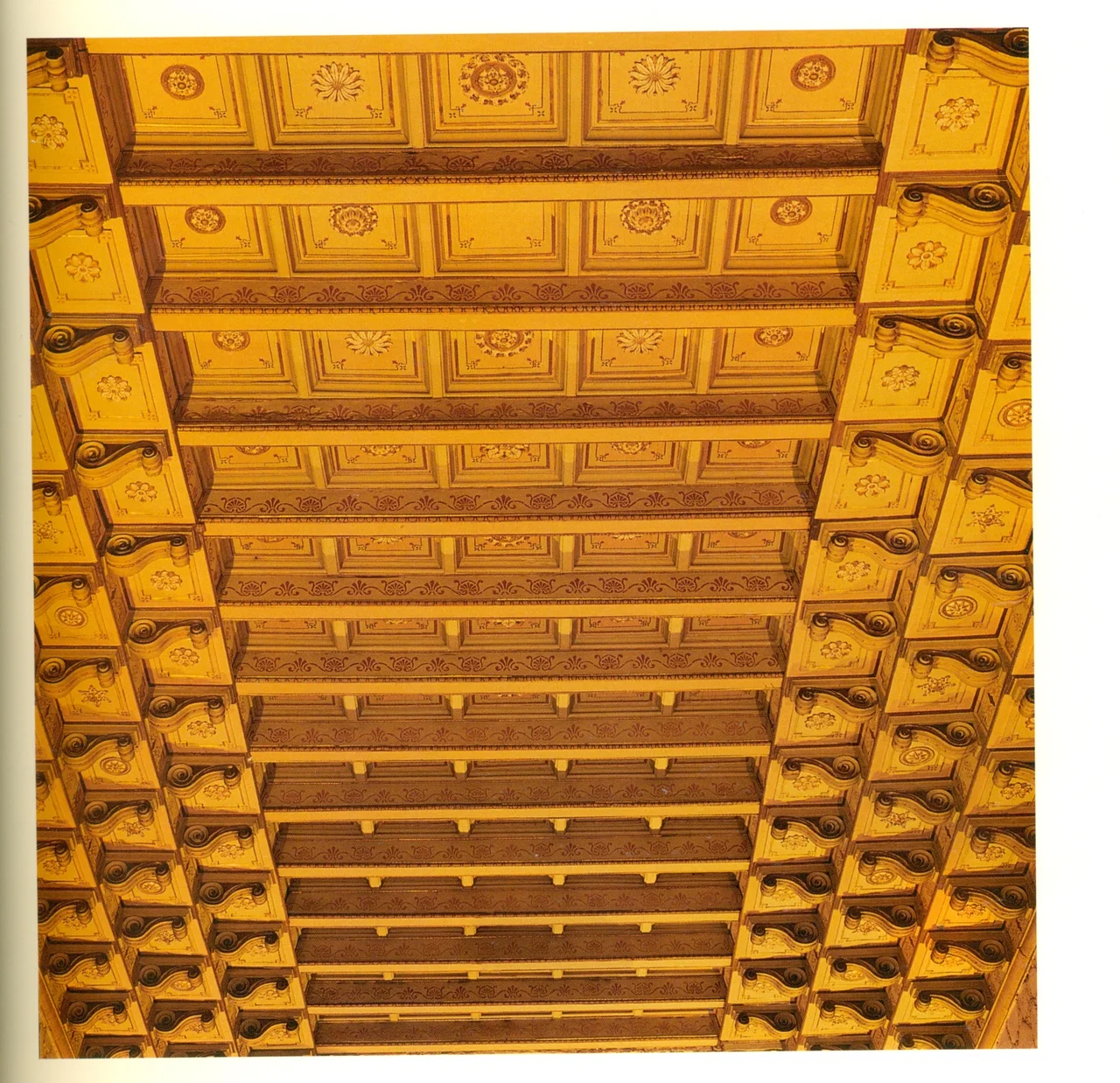
Look up inside the nave and the ceiling tells its own story. The coffered wooden ceiling is Mudéjar in style, a tradition of geometric Islamic-influenced woodwork carried across the Atlantic from Spain, and its construction began as early as 1615, before the church was even consecrated. The bell tower that finally endured belongs to a much later age. Built in the mid-1800s in a Victorian manner by the Chilean architect Fermín Vivaceta, it carries a distinctive clock and gives the old colonial church its familiar silhouette above the Alameda.
A Neighborhood Around a Relic
The church no longer stands alone. In the early twentieth century, part of the old convent was sold and cleared to make way for the Barrio París-Londres, a charming pocket of curving European-style streets that remains one of central Santiago's most beloved corners. What survived of the convent now houses the Museo Colonial, where colonial art keeps company with the church's long memory. Together they form a small island of the deep past in a restless capital, a place where the city can still touch its own beginnings.
From the Air
The Iglesia de San Francisco stands at 33.44°S, 70.65°W on the Alameda (Avenida Libertador General Bernardo O'Higgins) in central Santiago. From the air, look for its squat masonry body and the taller Victorian bell tower along the broad diagonal sweep of the Alameda, with the charming curved streets of Barrio París-Londres tucked just beside it. The green knoll of Santa Lucía Hill rises a few blocks to the northeast, and the Andes form the basin's eastern wall. Best viewed at lower altitudes in clear conditions; the summer months (December–February) offer the cleanest air, while winter inversions can trap haze over downtown. Nearest major airport is Arturo Merino Benítez International (SCEL), roughly 15 km northwest; Eulogio Sánchez Airport (SCTB) lies to the southeast.
Nearby Stories
- Paine Memorial 21 km away
- 1947 BSAA Avro Lancastrian Star Dust accident 23 km away
- Battle of Chacabuco 31 km away
- La Campana National Park 36 km away
- Puente del Inca 44 km away
- Casa de Isla Negra 62 km away
- Santa Cruz, Chile 103 km away
- Pierre Auger Observatory 172 km away