
Imperial War Museum North
Daniel Libeskind asked his clients to imagine a globe shattered by war, then to pick up three of the broken pieces and build a museum out of them. That is the simplest way to read the Imperial War Museum North, which opened on Trafford Wharf in July 2002. One shard is air, one is earth, one is water, and the seams where they meet are uneasy on purpose. Libeskind, born in Lodz in 1946 to a Polish-Jewish family that lost dozens of relatives in the Holocaust, was making his first building in the United Kingdom. He wanted, in his words, to 'emotionally move the soul of the visitor toward a sometimes unexpected realization.' Standing under the canted walls of the air shard at dusk, exposed to the Manchester rain, most visitors get there.
Why This Site
Trafford Park, just across the Manchester Ship Canal from the new museum, is not an arbitrary choice. During the Second World War this district built Avro Lancaster heavy bombers and Rolls-Royce Merlin engines that powered Spitfires and Hurricanes. By 1945 some 75,000 people worked here. The Luftwaffe knew the address. On the nights of 22 and 23 December 1940, the Manchester Blitz killed 684 people in raids that targeted the factories and burned through the surrounding streets. The museum stands on land where the war was made and where the war came home. Across the water, the Lowry and the BBC's MediaCityUK now share the skyline, but the Ship Canal itself still smells of industrial water and the cranes of an older Salford.
Three Shards
The 55-metre air shard rises like a wind-bent blade and contains the entrance and a viewing balcony, now closed to the public, that once gave visitors a thin slice of Manchester's skyline through gaps in the cladding. The earth shard holds the main exhibition space, a windowless dark hall in which the projections take over the walls. The water shard houses the cafe, looking out at the canal. Cost cuts during construction forced the substitution of metal for concrete on the cladding, killed a planned auditorium, and trimmed the landscaping. War correspondent Kate Adie led the final fundraising push that closed the gap. The shortlist for the 2004 Stirling Prize confirmed the building had survived its compromises.
The Big Picture
When the budget tightened, the original exhibition plan was scrapped and a new idea took over: the walls themselves would become the show. Every hour, lights dim, and the gallery becomes a theatre. Up to 1,500 images from the Imperial War Museum's archive wash across the curved walls, paired with voices from the museum's oral history collection. A grandmother in Coventry. A soldier in Helmand. A nurse in Bosnia. Originally 60 synchronised slide projectors threw the images; the technology has changed, but the immersive shock has not. Critics who came expecting a traditional collection of artefacts left talking about the projections and the building. The artefacts that are there earn their place: a Soviet T-34 tank, a U.S. Marine Corps AV-8A Harrier, a Berlin Wall searchlight, the British Army's first 13-pounder gun of the First World War, and a seven-metre section of twisted steel from the World Trade Center, brought here because Libeskind would later draw the masterplan for that site too.
Art Among the Engines
Three paintings in particular reward attention. Anna Airy's The 'L' Press, painted in 1918 at the Armstrong-Whitworth works in Openshaw, shows the forging of an 18-inch gun barrel and was Airy's commission from the new women-only War Artists scheme. Flora Lion's Building Flying-Boats records the women who built seaplanes in 1919. And L. S. Lowry's Going to Work, painted in 1943, shows workers streaming towards a factory under a smoky northern sky, a scene Mancunians knew by heart. The Witness series of temporary exhibitions has drawn on the museum's deeper collections, including under-shown female war artists, and the WaterWay passageway between shards hosts photographic work like Ghislaine Howard's painted series 365, made from a year of news photographs.
Vehicles Outside
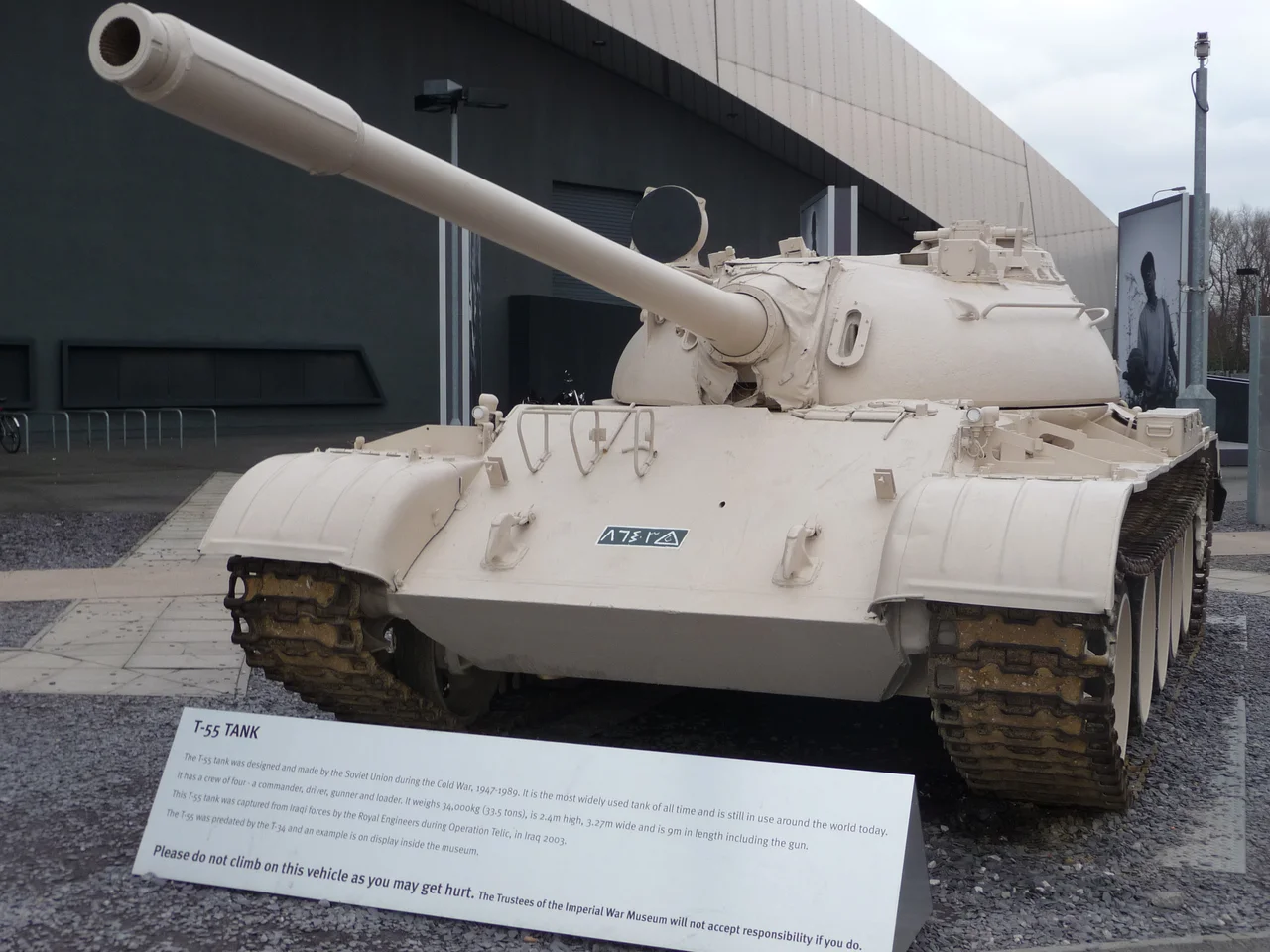
Two captured vehicles have rotated through the spot outside the main entrance. A ZSU-23-4 Shilka anti-aircraft gun, taken by the Royal Artillery after the 1991 Gulf War, moved here from IWM Duxford for the museum's fifth anniversary in 2007. The following August it was replaced by a T-55 tank captured by the Royal Engineers during the 2003 Iraq War. The choice to display them outdoors, weathered by Salford rain, sharpens the museum's central argument: these were not abstract weapons. They belonged to specific people, in specific countries, who used them or had them used against them, and the consequences are still being lived. Admission is free, the same as every branch of the Imperial War Museum, which is the most quietly radical thing about it.
From the Air
IWM North sits at 53.4697°N, 2.29889°W on the south bank of the Manchester Ship Canal at Trafford Wharf, directly opposite the Lowry and MediaCityUK at Salford Quays. Recommended viewing altitude 1,500-3,000 ft AGL. The angular silver shards are easy to pick out against the surrounding warehouses and dock basins. Nearest ICAO airports: Manchester (EGCC) 6 nm south, Manchester Barton (EGCB) 3 nm west, Liverpool John Lennon (EGGP) 25 nm west. The Ship Canal is a useful long thin landmark running roughly east-west; the museum sits where the canal narrows toward the basin at Trafford Wharf. Low cloud is common and visibility often drops in winter.
Nearby Stories
- National Science and Media Museum 0.2 km away
- Jodrell Bank Observatory 3.2 km away
- Siege of Lathom House 5.6 km away
- Chester Zoo 6.2 km away
- Whalley Abbey 8.9 km away
- Haddon Hall 10 km away
- Wentworth Castle 16 km away
- Blackpool 16 km away