
Iron Mike
The phrase started at sea. Iron Mike was what early-twentieth-century sailors called a gyrocompass - the mechanical brain that keeps a ship pointing the way it set out to go, no matter how the wind shifts. By extension, an Iron Mike came to mean a man like that: unwavering, tough, the kind who holds a line. The slang traveled from ships to barracks, and from barracks to bronze. At some point in the first half of the century, soldiers and Marines began calling their unit memorials Iron Mike too. Sculptors never used the name. The men who marched past the statues every morning did, and over the generations the official titles faded while the nickname stuck.
Quantico's Mistake
The first Iron Mike was technically a misunderstanding. After World War I, Army General John J. Pershing commissioned French sculptor Charles Raphael Peyre to commemorate the doughboys of the American Expeditionary Forces. Peyre, working in Paris and unfamiliar with the visual differences between U.S. service branches, used a Marine private as his model and placed the Eagle, Globe and Anchor insignia on the figure's helmet. When Pershing saw the finished statue, he insisted the Marine insignia come off. Peyre refused to alter his work. The Army declined to buy. Eventually Marine Corps General Smedley Butler - who had two Medals of Honor and few patience for bureaucratic stalemates - raised the money himself. The statue, officially titled Crusading for Right, was installed at Marine Corps Base Quantico in December 1921. It became the prototype Iron Mike. The full-sized reproduction now stands in front of the National Museum of the Marine Corps in Triangle, Virginia, where pedestal lettering finally formalized the nickname.
The Hiebert Trooper
The Iron Mike most associated with Fort Bragg is officially called The Airborne Trooper. Sculpted by Leah Hiebert between 1960 and 1961, the figure stands sixteen feet from boot heel to helmet top and depicts a World War II paratrooper with a Thompson submachine gun at the ready. Hiebert worked from a living model: Sergeant Major James Runyon, an active-duty paratrooper whose proportions and bearing she captured in painstaking sittings. The statue was the vision of Lieutenant General Robert F. Sink, former XVIII Airborne Corps commander, and was meant to honor not a particular man or unit but every paratrooper who ever jumped. The dedication ceremony in September 1961 drew fifteen general officers - Omar Bradley, Matthew Ridgway, Anthony McAuliffe (the same McAuliffe who said "Nuts!" at Bastogne), Maxwell Taylor, William Westmoreland, and others. The original statue was made of polyester strips dipped in epoxy stretched over a steel frame - durable but not eternal. In 2005, after deterioration set in, the original was replaced with a faithful bronze version, with a digital scan of the Hiebert original used to ensure the replica was accurate.
Two Mikes, Two Homes
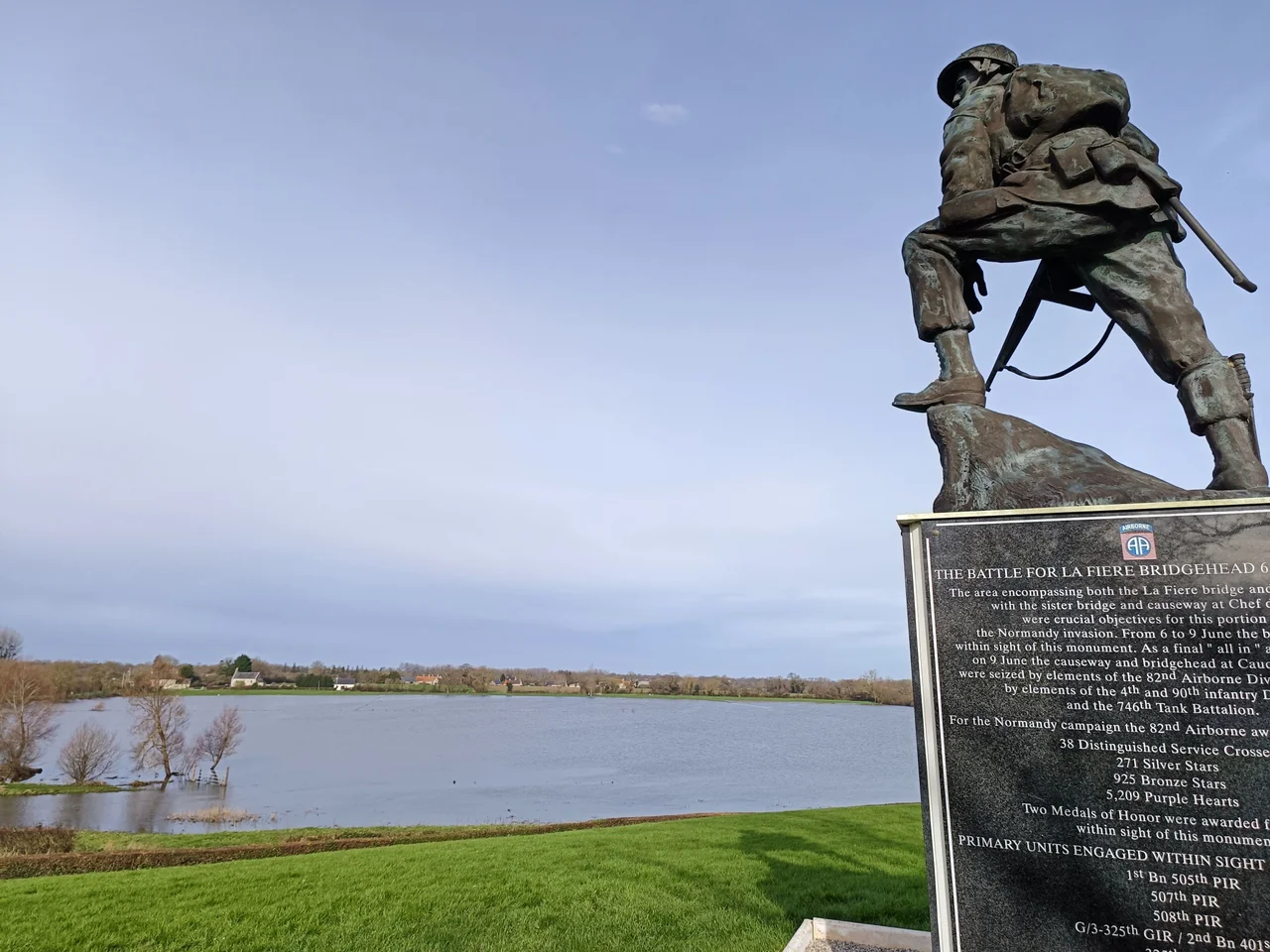
The original 1961 statue did not get thrown away. It was refurbished and on June 14, 2010, moved to the Airborne and Special Operations Museum in downtown Fayetteville. The bronze replica now stands at the traffic circle in front of Fort Bragg's post headquarters - moved there from the original Bragg Boulevard location in 1979 to prevent vandalism and increase visibility. Soldiers reporting for duty drive past it on their first morning. Soldiers leaving the service salute it on their last. President George W. Bush spoke in front of the bronze version on July 4, 2006, addressing a Fort Bragg crowd in what was becoming a kind of annual ritual at the statue's base. A second bronze replica of The Airborne Trooper stands above the bridge at La Fiere in Normandy, where on June 6-9, 1944 paratroopers of the 505th Parachute Infantry Regiment and 325th Glider Infantry Regiment - both elements of the 82nd Airborne Division - fought a four-day battle against German armor and infantry for control of a small stone bridge over the Merderet River. The Germans needed the bridge to break up the Utah Beach landings. The Americans needed it to expand their beachhead. The Germans never crossed. The La Fiere monument was unveiled June 7, 1997, on land that still holds the names of paratroopers who died holding it.
All the Other Mikes
At least a dozen other statues across the country have picked up the Iron Mike nickname over the years. Parris Island has one by Robert Ingersoll Aitken, sculptor of the U.S. Supreme Court Building pediment - a Marine carrying a Vickers machine gun, dedicated in 1924 to graduates who died in World War I. Belleau Wood in France has The Marine Memorial by Felix Weihs de Weldon, the same sculptor who later created the Marine Corps War Memorial at Arlington. The University of Minnesota's Iron Mike is actually The Hiker by Theo Alice Ruggles Kitson, installed in 1906 - one of thirty-nine copies of Kitson's tribute to Spanish-American War veterans scattered from Maine to California. Fort Moore has Follow Me, often mistakenly called Iron Mike. Fort Lewis, Washington has The Infantryman, modeled after the Fort Bragg trooper but rendered in early Vietnam-era kit with an M14 rifle. There is even an Iron Mike that is not a statue at all: a steep ridge at Marine Corps Logistics Base Barstow named for the determination required to run up without stopping. The same nickname at Camp Pendleton refers to a different running course. Iron Mike, in the end, is less a sculpture than an idea - the unwavering one, the figure who holds his ground - and any monument or hill that asks soldiers to be like that eventually earns the name.
From the Air
The Fort Bragg Iron Mike (The Airborne Trooper) stands in the traffic circle at the post headquarters at 35.15°N, 78.99°W. Simmons Army Airfield (KFBG) is on the installation. Pope Field (KPOB) lies just to the north. Fayetteville Regional Airport (KFAY) handles civilian commercial traffic about 13nm south. Most of Fort Bragg sits under restricted airspace - check NOTAMs before any operations near the post. From the air, the statue is too small to spot directly, but the headquarters complex with its open traffic circle is the navigational reference point.
Nearby Stories
- Laurinburg, North Carolina 4.7 km away
- Sampson County, North Carolina 9.1 km away
- Rockingham Speedway 18 km away
- Campbell University 19 km away
- The Robesonian Takeover 20 km away
- Johnston County, North Carolina 21 km away
- North Carolina Aviation Museum 53 km away
- Pender County, North Carolina 57 km away