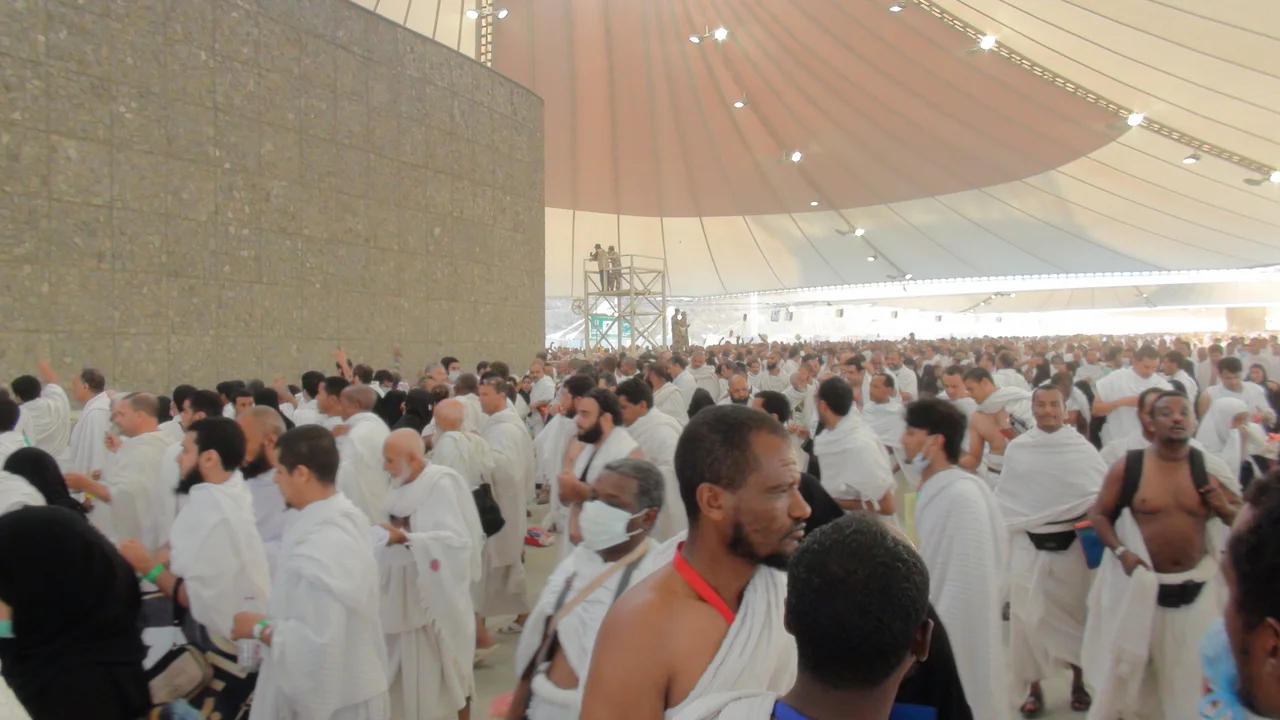

Jamaraat Bridge
Keith Still, the British crowd scientist who was consulted on the bridge's redesign, once put the problem this way: the Jamaraat Bridge can move five hundred thousand people an hour. That is a full-capacity football stadium every twenty-four minutes, or the entire population of Germany in a week. For most of its life, the bridge could not move enough. Pilgrims arrived faster than they could leave. Crowds compressed against themselves. And in 1994, 1998, 2001, 2003, 2004, and 2006, pilgrims died in the valley of Mina because the geometry of a concrete ramp and three pillars could not bear the weight of human faith.
The Ritual and the Bridge
The stones are small, pebble-sized, gathered the night before at Muzdalifah. In the final days of the Hajj, pilgrims cast them at three pillars called the jamarat, reenacting Ibrahim's stoning of Shaytan in the Islamic tradition of the patriarch's trial. The pillars themselves are ancient in concept, but the Jamaraat Bridge, built in 1963 to ease access, is modern. For decades it was a single-level ramp with three openings through which the pillars rose. More than a million people might gather there on a single day. The word jamaraat is the plural of jamraah, the Arabic term for a small stone or pebble. What followed, too often, was the arithmetic of too many people and not enough space.
The Names of the Dead
On 23 May 1994, at least 270 pilgrims died in a stampede. On 9 April 1998, another 118 were trampled, 180 more injured. On 5 March 2001, 35. On 11 February 2003, 14. On 1 February 2004, 251 killed and 244 injured. On 12 January 2006, at least 346 more deaths. And then, on 24 September 2015, the Mina disaster in the tent city near the bridge killed somewhere between 1,100 and 2,431 people, depending on whose count you trust, and injured at least 934. These were elderly pilgrims, mothers, sons, people who had saved for years for this single journey. They had performed every other rite. The bridge was the last obstacle between them and home. Many did not survive it.
Redesigning a Sacred Bottleneck
After the 2004 crush, Saudi authorities turned to engineers and crowd scientists, including Keith Still at Manchester Metropolitan University and Edwin Galea at the University of Greenwich. The old bridge was demolished in 2006, and a new multi-level structure, designed by Dar Al-Handasah and built by the Saudi Binladin Group, rose in its place. The cylindrical pillars were replaced with long, oblong concrete walls that more pilgrims could reach at once. Ramps were added, tunnels bored through the surrounding rock, bottlenecks eased wherever the mathematics allowed. A fatwa was issued permitting the stoning to take place at any time between sunrise and sunset, spreading the flow across the day rather than concentrating it at midday. Shade canopies were planned against the sun. By December 2007 the full four levels were complete.
The Limits of Engineering
Still's warning from the beginning was that the bridge was only one point in a system. You can make the bottleneck wider, but if the valley of Mina that feeds it has not also been redesigned, the crowd simply jams somewhere else. That prediction came true in 2015, when the disaster happened not on the bridge itself but in the tent city beside it, on streets 204 and 223, where two columns of pilgrims collided. Galea argued that the only real solution was to spread the Hajj across more days. The Egyptian physician Nawal El Saadawi, writing after the 2015 disaster, asked a different question: why stone the devil at all, if the ritual itself could not be performed without killing the faithful? These are uncomfortable questions that faith does not always want to answer.
What the Bridge Is Now
Today the Jamaraat Bridge is a vast, column-free structure, four levels high, air-conditioned in places, fitted with emergency exits and evacuation ramps. At the height of the Hajj it still moves enormous crowds, now more smoothly than before. Pilgrims arrive on dedicated metro lines, climb to their assigned level, cast their seven pebbles at the jamrah they have come to stone, and continue along prescribed one-way paths. For most, it is now a ritual remembered with weariness rather than dread. But the names of the dead still weigh on the valley. They belonged to grandmothers from Indonesia, merchants from Nigeria, students from Pakistan, retired workers from Egypt. They came for their one obligatory pilgrimage and never went home. Every new pilgrim who casts a pebble at Mina walks, in some sense, in their memory.
From the Air
The Jamaraat Bridge is located at 21.4214°N, 39.8728°E in the Mina valley, about 8 km east of Masjid al-Haram. The large, flat multi-level structure is visible from the air during daylight. Nearest airport is King Abdulaziz International Airport (OEJN) in Jeddah, 75 km west. Mecca's airspace is restricted; non-Muslims cannot enter the Mina valley on the ground. Recommended viewing altitude is 8,000 to 12,000 ft AGL in clear weather.
Nearby Stories
- Al-Balad, Jeddah 23 km away
- Jeddah Tower 33 km away
- Battle of Turubah 123 km away
- Red Sea Rift 143 km away
- Ghadir Khumm 159 km away
- Al-Baha 162 km away
- Thee Ain 206 km away
- Hejaz 214 km away