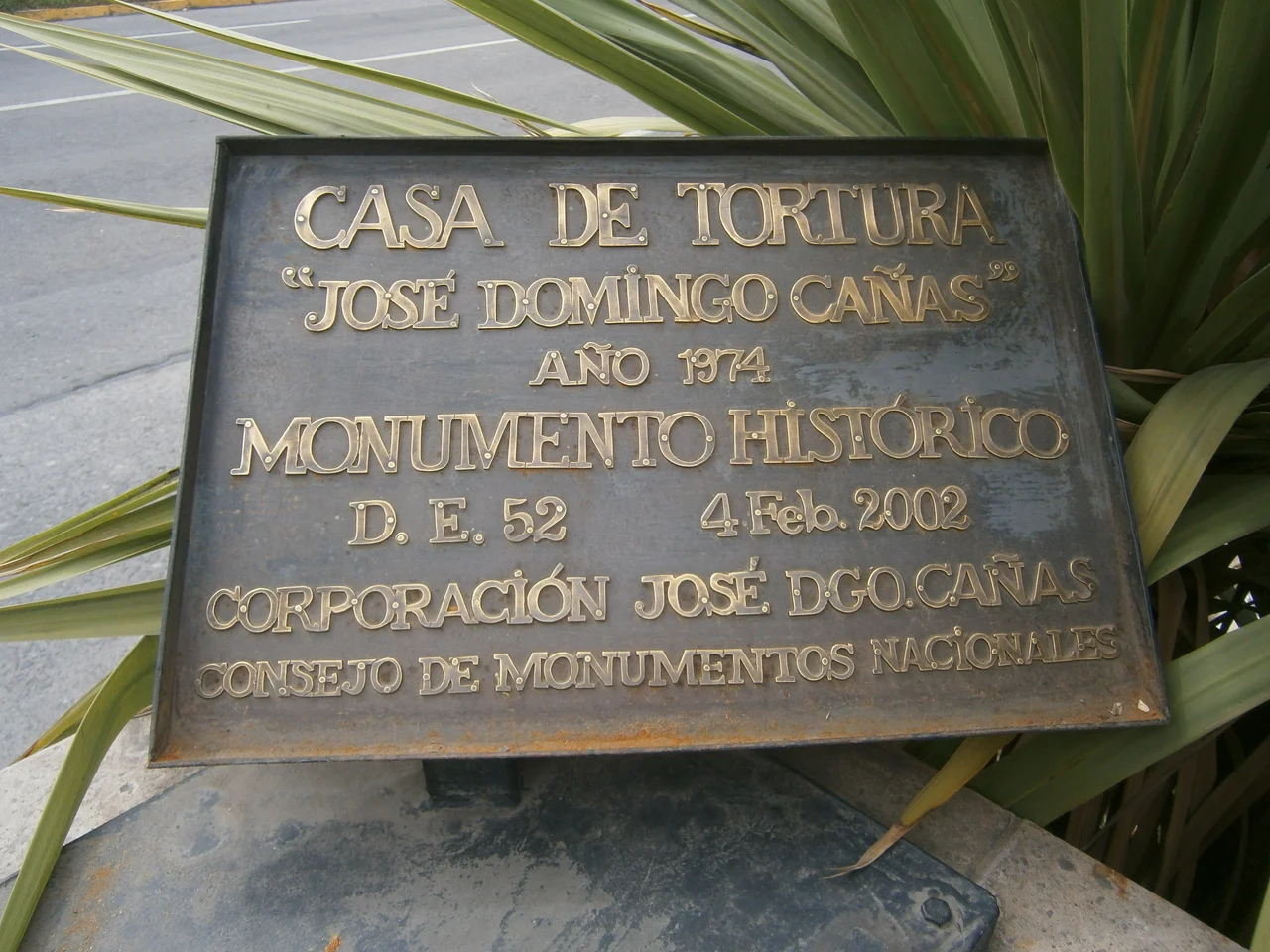

José Domingo Cañas Memory House
There is no house here anymore. At 1367 José Domingo Cañas Street, in the leafy Ñuñoa district of Santiago, what remains is an outline in the ground: foundations, a swimming pool, the footprint of rooms that no longer have walls. The house that stood here was demolished in December 2001 to clear space for a parking lot. But the people who lived nearby would not let the lot be built, because they knew what those rooms had been used for, and they had spent years gathering every Wednesday evening to make sure no one could pretend it had never happened.
The House That Changed Hands
Before the coup, the house belonged to the Brazilian sociologist Theotônio Dos Santos, an intellectual who had found refuge in Salvador Allende's Chile. After September 11, 1973, it briefly sheltered Chileans seeking asylum under the protection of the Panamanian embassy. Then, in August 1974, it changed hands again, and its purpose was inverted entirely. The National Intelligence Directorate, the DINA, took it over and gave it a code name: Ollagüe Barracks. A house that had held a thinker and then protected the hunted became a place where people were brought to be broken. It served as a way station in the DINA's network, where prisoners were held in transit between the cells of Londres 38 and the larger compound at Villa Grimaldi.
Lumi Videla
Among those brought here was Lumi Videla, a young sociology student at the University of Chile. DINA agents detained her on September 21, 1974, along with her husband, Sergio Pérez Molina; both belonged to the Revolutionary Left Movement. Her captors wanted information about the movement's leadership, and they tortured her to get it. On November 3, 1974, Lumi Videla died during a torture session in this house. The regime then staged a lie around her death: her body was thrown over the wall of the Italian embassy under cover of the night curfew, and pro-government press claimed she had died in an "orgy" among the political refugees sheltering inside. It was a fabrication, later dismantled in court. She was 27. Decades afterward, Italy and Chile would jointly honor her at the embassy where her body had been so cruelly discarded.
Counting the Lost
It is estimated that 61 disappeared prisoners were held in this facility, and that roughly 50 people lost their lives here while more than a hundred were tortured. Once Villa Grimaldi was operating at full capacity, the house on José Domingo Cañas shifted into an operational headquarters, first for the DINA and later for its successor, the National Information Center. Behind these figures, recorded in the Rettig and Valech commission reports, are individual people with names, families, and futures that were taken from them in a quiet residential block where neighbors heard things they could not, at the time, openly speak about. Remembering them by number alone would repeat a small version of the erasure the regime intended.
What the Neighbors Built
In the mid-1990s, residents began to speak openly about what the house had been, and they organized to reclaim it. Their weekly vigils kept the memory alive long enough to matter. When the building was demolished in 2001, they did not give up; they installed a monument out front bearing the names of the disappeared and of Lumi Videla. Two parallel stone columns represent a human couple, and a flock of birds rises from the top, standing for the dreams and the hopes that the violence tried to extinguish. The site was declared a national monument on January 21, 2002. In 2010 the 1367 Foundation opened the José Domingo Cañas Memory House, where the preserved foundations let visitors trace the original rooms, a mural honors the disappeared, and a small museum displays objects recovered from the ground. The house is gone. The remembering, deliberately, is not.
From the Air
The José Domingo Cañas Memory House lies in the Ñuñoa district of eastern Santiago at 33.4562°S, 70.6174°W, set among the orderly residential streets and plazas that characterize the area. The site itself is small and open-air, best appreciated on the ground, but from the air the surrounding Ñuñoa grid is framed by the green wedge of Parque Bustamante to the west and the unmistakable wall of the Andes rising directly to the east. Clear winter mornings, before the basin's haze builds, give the sharpest view; aim for 1,500 to 2,500 feet AGL. Arturo Merino Benítez International (ICAO SCEL) sits about 18 km to the northwest in Pudahuel, while the small Tobalaba aerodrome (ICAO SCTB) is closer, just to the east toward the foothills.
Nearby Stories
- Paine Memorial 21 km away
- 1947 BSAA Avro Lancastrian Star Dust accident 23 km away
- Battle of Chacabuco 31 km away
- La Campana National Park 36 km away
- Puente del Inca 44 km away
- Casa de Isla Negra 62 km away
- Santa Cruz, Chile 103 km away
- Pierre Auger Observatory 172 km away