
Julius Caesar's Invasions of Britain
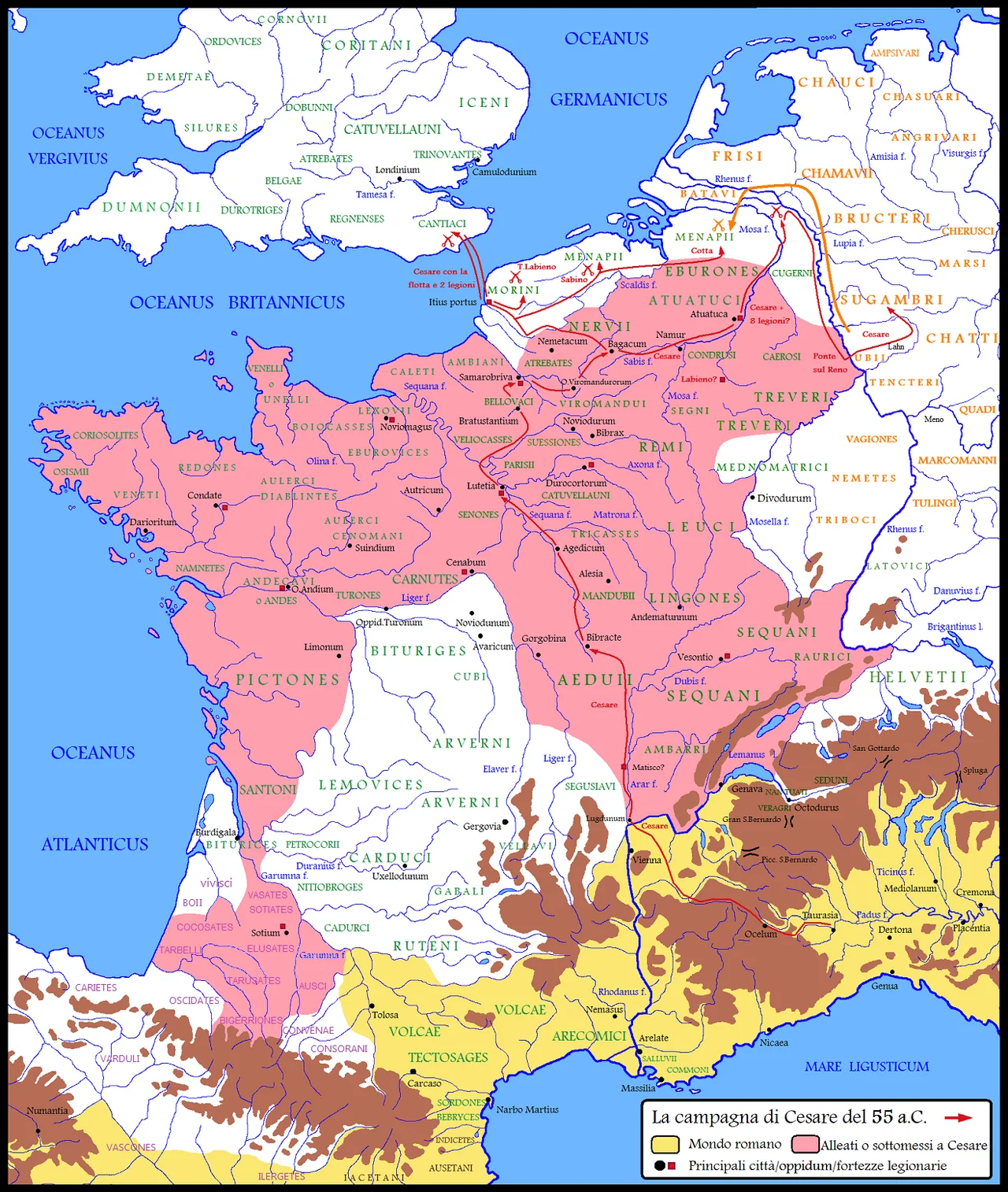
Just after midnight on the 23rd of August, 55 BC, two Roman legions pushed away from a port on the coast of Gaul - probably Portus Itius, near modern Saint-Omer - and rowed into the dark towards an island Roman geographers half-believed didn't exist. Julius Caesar was in command. He had eighty transport ships and an unknown number of warships. He was missing his cavalry, who had been ordered to follow from a second port and never arrived. The legions had been told to leave their baggage and heavy siege equipment behind. By dawn the fleet was off the Kent coast, and Caesar could see what he had not expected: massed British forces on the chalk cliffs above the beach, watching him approach.
Why Cross the Ocean?
Caesar had been conquering Gaul since 58 BC, and by 56 BC he had taken most of northwestern France. His stated reason for invading Britain was that British tribes had been sending help to his Gallic enemies - fugitive Belgae had fled to Belgic settlements in Britain, the Veneti of Armorica had called on their British allies in the rebellion he had crushed. Strabo, the Greek geographer, thought the Venetic rebellion had itself been an attempt to keep Caesar from disrupting Channel trade. There were quieter motives too. Cicero later joked that Caesar had been disappointed to find no gold or silver on the island. Suetonius reports a rumour that he had gone in search of pearls. The real prize was political: his rivals Pompey and Crassus dominated Rome that year, and Caesar needed something spectacular to keep the city talking about him. So he crossed two bodies of water no Roman army had crossed before. The Rhine first. Then the Channel.
The First Landing
Caesar's tribune Gaius Volusenus had scouted the Kent coast between Hythe and Sandwich in a single warship five days earlier, but he 'did not dare leave his ship and entrust himself to the barbarians' - so the intelligence was thin. When the legions arrived off Dover, the Britons watching from the cliffs were enough to make Caesar order the fleet to sail along the coast and beach on open ground. The loaded ships drew too much water to come close inshore. Roman soldiers had to drop into the sea in armour, wading through the surf while Britons attacked them in the shallows. The legions hesitated. Then the standard-bearer of the Tenth Legion - whose name has not survived - jumped overboard and waded toward the beach with the eagle held high. To let the standard fall in combat was the deepest disgrace a legion could suffer. The men followed him into the water. They formed up. The Britons withdrew. The Romans built a camp and started taking hostages.
Storm and Retreat
Then the weather turned. The Romans, accustomed to the tideless Mediterranean, had not understood what an Atlantic storm and a Channel tide could do together. The cavalry transports that had finally set out from Gaul were scattered and driven back. The beached warships filled with water. The transports at anchor smashed into each other. Some were wrecked outright. Many lost rigging and were left unseaworthy. The Britons, sensing the Roman position was weakening, ambushed a foraging party and then attacked the camp itself. Caesar's improvised cavalry, recruited from his ally Commius and his pro-Roman British contacts, repulsed them in a bloody rout. The campaigning season was nearly over. Caesar gathered what ships could be repaired with flotsam from the wrecks and pulled the legions back to Gaul. He had taken no territory and gained no plunder. But he had landed on Britain - the first Roman to do so - and his Commentarii de Bello Gallico, the running dispatches he was sending back to Rome, turned the expedition into a propaganda triumph. The Senate voted him an unprecedented twenty-day thanksgiving.
The Second Invasion
He came back in 54 BC. This time he was ready - eight hundred ships, five legions, two thousand cavalry, new transports built broader and shallower based on what he had learned from Venetic shipwrights. He took along several Gallic chiefs he didn't trust, to keep them under his eye. The fleet sailed in the evening so the army would land at dawn. The wind dropped in the night and the tide carried them too far northeast; they had to row back. The Britons, seeing the scale of the fleet, fell back to the high ground. Recent archaeology by the University of Leicester, completed in 2017, suggests the landing was at Ebbsfleet in Pegwell Bay, where a massive defensive ditch enclosing over twenty hectares has been found, dating to exactly this period. The site is now a kilometre inland because the Wantsum Channel has silted up.
Cassivellaunus and the Thames
Caesar marched twelve miles inland that first night and fought the British forces at a river crossing - probably the Stour, somewhere east of Canterbury. He won. The next morning, word came back that another storm had wrecked forty of his ships. He returned to the coast, spent ten days beaching and repairing the fleet, and only then resumed the campaign. The Britons had used the delay to gather their forces under a single commander: Cassivellaunus, a warlord from north of the Thames who had recently been at war with most of his neighbours and had overthrown the king of the powerful Trinovantes, forcing the king's son Mandubracius into exile. Cassivellaunus realised he could not match Caesar in pitched battle. He disbanded most of his army, kept his four thousand chariots, and used them for guerrilla raids - harassing the Roman column, vanishing into terrain the legions did not know. Caesar reached the Thames and found the ford fortified with sharpened stakes both on the banks and submerged in the water. The Romans crossed - somehow; the sources disagree - and Cassivellaunus retreated to a hillfort, probably the one at Wheathampstead in Hertfordshire. The Trinovantes defected to Caesar; five more tribes followed. Cassivellaunus sent word to his allies in Kent to attack the Roman beachhead, but the diversionary attack failed. He sued for peace. Caesar took hostages, fixed an annual tribute that may never have been paid, and sailed home before the autumn storms made the Channel impassable.
What He Wrote, What He Saw
Caesar left not a single Roman soldier in Britain. He had not conquered the island - that would wait nearly a century, until the Emperor Claudius's invasion in AD 43. But he had written about it. His Commentarii are the earliest substantial eyewitness account of British people, customs, and geography to survive. He described the chariot warfare that astonished the Romans - the British charioteers who could run along the chariot pole at full speed and stand on the yoke. He noted that the Britons would not eat hare, rooster, or goose but kept them as pets. He described coracles of wickerwork covered in hides, which he later copied for the Roman civil war. He recorded that the druidic religion was thought to have originated in Britain and that Gaulish druids still travelled there to study. With that one essay, Britain stopped being a place rumour-mongers in Rome could deny the existence of. It entered written history. From that moment, no Roman could pretend the island wasn't real.
From the Air
The 55 and 54 BC invasions are associated with the East Kent coast, with the second invasion likely landing at Ebbsfleet in Pegwell Bay (modern coordinates 51.34°N, 1.39°E). The defensive ditch identified by University of Leicester archaeology is now about 1 km inland due to silting of the former Wantsum Channel. From the air, the landing zone runs from Walmer northward toward Pegwell Bay along the east-facing Kent coast. Nearest airport is Manston (EGMH) immediately adjacent; London Ashford (Lydd) (EGMD) is 30 km southwest. Best viewed at low altitude when the modern coastline can be compared with the silted-up channels of the ancient one.
Nearby Stories
- HMS Hermes (1898) 7.3 km away
- Herne Bay Museum and Gallery 8.5 km away
- Benenden School 9.2 km away
- Boulonnais 9.4 km away
- Priestfield Stadium 12 km away
- 1382 Dover Straits Earthquake 17 km away
- Royal Sovereign Lighthouse 21 km away
- Battle of Boulogne 28 km away