
Kaaba
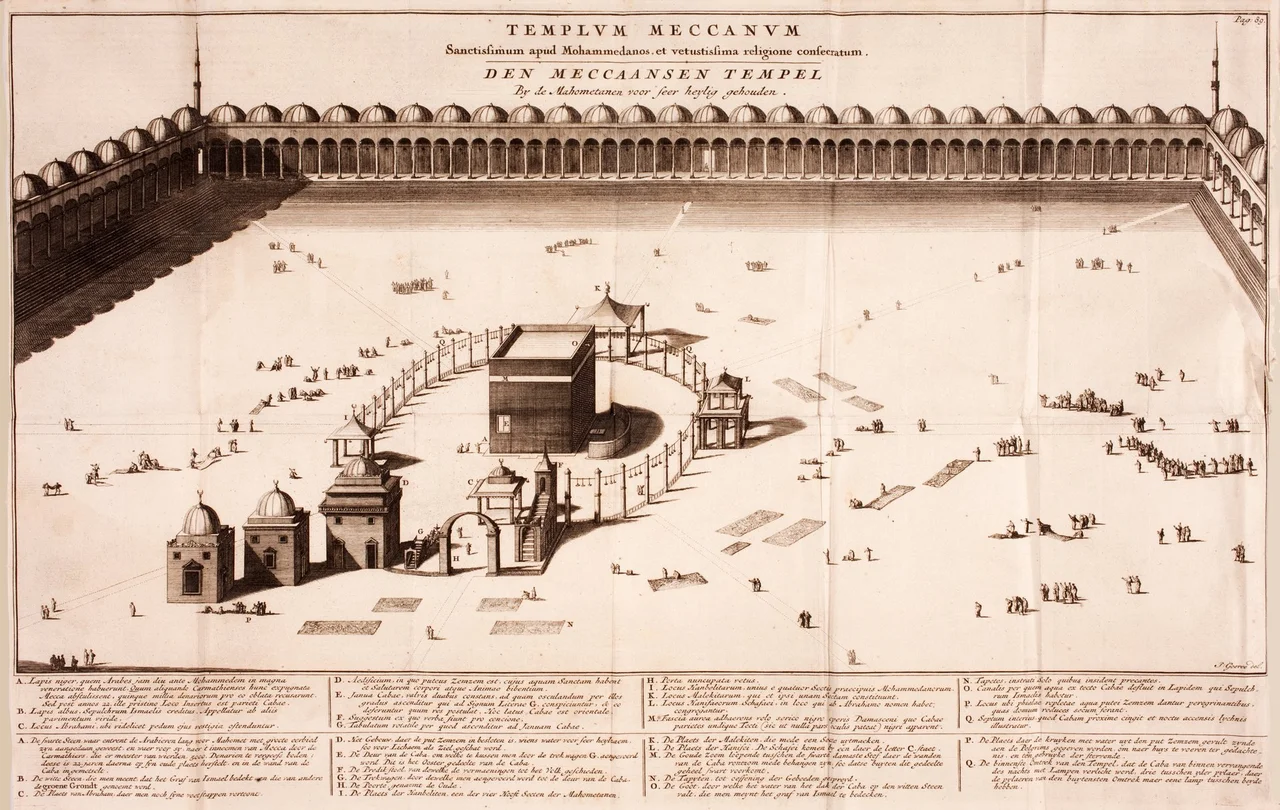
At this moment, somewhere on Earth, a Muslim is turning to face the Kaaba. The direction, called the qibla, determines how mosques are oriented in Jakarta and Casablanca and Toronto and Johannesburg. It determines which way the dying are laid in Muslim hospitals. It determines the alignment of entire Islamic cities. And it all points to a single cuboid building, clad in a black silk and gold curtain, tucked into a valley in western Saudi Arabia. The Kaaba is not grand by the standards of world religious architecture. It is austere, almost severe. But for nearly two billion Muslims, it is the most important spot on the planet.
A Cube Aligned with the Stars
The Kaaba is a cuboid of stone, its interior floored in marble and limestone, its walls tiled partway up with white marble trimmed in darker stone. The four corners roughly point to the four cardinal directions, but not exactly. Astronomers have noted that the building's long axis aligns with the rising of Canopus, the second-brightest star in the night sky, while its minor east-west axis aligns with the sunrise of the summer solstice and the sunset of the winter solstice. Whoever laid out the Kaaba in its earliest form knew the sky. The oldest surviving door dates to 1045 AH, or 1635 CE. The corners have names: Rukn al-Yamani to the southwest, Rukn al-Shami to the northwest, Rukn al-Iraqi to the northeast, and the corner of the Black Stone to the slightly southeast.
The Kiswah
Every year, during the Hajj, the building is dressed fresh. The kiswah is a black silk curtain embroidered with gold, replaced annually in a formal ceremony. Two-thirds of the way up wraps the hizam, a band of gold-embroidered Quranic verses including the Shahada, Islam's declaration of faith. The curtain that covers the door, known as the sitara or burqu, is especially ornate; its calligraphy is inscribed in gold and silver wire. Inside, engraved marble slabs (ten of them) chronicle the architectural contributions of various rulers to the surrounding Masjid al-Haram over centuries. Two of those slabs come from the Circassian sultans Barsbay, dated 1423, and his son Qaitbay, dated 1479. Their inscriptions still translate into something like prayer: In the name of God, the Most Compassionate, the Most Merciful. Our Lord, accept from us that you are the All-Hearing, the All-Knowing.
The Tawaf
To approach the Kaaba in the flesh is to perform tawaf: seven counterclockwise circumambulations, the first three at a quickened pace on the outer edge of the mataf, the paved circular area around the building, and the final four at a leisurely pace closer in. It is compulsory during both the Hajj and the lesser pilgrimage called Umrah. It begins at the corner of the Black Stone, where pilgrims touch or kiss the stone if they can reach it, though the crowds usually make that impossible. Each circuit is marked by a marble stripe set into the floor. Pilgrims chant the Basmala and the Takbir with each revolution. The practice is believed to demonstrate the unity of believers moving in harmony around the One God. It has its roots in pre-Islamic Arabian practice, adopted and reformed by Muhammad after his conquest of Mecca in 630 CE.
The Cleaning of the House
Twice a year, the Kaaba is opened and cleaned. The ceremony takes place on the first day of Sha'ban, the eighth month of the Islamic calendar, and on the fifteenth of Muharram, the first month. The keys are held by the Bani Shaybah tribe, an honor Muhammad bestowed on them more than thirteen centuries ago. Preparation begins the day before: Zamzam water, drawn from the ancient well beside the Kaaba, is mixed with Tayef rose, agarwood oud, and musk. The Governor of Mecca Province and a delegation of dignitaries step inside. They wipe the walls with cloths dipped in the scented Zamzam. They splash the rose-scented water onto the floor and sweep it clean with palm leaves. The entire ritual takes about two hours. When it is done, the door is closed again, and the world outside goes back to circling.
The Black Stone
Set into the eastern corner of the Kaaba is the Black Stone, a dark object that exists today as several fragments held together in a silver frame. Islamic tradition holds that an angel brought it to Abraham from heaven, fallen originally onto the nearby hill of Abu Qubays. Scientists who have examined what little can be seen of it lean toward a meteoritic origin, though the stone has not been subjected to modern analysis; access is restricted. Muslim tradition says the stone was once white as milk and darkened over centuries from the sins of the world. Touching or kissing it during tawaf is considered sunnah, a practice of the Prophet. The first Shia imam, Ali ibn Abi Talib, is said by many sources, both Sunni and Shia, to be the only person ever born inside the Kaaba itself. Whether history or faith, the detail tells you what the building means to those who travel from every corner of the earth to reach it.
From the Air
The Kaaba sits at the center of Masjid al-Haram in Mecca, at 21.4225°N, 39.8262°E, in the Hejaz region of western Saudi Arabia. The nearest airport is King Abdulaziz International Airport (OEJN) in Jeddah, 70-75 km west. Mecca's airspace is restricted and the city itself is closed to non-Muslims. Recommended viewing altitude from permitted airspace is 10,000 ft or higher; the Kaaba sits in a valley with mountains rising to 300-500 m nearby. The Abraj Al Bait clock tower (601 m) dominates the skyline immediately adjacent to the mosque.
Nearby Stories
- Al-Balad, Jeddah 23 km away
- Jeddah Tower 33 km away
- Battle of Turubah 123 km away
- Red Sea Rift 143 km away
- Ghadir Khumm 159 km away
- Al-Baha 162 km away
- Thee Ain 206 km away
- Hejaz 214 km away