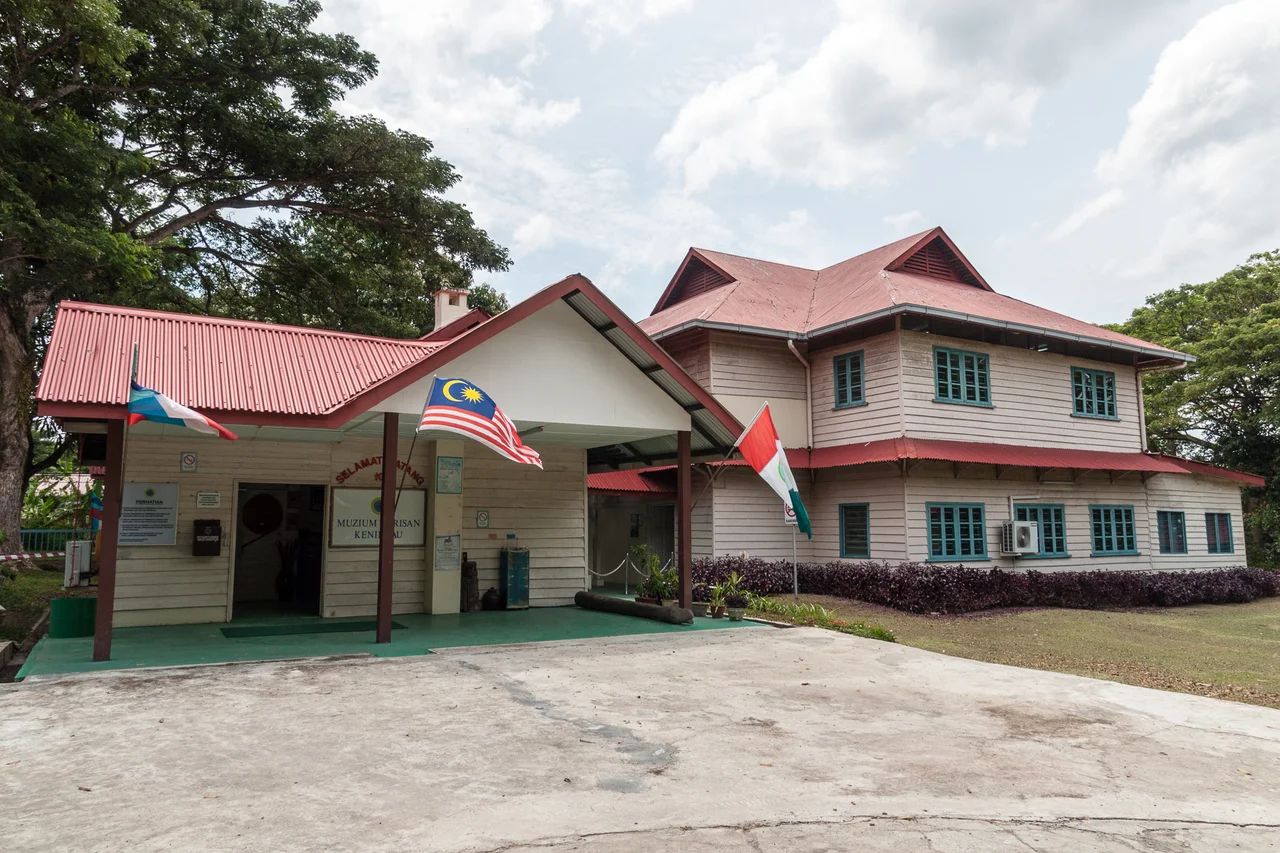

Keningau Heritage Museum
The building was meant for passing officials, a government rest house erected in 1946 by the Borneo Construction Company during the brief era of British Crown Colony rule over North Borneo. It was completed the following year, a modest structure designed for bureaucratic convenience in the town of Keningau, deep in Sabah's mountainous interior. Decades later, that same building has become something its builders never intended: a museum that holds the most politically charged artifact in the state, the Keningau Oath Stone, a boulder that records the promises Malaysia made to the people of Sabah when the federation was formed.
From Rest House to Repository
Keningau sits in the Interior Division of Sabah, surrounded by the Crocker Range and the peaks that define Borneo's mountainous spine. During the colonial period, the town served as an administrative outpost, and the rest house provided accommodation for officials traveling the difficult routes through the interior. After North Borneo became part of Malaysia in 1963, the building's purpose evolved. By 2008, it had been converted into the Keningau Heritage Museum, preserving not just the physical structure of colonial administration but filling it with the cultural and historical materials of the people who had lived in these mountains long before any colonial power arrived.
The Oath Stone Comes Home
The museum's most significant acquisition arrived in September 2018, when the Keningau Oath Stone was relocated to the museum grounds after years of political controversy. The stone, carved from a boulder pulled from the Pegalan River, records the constitutional guarantees made to Sabah's people when the state joined Malaysia: freedom of religion, state authority over land, and respect for native customs. Words had been tampered with on the original monument, and the restoration and relocation became a cause that consumed Sabah's political establishment for years. Its placement at the museum, with the three missing words restored, gave the stone both a permanent home and a new generation of visitors.
Soldiers and Stories
In 2015, the museum received a donation that connected two unlikely histories. A former Australian soldier who had married a local indigenous woman and settled permanently in Sabah donated wartime and personal artifacts to the collection. His story, of a foreign soldier who came to Borneo during the war and never left, mirrors the broader theme of the museum: that Keningau's history is not a single narrative but a collision of cultures, armies, colonial powers, and indigenous traditions that have layered upon one another across centuries. The museum houses these threads together, from traditional Murut and Dusun cultural objects to the relics of wartime occupation and liberation.
A Window Into the Interior
Located in Mahathir Park, the museum has become one of the main tourism draws in Sabah's interior, a region that sees far fewer visitors than the coastal cities of Kota Kinabalu and Sandakan. Over 108,000 tourists visited Keningau between January and October 2018 alone, many drawn by the Oath Stone's relocation. The museum offers something rare in Malaysian tourism: a place where the story of nation-building is told not from the capital's perspective but from the interior, where the people who were asked to join a new country carved their conditions into river stone and have spent decades ensuring those promises are kept.
From the Air
Keningau Heritage Museum is located in Keningau town (5.35°N, 116.16°E) in Sabah's Interior Division. The town sits in a broad valley surrounded by mountains of the Crocker Range. Nearest airport is Keningau Airport, though Kota Kinabalu International Airport (WBKK) is the primary commercial field, approximately 135 km northwest. The museum is within the town center at Mahathir Park. Best seen in the context of the Keningau valley when flying over the interior highlands at 5,000-8,000 feet.
Nearby Stories
- Nunuk Ragang 18 km away
- De Fontaine Memorial 25 km away
- North Borneo 34 km away
- Maliau Basin 36 km away
- Labuan War Cemetery 45 km away
- The Forests That Burn Underground 56 km away
- Mosquito Island's Older Residents 120 km away
- Tango Maru 235 km away