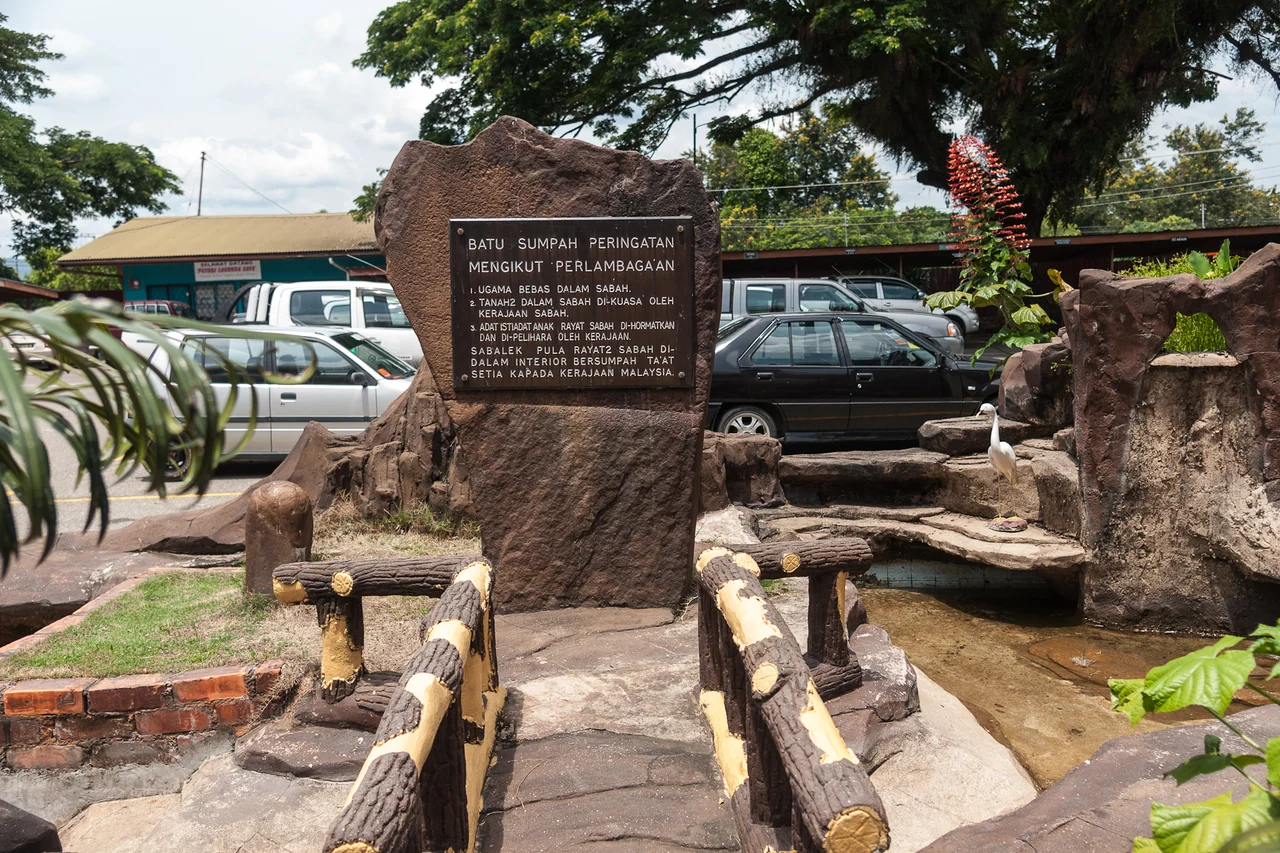

Keningau Oath Stone
Someone removed three words from the stone. Not dramatic words, not poetic ones, but three words that carried the weight of a nation's promise: 'Kerajaan Malaysia Jamin' -- 'The Government of Malaysia guarantees.' When the vandalism was discovered on Malaysia Day 2014, it did not take long for Sabah's political leaders to see it as something larger than graffiti. The Keningau Oath Stone had been carved in the early 1960s to record the constitutional guarantees that persuaded the indigenous peoples of North Borneo to join the Malaysian federation. Erasing those words looked very much like erasing the deal itself.
A Federation Built on Reservations
When the Federation of Malaya proposed to expand into a larger Malaysia in the early 1960s, incorporating the British territories of North Borneo, Sarawak, Singapore, and the protectorate of Brunei, the idea met resistance. In North Borneo, the traditional native chiefs known as the Orang Kaya-Kaya harbored deep apprehension about being absorbed into a distant federation dominated by Peninsular interests. Donald Stephens drafted a 20-point agreement spelling out the protections Sabah required, and the North Borneo Legislative Council agreed to accede to the Malaysia Agreement on 12 September 1962. But agreement on paper was not the same as trust. The interior communities wanted something they could touch, something that would stand as physical witness to the promises being made.
Carved from the River
The District Officer of Keningau, Richard Lind, who would later become Sabah's State Secretary, was charged with overseeing the creation of the oath stone. Teams searched the surrounding rivers and hills, collecting boulders from areas including Bandukan, Bayayo, Dangulad, Senagang, Tuarid, and Ulu Liawan, but most were too fragile and broke easily. A suitable boulder was finally taken from the Pegalan River near Kampung Dangulad. Garukon Gurun, a former Sergeant Major of the North Borneo Constabulary, carved the stone. A brass plaque was commissioned from the Thornycroft Shipyard in Singapore and affixed to it. The inscription, written in pre-1972 Malay spelling, recorded three guarantees: freedom of religion in Sabah, state authority over land, and respect for native customs. In return, the people of Sabah's interior pledged loyalty to the Government of Malaysia.
The Missing Words
For half a century the stone stood as a quiet landmark in Keningau. Then, during Malaysia Day celebrations on 16 September 2014, someone noticed the tampering. The phrase 'Kerajaan Malaysia Jamin' had been removed from below the title. Sabah's political leaders erupted. Joseph Pairin Kitingan expressed outrage. Jeffrey Kitingan demanded answers. In July 2015, a resident in Kampung Apin-Apin reportedly found the original plaque, though Sabah Museum Director Joanna Kitingan questioned its authenticity. The federal government allocated RM1.025 million for restoration and relocation, but delays stretched on, provoking accusations that Kuala Lumpur lacked the will to honor its original commitments.
A Promise Restored
In September 2018, the Oath Stone was finally relocated to the grounds of the Keningau Heritage Museum with the three missing words restored. The journey from river boulder to political flashpoint and back to honored monument had taken more than fifty years. The stone remains a living document in Sabah politics, invoked whenever the relationship between the state and the federal government comes under strain. Its inscription is not merely historical. It is a contract, carved in stone because the people who demanded it understood that paper promises could be filed away and forgotten. A boulder from the Pegalan River, they wagered, would be harder to ignore. They were right.
From the Air
The Keningau Oath Stone is housed at the Keningau Heritage Museum in Keningau town (5.34°N, 116.16°E), in Sabah's Interior Division. The town occupies a valley in the Crocker Range. Nearest major airport is Kota Kinabalu International Airport (WBKK), approximately 135 km to the northwest. The Pegalan River, from which the stone was sourced, flows through the Keningau area and is visible from altitude as a silver thread through the valley.
Nearby Stories
- Nunuk Ragang 18 km away
- De Fontaine Memorial 25 km away
- North Borneo 34 km away
- Maliau Basin 36 km away
- Labuan War Cemetery 45 km away
- The Forests That Burn Underground 56 km away
- Mosquito Island's Older Residents 120 km away
- Tango Maru 235 km away