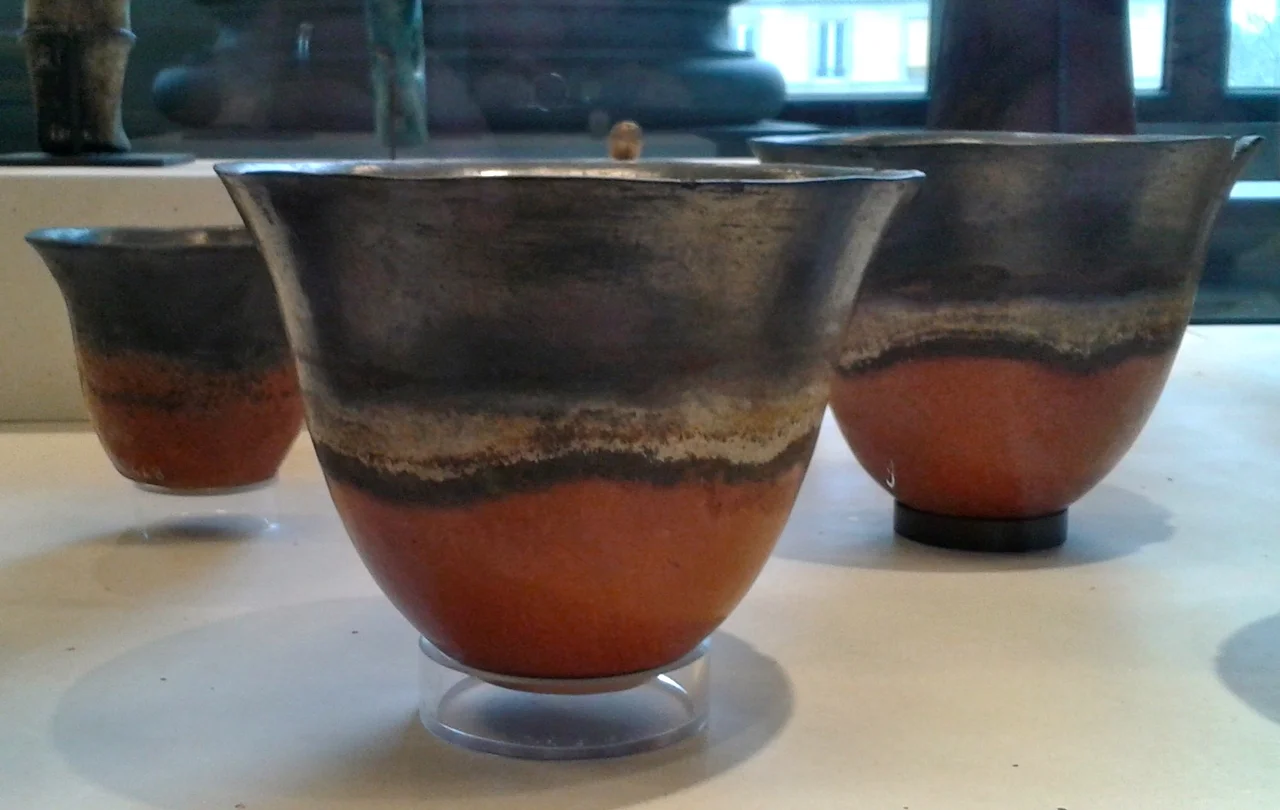

Kerma culture
For most of the twentieth century, the massive adobe structures at Kerma were thought to be Egyptian. George Reisner, who excavated them in the 1910s and 1920s, saw Egyptian-style monuments and Egyptian-style grave goods, and concluded that Kerma must have been an Egyptian fortress - a colonial outpost run by Egyptian governors who eventually declared independence. It took another sixty years before Charles Bonnet and his Swiss team, working from 1977 to 2003, proved him wrong. Kerma was not Egyptian. It was Nubian. It was the capital of a sophisticated kingdom that traded with Egypt, rivaled it, and at its height controlled a stretch of the Nile as extensive as Egypt itself.
Older Than the Pharaohs
The roots of Kerma run back to the pre-Kerma culture of Upper Nubia, around 3500 BC. That earlier phase gave rise to small statelets - fewer, but larger, than the polities of the A-Group culture to the north in Lower Nubia. Kerma itself emerged around 2500 BC and flourished until about 1500 BC, its chronology paralleling that of Egypt - Early Kerma during the late Old Kingdom, Middle Kerma during the Middle Kingdom, Classic Kerma during the Second Intermediate Period, Late Kerma during the 17th Dynasty. The population was a mix. Craniometric and dental studies show a heterogeneous people, with affinities to Upper Nile Valley populations, the A-Group of Lower Nubia, early Ethiopians, and more distantly to Predynastic Egyptians from Naqada. The Kerma civilization was, from its beginnings, an African melting pot rooted in Central African, Saharan, and Nile Valley cultures.
Kingdom at the Cataracts
Kerma controlled the Nile from the First Cataract to the Fourth - a domain as extensive as ancient Egypt's. During the Egyptian 13th Dynasty and the Second Intermediate Period, when central Egyptian authority weakened, Kerma expanded and pressed against Egypt's southern border. Egyptian records from this period speak of Kerma's "rich and populous agricultural regions." The kingdom produced gold, cattle, milk products, ebony, incense, and ivory - resources Egypt coveted. Its army was built around archers, and the Egyptians knew to respect them. Kerma's principal urban center held at least 10,000 people by 1700 BC. Another sizable population lived on Sai Island and at Doukki Gel, less than a kilometer south of Kerma proper. Doukki Gel's architecture was distinct: more rounded, with sub-Saharan influences that set it apart from the main city. It was a polity built by several related peoples under a centralized Kerman crown.
Blue Faience, Animistic Gods
Kerman artisans worked in blue faience - developing their own techniques, independent of Egypt's - and in glazed quartzite and architectural inlays. The daggers of bone and copper excavated from royal burials, now in the British Museum, were made between about 1750 and 1450 BC; nothing like them exists in Egypt. Religious life was distinct too. Where Egypt had anthropomorphic gods with human bodies and animal heads, the Kermans during the Classical period depicted animals in their full form, without human grafting. Scholars read this as likely animism. The indigenous Upper Nubian deity Apedamak - later a major god of Meroe - evolved out of Kerman reverence for non-anthropomorphic lions, which only later were deified in Egyptian polytheistic style. The Kermans also held Jebel Barkal sacred, a tradition that the conquering Egyptians of the New Kingdom would inherit.
Conquest and Memory
Around 1500 BC, Pharaoh Thutmose I of Egypt's New Kingdom launched a series of campaigns south, destroying Kerma as a political center. The armies of Thutmose I took Doukki Gel. The southern frontier of Egypt was pushed to Kanisah Kurgus, south of the Fourth Cataract. Rebellions continued for 220 years, but the kingdom never recovered. Kerma became a province of the Egyptian Empire - crucial economically and politically, site of great ceremonies at nearby Jebel Barkal, where Egypt built one of its most important Amun temples. And yet Kerma's story did not end with Egyptian conquest. By the eleventh century BC, a new Nubian state - the Kingdom of Kush - emerged, possibly from Kerman roots, and reclaimed the region's independence. Three centuries later, the Kushite kings of Napata would march north and conquer Egypt themselves, ruling as the 25th Dynasty. Kerma was the cradle. Bonnet's excavations, continuing today, are still uncovering the evidence that Kerma deserves its own chapter in the history of African civilizations - not a footnote to Egypt, but a parallel story.
From the Air
Coordinates 19.60°N, 30.41°E, on the east bank of the Nile in Sudan's Northern State. The Western Deffufa, a massive mud-brick temple, still stands at the core of the ancient city. Nearest airport is Dongola (HSDN) about 60 km northwest. Recommended viewing altitude 3,000-6,000 feet to see the Deffufa, the 30,000-grave necropolis, and the broad curve of the Nile.
Nearby Stories
- Dongola Reach 13 km away
- Sabu-Jaddi 15 km away
- Nubia 80 km away
- Napata 150 km away
- Selima Oasis 177 km away
- Semna (Nubia) 182 km away
- Northern State (Sudan) 197 km away
- Lake Ptolemy 407 km away